
How I Earn While I Sleep: My Real Passive Income Breakdown – A 6-Month Experiment
Imagine waking up in the morning, checking your phone and finding that you earned money overnight without attending a meeting, completing a client project or working extra hours.
Sounds attractive, right?
But is passive income really passive? Can you genuinely earn money while sleeping, travelling or spending time with family?
I had the same questions. Instead of believing every online income success story, I decided to examine passive income more carefully. I tracked different income sources over six months to understand how they work, what effort they require and whether they can generate revenue consistently.
Here is what I learned about building income streams that can continue earning even when you are not actively working.
What Is Passive Income and How Does It Work?
Passive income is money generated from an asset, investment, business system or digital product without requiring continuous active involvement in every transaction.
Unlike traditional employment, where you generally exchange working hours for money, passive income allows you to create something once and potentially earn from it repeatedly.
However, passive income does not mean zero work.
Most income streams require:
- Initial research and investment.
- Time to create products or build an audience.
- Marketing and customer acquisition.
- Regular maintenance and updates.
- Monitoring revenue, expenses and performance.
The real advantage is that your earning potential is not always directly connected to the number of hours you work each day.
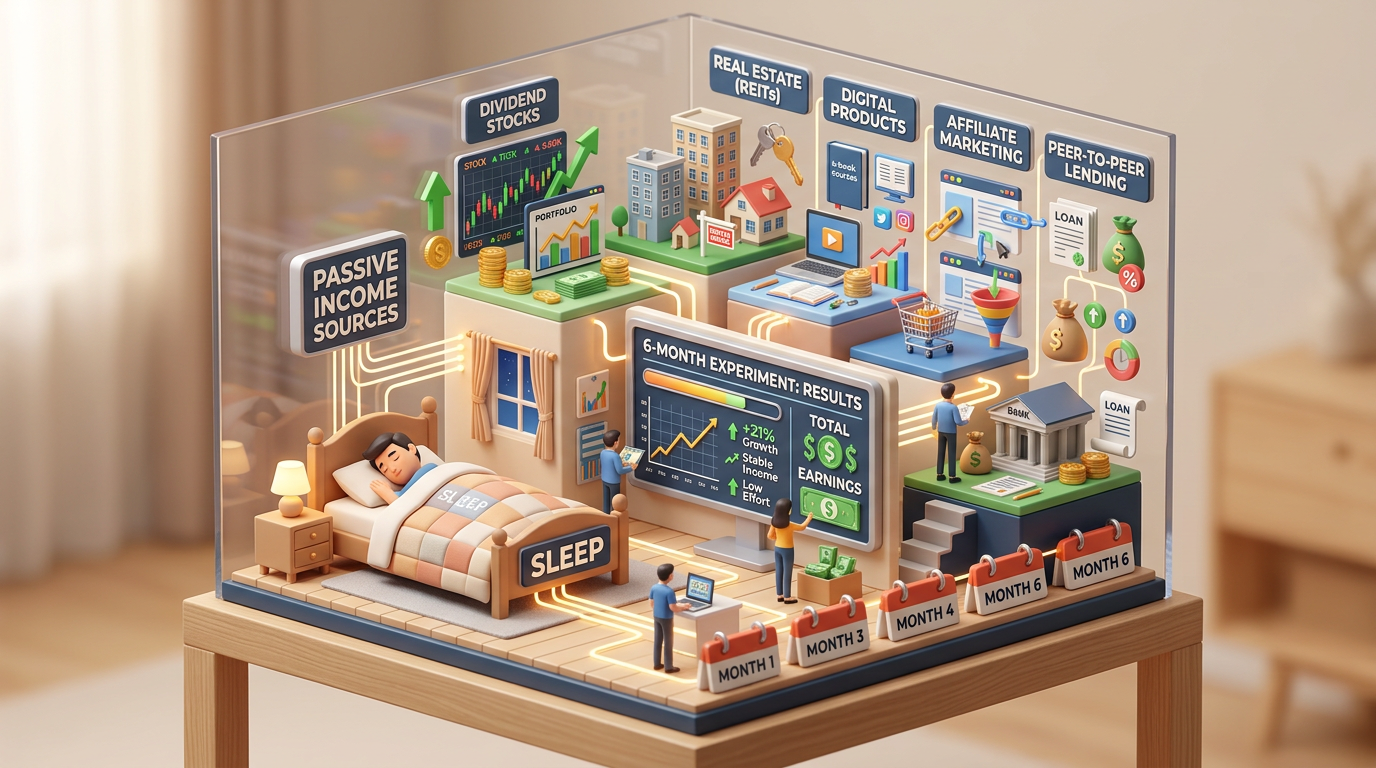
My Six-Month Passive Income Experiment
The biggest question was simple: Could different online income sources generate revenue without requiring me to work on them every day?
I decided to examine several income models rather than depend on just one.
The experiment focused on five important factors:
- Initial time and financial investment.
- Monthly revenue generated.
- Ongoing maintenance requirements.
- Customer acquisition and marketing effort.
- Potential for long-term scalability.
Instead of looking only at total earnings, I also considered the amount of work required to maintain each income stream.
Five Passive Income Sources I Explored
1. Digital Products: Create Once, Sell Multiple Times
Income model: Digital product sales
Digital products are among the most accessible ways to build an online income stream.
You create a product once and sell it repeatedly through digital platforms.
Examples include:
- E-books and downloadable guides.
- Excel and Google Sheets templates.
- Budget planners and financial trackers.
- Canva templates and design resources.
- Online resources and educational materials.
For example, imagine creating a social media content calendar and selling it through an online marketplace.
Once the product is uploaded, customers can purchase and download it without requiring you to personally deliver every order.
What I learned: Product quality, niche selection, pricing and visibility determine whether a digital product generates consistent sales.
However, competition, refunds, platform fees and marketing costs must also be considered.
2. Affiliate Marketing: Earn Through Product Recommendations
Income model: Commission-based earnings
Affiliate marketing allows you to earn commissions by recommending products or services through unique tracking links.
When someone purchases through your affiliate link, you may receive a commission according to the programme’s terms.
Popular affiliate marketing channels include:
- Blogs and niche websites.
- YouTube videos.
- Instagram and Facebook content.
- Email newsletters.
- Product comparison articles.
For example, a technology blog can publish a detailed comparison of laptops and include affiliate links to relevant products.
An article published today may continue attracting search traffic and generating commissions months later.
What I learned: Affiliate marketing works best when recommendations are relevant, transparent and genuinely useful.
Search engine visibility, audience trust and conversion rates are more important than simply publishing hundreds of affiliate links.
3. Blogging and SEO: Build a Long-Term Traffic Asset
Income model: Advertising, affiliate and sponsored content
A blog can become a long-term digital asset when it consistently attracts visitors through organic search.
Instead of creating content only for immediate engagement, focus on topics people regularly search for.
Potential monetisation methods include:
- Display advertising.
- Affiliate marketing.
- Sponsored articles.
- Digital product sales.
- Lead generation.
For example, a website publishing tutorials about accounting software, taxation, business registrations or personal finance can attract visitors searching for specific solutions.
A well-optimised article can continue receiving organic traffic long after publication.
What I learned: SEO is not an overnight income strategy. It requires keyword research, helpful content, technical optimisation, internal linking and regular content updates.
Search rankings can also change, so relying on a single article or traffic source is risky.
4. YouTube Content: Monetise Videos Over Time
Income model: Advertising and multiple revenue streams
YouTube offers creators an opportunity to earn from content that continues attracting viewers after publication.
A useful tutorial, educational video or product review can receive views for months or even years.
Potential revenue sources include:
- YouTube advertising revenue.
- Affiliate commissions.
- Sponsorships.
- Memberships.
- Sales of personal products and courses.
For example, a tutorial explaining how to use an AI tool may continue attracting viewers as new people search for that solution.
What I learned: Evergreen content has long-term potential, but monetisation depends on eligibility, audience engagement, advertiser demand and platform policies.
Creating videos also requires research, editing, thumbnails and ongoing channel management.
5. Online Courses and Educational Resources
Income model: Course sales
If you have knowledge of a particular subject, you can convert it into an online course.
Popular topics include:
- Digital marketing.
- Graphic design.
- Accounting and taxation.
- Programming and automation.
- Artificial intelligence tools.
- Business management.
Once a course is created and published, students can purchase and access the learning material without requiring you to teach every individual session.
However, course updates, student support, marketing and platform commissions still require attention.
What I learned: People pay for practical solutions, not simply large collections of videos. A focused course that solves a specific problem can offer more value than a lengthy course without a clear learning outcome.
How to Measure Passive Income Properly
One of the biggest mistakes people make is confusing revenue with profit.
If an online business generates ₹20,000 in sales but spends ₹8,000 on advertising, platform charges and other expenses, the actual earnings are not ₹20,000.
A realistic income breakdown should consider:
| Measurement | What to Track |
|---|---|
| Gross revenue | Total money received from sales |
| Platform fees | Marketplace and payment charges |
| Marketing expenses | Advertising and promotion |
| Operating costs | Hosting, software and subscriptions |
| Net profit | Revenue minus relevant expenses |
| Time invested | Hours spent creating and maintaining |
| Effective hourly return | Net profit divided by hours worked |
Also distinguish between recurring revenue and one-time sales.
A digital product selling every month is different from a single successful launch.
What Does a Realistic Passive Income Breakdown Look Like?
There is no universal passive income formula. Your results depend on your niche, audience, pricing, product quality, traffic and expenses.
For illustration, consider the following hypothetical monthly income model:
| Income Source | Monthly Revenue |
|---|---|
| Digital product sales | ₹10,000 |
| Affiliate commissions | ₹5,000 |
| Blog advertising | ₹3,000 |
| YouTube monetisation | ₹2,000 |
| Online course sales | ₹5,000 |
| Total gross revenue | ₹25,000 |
These are illustrative figures, not verified earnings or guaranteed results.
If the combined monthly operating expenses were ₹5,000, the estimated amount remaining would be ₹20,000 before applicable taxes and other unaccounted costs.
The important lesson is that multiple income streams can diversify your revenue rather than forcing you to depend entirely on one platform.
Is Passive Income Really Passive?
Not completely.
This is probably the most important lesson from exploring different passive income models.
Even when an income source generates sales automatically, someone must maintain the system.
For example:
- Digital products need updates and customer support.
- Affiliate websites need fresh content and link monitoring.
- Blogs need technical maintenance and SEO improvements.
- YouTube channels need new content and audience engagement.
- Online courses need updated lessons and student support.
The goal should not be to eliminate work entirely.
The goal should be to reduce the amount of active work required for each additional sale.
Common Passive Income Mistakes to Avoid
Expecting Immediate Results
Most sustainable passive income models take time to develop. Publishing one blog post or uploading one digital product does not guarantee sales.
Depending on One Platform
Platform algorithms, commission structures and monetisation policies can change.
Build independent assets such as your own website, email list and customer relationships wherever practical.
Ignoring Hidden Expenses
Software subscriptions, hosting, advertising, payment processing and platform fees can reduce profitability.
Copying Other People’s Strategies
A strategy that works for one creator may not work for another. Your niche, audience, expertise and available resources matter.
Believing Guaranteed Income Claims
Be cautious of programmes promising fixed monthly earnings with little or no effort. No legitimate passive income model guarantees consistent returns.
How to Start Building Your Own Passive Income Stream
If you are starting from zero, you do not need five income streams immediately.
Start with one model and build a repeatable system.
Step 1: Identify Your Skills
List the subjects you understand, the problems you can solve and the knowledge people may be willing to pay for.
Step 2: Choose One Income Model
Select a starting point based on your skills and resources.
For example:
- Good at writing? Start a niche blog.
- Good at designing? Create digital templates.
- Comfortable on camera? Explore YouTube.
- Have an engaged audience? Consider affiliate marketing.
- Have professional expertise? Develop an online course.
Step 3: Create Something Valuable
Focus on solving a specific problem rather than creating products simply because they are trending.
Step 4: Build a Traffic Strategy
Use SEO, social media, YouTube, email marketing or relevant online communities to reach potential customers.
Step 5: Automate Repetitive Tasks
Tools such as email automation, payment gateways, scheduling software and AI-powered workflows can reduce manual work.
Step 6: Track Results and Improve
Measure revenue, expenses, conversions and maintenance time every month. Continue improving what works and discontinue activities that consistently consume resources without producing results.
Frequently Asked Questions About Passive Income
1. Can you really earn money while sleeping?
Yes. Digital products, affiliate marketing, advertising and online courses can generate sales or revenue outside your working hours. However, they require initial work and ongoing maintenance.
2. What is the easiest passive income source for beginners?
Digital products and affiliate marketing can be accessible starting points, particularly if you already have useful skills or an audience. Neither guarantees immediate earnings.
3. How much money can you earn from passive income?
There is no fixed amount. Earnings depend on product demand, pricing, traffic, conversion rates, expenses and consistency.
4. Can I start passive income without investment?
You can start some models with little financial investment by using free tools and platforms. However, you will still invest time, effort and potentially money as the business grows.
5. Is blogging still profitable in 2026?
Yes, blogging can generate income through advertising, affiliate marketing, sponsored content and digital products. However, success depends on useful content, audience trust, search visibility and diversification.
6. How long does it take to build passive income?
It varies significantly. Some people may generate their first sale within weeks, while building a reliable income stream can take months or longer.
7. Do I need multiple passive income streams?
Not necessarily. Start by building one sustainable income source. Once it becomes manageable, consider adding complementary revenue streams.
8. Is passive income taxable in India?
Income generated through digital products, affiliate marketing, advertising and other online activities may be taxable in India, depending on the nature of the income and applicable provisions. Maintain proper records and evaluate your income-tax and GST obligations where relevant.
Conclusion: Build Systems That Work Beyond Your Working Hours
The biggest takeaway from examining passive income is that earning while sleeping is possible, but it is not magic.
You are essentially investing time, knowledge, money or creativity upfront to build assets that can generate revenue repeatedly.
Digital products, affiliate marketing, blogging, YouTube and online courses all offer opportunities, but none guarantees success.
Start small, choose a model that matches your skills, track your actual profits and build systems that reduce your dependence on daily active work.
Remember: The real goal of passive income is not to stop working. It is to stop depending entirely on your time to earn money.
Financial Disclaimer: This article is for educational and informational purposes only. Income examples are hypothetical and do not represent guaranteed earnings. Actual results vary depending on individual circumstances, market conditions, costs and effort.
Leave a Reply