
How to Build a High-Trust B2B Hero Section That Converts Warm Leads
Your website may attract the right visitors, generate enquiries and bring potential customers to your business. But what happens when they land on your homepage and cannot immediately understand what you offer?
They leave.
In B2B marketing, attracting visitors is only half the battle. Your website must communicate your value, establish credibility and encourage visitors to take the next step.
One of the most important elements responsible for this is the hero section.
The hero section is the first prominent area visitors see when they land on your website, usually before scrolling. It creates the first impression of your business and influences whether potential customers continue exploring or leave.
For businesses receiving warm leads through referrals, LinkedIn, email campaigns or paid advertisements, a well-designed hero section can significantly improve conversion opportunities.
Let’s explore how to build a high-trust B2B hero section that converts warm leads into qualified enquiries.
1. Understand Why Your B2B Hero Section Matters
A B2B buyer rarely makes a purchasing decision immediately. They want to understand your offering, evaluate your expertise and determine whether your business can solve their problem.
When visitors arrive on your website, they generally look for answers to five questions:
- What does your business offer?
- Who are your services designed for?
- What problems can you solve?
- Why should they trust your company?
- What should they do next?
If your hero section does not answer these questions clearly, visitors may struggle to understand your value proposition.
For example, consider these two headlines.
Generic headline:
“Transforming Businesses Through Innovative Digital Solutions.”
Clear and benefit-driven headline:
“Automate Your Business Operations and Reduce Manual Work with Intelligent Workflow Solutions.”
The second headline communicates a specific service and its potential benefit.
The key principle: Clarity is more important than clever marketing language.
2. Create a Clear and Specific Value Proposition
Your value proposition explains why customers should choose your business over alternative providers.
It should communicate the value your company delivers rather than simply describing what you do.
A strong B2B value proposition generally includes three elements:
- Target audience: Who do you help?
- Problem: What challenge do you solve?
- Outcome: What measurable or meaningful benefit do you deliver?
Example of a B2B Value Proposition
Imagine a company offering AI-powered business automation.
Instead of writing:
“We provide next-generation AI solutions for modern enterprises.”
Consider:
“We help growing businesses automate repetitive workflows, improve operational efficiency and reduce manual administrative work.”
The second statement is more specific and customer-focused.
Use This Simple Value Proposition Formula
We help [target audience] achieve [desired outcome] through [your solution].
Examples:
- We help startups streamline financial operations through automated accounting workflows.
- We help enterprises improve productivity through AI-powered business process automation.
- We help B2B companies generate qualified leads through data-driven digital marketing.
Avoid using too many technical terms, exaggerated promises or generic statements.
3. Write a Headline That Communicates Immediate Value
Your headline is one of the most important components of your hero section.
Visitors should understand your primary offering without having to read several paragraphs.
A strong headline should be:
- Clear and straightforward.
- Relevant to your target audience.
- Focused on customer benefits.
- Specific about the problem you solve.
- Easy to understand within a few seconds.
Headline Examples for Different B2B Industries
| Industry | Recommended headline |
|---|---|
| SaaS | Simplify Your Business Operations with One Powerful Platform |
| IT Consulting | Build Scalable Technology Solutions for Your Business |
| Digital Marketing | Generate Qualified Leads with Performance-Driven Marketing |
| Business Automation | Automate Repetitive Tasks and Improve Team Productivity |
| Financial Consulting | Make Better Financial Decisions with Expert Business Insights |
Your headline should communicate one primary benefit instead of trying to promote every service your company offers.
4. Add a Supporting Subheadline
The headline captures attention, but the subheadline provides additional context.
It should briefly explain how your solution works, who it serves and what makes your offering valuable.
For example:
Headline:
“Turn Business Data into Better Decisions.”
Supporting subheadline:
“Our business intelligence solutions help growing companies consolidate data, automate reporting and gain actionable insights through customised analytics.”
The supporting statement makes the headline more meaningful.
Keep it concise. Avoid turning your hero section into a lengthy company introduction.
5. Build Trust with Relevant Social Proof
B2B buyers often evaluate risk before choosing a service provider.
They want evidence that your business has the experience, expertise and reliability to deliver what it promises.
This makes trust signals essential.
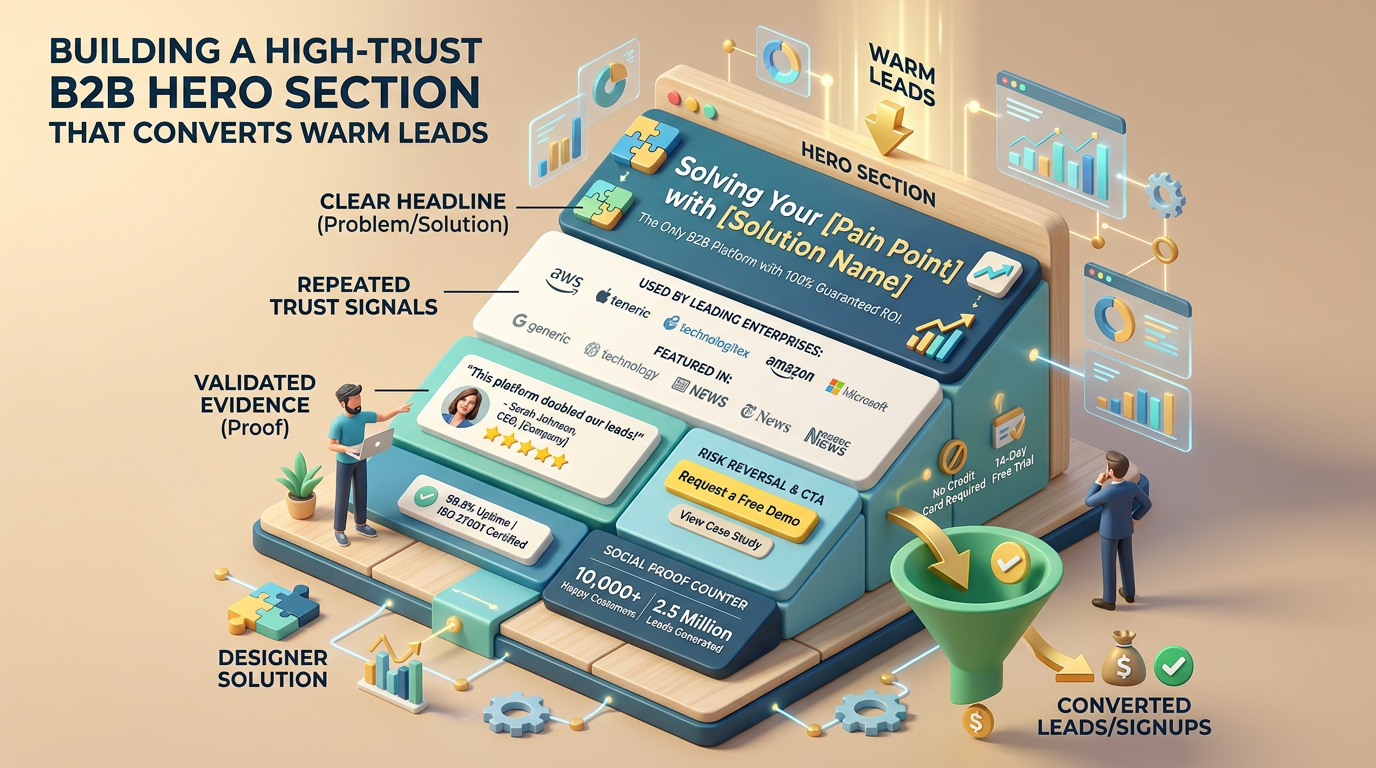
Include relevant credibility indicators in or immediately below your hero section.
Effective B2B Trust Signals
1. Client Logos
Display logos of recognised companies you have genuinely worked with, subject to permission.
2. Customer Testimonials
Use short testimonials that explain the customer’s experience and the value received.
3. Industry Experience
Mention your years of experience when the figure is accurate and relevant.
4. Certifications and Accreditations
Display relevant professional certifications, industry memberships and recognised credentials.
5. Case Studies
Highlight successful projects with measurable outcomes and meaningful business context.
6. Client Success Metrics
Include verified statistics such as:
- Number of businesses served.
- Projects successfully completed.
- Average operational time saved.
- Customer retention rate.
Never use fabricated testimonials, misleading client logos or unsupported performance statistics.
Authentic evidence builds stronger trust than exaggerated marketing claims.
6. Use a Strong and Action-Oriented Call to Action
Your hero section should guide visitors towards one clear next step.
A call to action (CTA) tells potential customers what they should do after understanding your offering.
Weak CTAs such as “Learn More” or “Explore” may not communicate what happens next.
Instead, use specific, action-oriented language.
Examples of High-Converting B2B CTAs
| Business objective | Recommended CTA |
|---|---|
| Generate enquiries | Book a Free Consultation |
| SaaS product | Start Your Free Trial |
| B2B services | Schedule a Discovery Call |
| Enterprise solutions | Request a Custom Demo |
| Consulting | Talk to an Expert |
| Lead generation | Get a Free Business Assessment |
Use Primary and Secondary CTAs Strategically
You can include two CTAs when visitors have different levels of buying intent.
For example:
- Primary CTA: Book a Consultation.
- Secondary CTA: View Our Case Studies.
The primary CTA should receive greater visual emphasis.
Avoid displaying too many competing buttons. Too many choices can make the next step less obvious.
Also, ensure the CTA leads to a relevant destination. If you promise a free consultation, visitors should reach a simple booking or enquiry process rather than a generic homepage.
7. Design the Hero Section for Better User Experience
Even excellent messaging can underperform when the design makes it difficult to understand.
Your hero section should have a clean layout, strong visual hierarchy and a clear reading path.
Essential Design Elements
1. Clear Visual Hierarchy
Your headline should be the most prominent text, followed by the supporting description and CTA.
2. Readable Typography
Use professional fonts, appropriate font sizes and sufficient spacing.
3. Strategic Colour Contrast
Make sure the headline and CTA buttons stand out against the background.
4. Relevant Visuals
Use product screenshots, service illustrations, dashboards or genuine business-related visuals.
5. Mobile Responsiveness
Ensure the hero section looks equally clear on smartphones, tablets and desktop screens.
6. Fast Loading Speed
Optimise images, reduce unnecessary scripts and avoid heavy animations that slow down the website.
A visually attractive hero section is not necessarily a high-converting one. Every design element should support clarity, credibility or action.
8. Address Customer Pain Points Instead of Promoting Features
One common B2B marketing mistake is focusing too heavily on product features.
Customers are more interested in understanding how your offering addresses their business challenges.
Consider this example.
Feature-focused message:
“Our platform includes advanced automation, analytics and reporting capabilities.”
Benefit-focused message:
“Reduce repetitive administrative work, simplify reporting and give your team more time to focus on important business activities.”
The second message connects the solution to practical business outcomes.
Before writing your hero section, identify the most important challenges your target customers face.
Examples include:
- High operational costs.
- Time-consuming manual processes.
- Poor visibility into business performance.
- Difficulty generating qualified leads.
- Inefficient team collaboration.
- Challenges in scaling operations.
Choose the most relevant pain point and position your solution around addressing it.
9. Optimise Your Hero Section for Warm Leads
Warm leads are visitors who already have some awareness of your business or services.
They may have discovered your company through:
- LinkedIn marketing.
- Google search.
- Email campaigns.
- Business referrals.
- Previous interactions with your sales team.
- Industry events and networking.
These visitors may already understand their problem and have some interest in your offering.
Your hero section should therefore move beyond generic awareness messaging.
Match Your Messaging to Buyer Intent
For warm leads, focus on:
Reinforcing your value proposition: Remind visitors why your solution is relevant to their business.
Demonstrating credibility: Show customer success stories, certifications and relevant experience.
Reducing purchasing friction: Explain what happens after they contact you.
Providing a clear next step: Make it easy to schedule a consultation, request a proposal or book a product demonstration.
For example:
“Looking for a Reliable Technology Partner? Let’s Discuss Your Business Requirements.”
This message directly addresses visitors who are already evaluating service providers.
10. Avoid Common B2B Hero Section Mistakes
Even established businesses make mistakes that negatively affect website conversions.
Here are some common issues to avoid.
| Common mistake | Better approach |
|---|---|
| Generic marketing headlines | Use specific, benefit-driven messaging |
| Too much text | Communicate your value concisely |
| No clear target audience | Identify who your solution serves |
| Missing trust signals | Add genuine testimonials and credentials |
| Multiple competing CTAs | Highlight one primary action |
| Unsupported claims | Use verified business results |
| Complex website navigation | Keep the next step easy to find |
| Slow-loading visuals | Optimise images and scripts |
| Poor mobile experience | Design for mobile-first usability |
| Feature-heavy messaging | Focus on customer outcomes |
Your hero section should make the buying journey easier, not create additional questions.
11. Measure and Improve Hero Section Performance
Building a hero section is not a one-time activity.
You should continuously evaluate its performance and identify opportunities for improvement.
Conversion Rate Optimisation (CRO) involves analysing visitor behaviour, identifying friction points and testing changes to improve the percentage of visitors who complete a desired action.
Important Metrics to Monitor
1. Hero CTA Click-Through Rate
Measures the percentage of visitors who click your primary CTA.
2. Landing Page Conversion Rate
Measures the percentage of visitors who complete your desired conversion action.
3. Bounce Rate
Helps identify visitors who leave without further engagement. Interpret it alongside engagement and conversion data rather than treating it as a standalone indicator.
4. Form Completion Rate
Shows how many visitors who start your enquiry form successfully submit it.
5. Qualified Lead Rate
Measures how many generated enquiries meet your target customer criteria.
Conduct A/B Testing
A/B testing allows you to compare two versions of your hero section to determine which performs better.
For example:
- Version A: Focuses on business efficiency.
- Version B: Focuses on reducing operational costs.
You can also test:
- Different headlines.
- CTA button wording.
- Supporting descriptions.
- Trust signal placement.
- Visual layouts.
Change one major element at a time where practical, use sufficient traffic and evaluate meaningful conversions rather than clicks alone.
Tools such as Google Analytics 4, Microsoft Clarity and website experimentation platforms can help you understand visitor behaviour and evaluate performance.
12. A Practical High-Trust B2B Hero Section Example
Let’s bring everything together with a sample hero section for a B2B technology consulting company.
Sample Website Hero Section
EYEBROW TEXT
TECHNOLOGY CONSULTING FOR GROWING BUSINESSES
Build Smarter Business Operations with the Right Technology Partner.
We help growing businesses streamline workflows, implement scalable technology solutions and improve operational efficiency through expert IT consulting and business automation.
Trusted by growing businesses
Primary CTA: Book a Free Consultation
Secondary CTA: Explore Our Services
Supporting trust signals: Verified client testimonials · Industry experience · Relevant certifications
Why This Hero Section Works
- Clear positioning: Visitors immediately understand the company’s service category.
- Relevant audience: The message targets growing businesses.
- Customer-focused benefits: It highlights operational efficiency and scalable solutions.
- Trust-building elements: It creates space for authentic credibility indicators.
- Clear conversion path: Visitors have an obvious next step.
This structure can be adapted to SaaS companies, IT service providers, consulting firms, digital agencies and other B2B businesses.
Conclusion: Turn Your Website’s First Impression into a Business Opportunity
Your B2B website hero section is more than a design element. It is an important part of your sales and conversion strategy.
When potential customers visit your website, they should immediately understand what you offer, how it solves their problems and why your business is worth considering.
Focus on these essential elements:
- A clear and specific value proposition.
- A benefit-driven headline.
- A concise supporting statement.
- Authentic trust signals.
- A compelling call to action.
- A clean, mobile-friendly design.
- Continuous performance measurement and optimisation.
Remember, the objective is not simply to make your website look professional. It is to make your value immediately understandable and give potential customers a reason to take the next step.
Leave a Reply