
Topic Clusters vs. Random Blogs: Build an Unstoppable Topical Authority
Publishing blog posts regularly is a good start for SEO. But is publishing articles on completely unrelated topics helping your website become an authority in your industry?
Imagine visiting a website that publishes an article about email marketing today, cryptocurrency tomorrow, healthy eating next week, and website design the following month. Even if every article is well-written, the website may struggle to establish a clear area of expertise.
Now imagine another website that consistently publishes valuable content around one subject, covering everything from beginner guides to advanced strategies. It creates a connected library of information that helps readers explore a topic in depth.
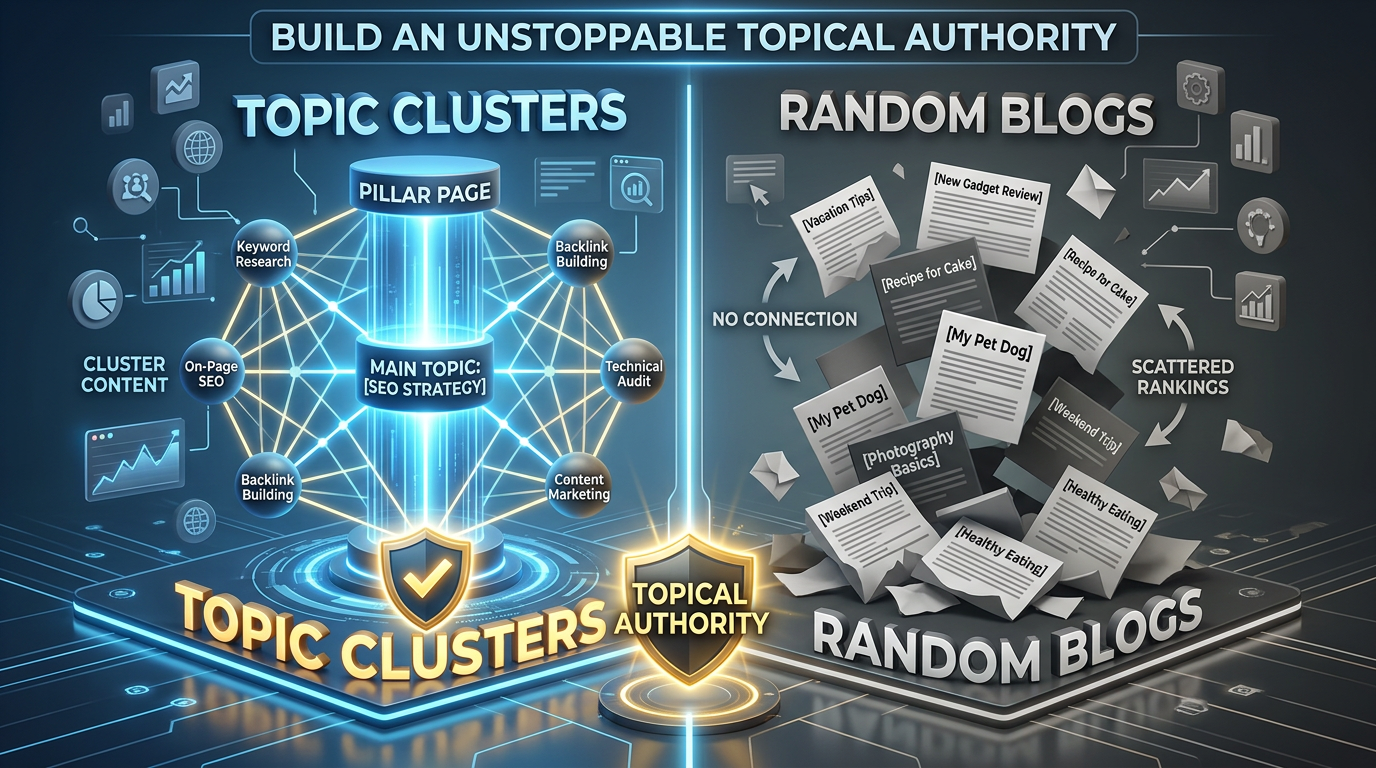
This is the difference between random blogging and a topic cluster strategy.
If your goal is to improve organic traffic, strengthen search engine visibility, and establish your website as a trusted resource, understanding topic clusters is essential.
What Are Topic Clusters in SEO?
A topic cluster is a content strategy where multiple related blog posts are organised around one central subject.
Instead of publishing individual articles without a connection, you create a structured content ecosystem consisting of:
- Pillar Page: A comprehensive article covering the main topic.
- Cluster Content: Supporting articles that explore specific subtopics in detail.
- Internal Links: Strategic links connecting supporting articles to the pillar page and relevant cluster content.
Together, these pages help search engines understand the relationship between your website’s content.
Example:
Suppose you run a digital marketing website and want to establish authority around SEO.
Your topic cluster could look like this:
Pillar Topic: Complete SEO Guide
Supporting blog topics:
- What Is SEO and How Does It Work?
- On-Page SEO Techniques for Beginners
- Technical SEO: A Complete Guide
- Keyword Research Strategies
- Link Building Best Practices
- Local SEO for Small Businesses
- Content Marketing and SEO
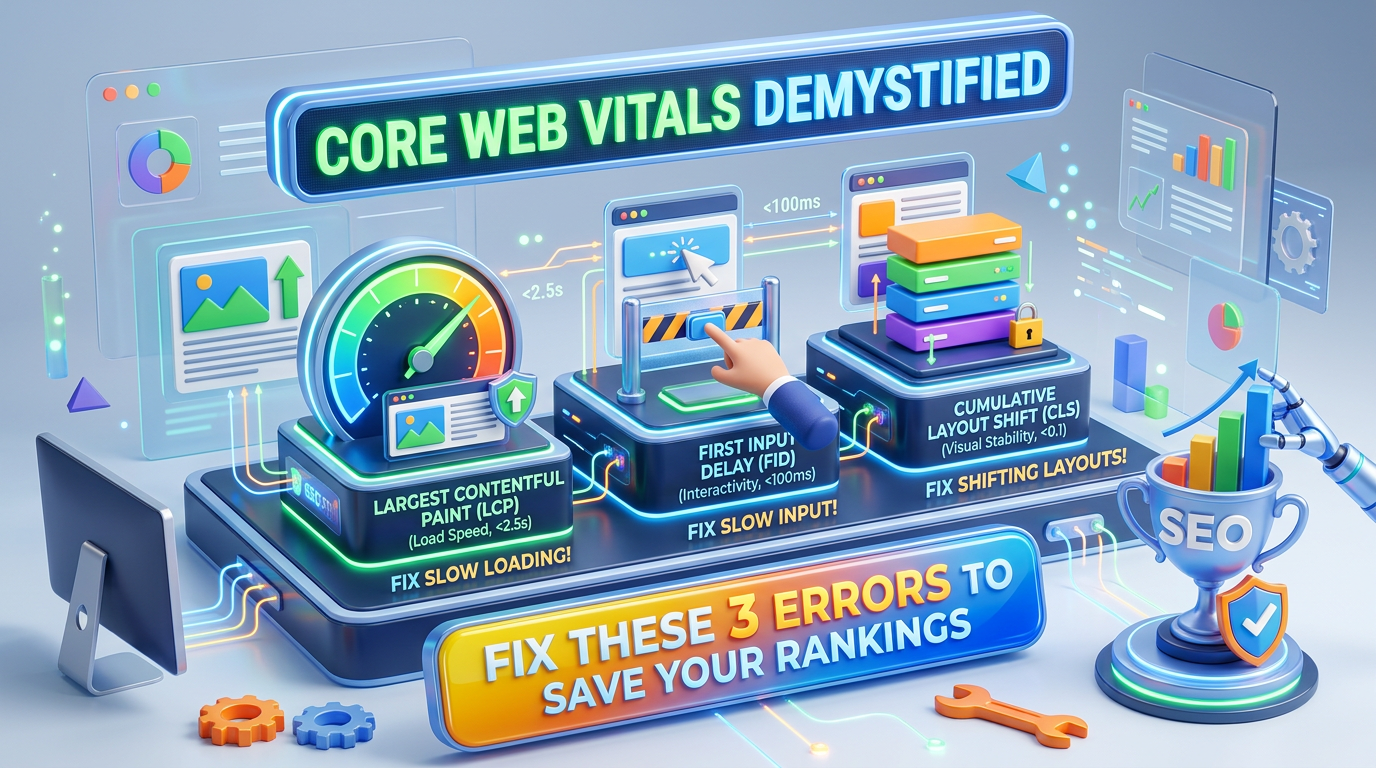
- Core Web Vitals Explained
- AI Search and the Future of SEO
Each article addresses a different search intent while contributing to the broader SEO topic.
What Is Random Blogging and Why Can It Limit Your SEO Growth?
Random blogging means publishing articles based on individual ideas, trending keywords, or occasional content opportunities without a broader content strategy.
For example, a website might publish:
- Best AI Tools for Businesses
- How to Start a YouTube Channel
- Top 10 Personal Finance Tips
- Best Restaurants in Bangalore
- Social Media Marketing Trends
There is nothing inherently wrong with these topics. However, if they are unrelated to the website’s primary niche, they may not contribute to a consistent topical identity.
Common problems with random blogging include:
- Lack of a clear content direction.
- Limited connections between related articles.
- Missed internal linking opportunities.
- Difficulty building comprehensive topic coverage.
- Inconsistent relevance to the target audience.
- Increased chances of publishing overlapping content.
Publishing more articles does not automatically mean building more SEO authority. The relevance, quality, depth, and organisation of your content matter.
Topic Clusters vs. Random Blogs: Key Differences
Understanding the difference can help you choose a more effective content strategy.
| Factor | Topic Clusters | Random Blogs |
|---|---|---|
| Content Strategy | Structured around themes | Based on individual ideas |
| Topic Relevance | Strong thematic connection | May cover unrelated subjects |
| Internal Linking | Planned and strategic | Often inconsistent |
| Search Intent | Covers multiple related intents | Depends on each article |
| Content Planning | Long-term strategy | Short-term publishing |
| Topical Coverage | Builds comprehensive coverage | May leave content gaps |
| User Experience | Encourages deeper exploration | Limited content journeys |
The key takeaway: Topic clusters create a connected content experience, while random blogging often creates isolated information.
How Topic Clusters Help Build Topical Authority
Topical authority refers to a website’s demonstrated expertise and comprehensive coverage of a particular subject.
Search engines aim to provide users with relevant, useful, and trustworthy information. A well-organised collection of high-quality content can help search engines understand what your website covers and how individual pages relate to one another.
Here is how topic clusters support that process.
1. Establish Clear Subject Relevance
When your website consistently publishes useful content around a particular subject, it creates a stronger thematic connection between your pages.
For example, a website covering GST could publish articles about:
- GST registration.
- GST return filing.
- Input Tax Credit.
- GST reconciliation.
- GST notices.
- GST audits.
- GST compliance for businesses.
This comprehensive coverage helps establish a clear subject focus.
2. Strengthen Internal Linking
Internal linking connects related articles and helps users discover additional information.
For example, an article about GST registration can link to supporting articles about GST returns, input tax credit, and GST compliance.
This creates a logical navigation structure.
Internal links can also help search engines discover pages and understand their contextual relationships.
3. Cover Different Search Intents
Customers search for information at different stages of their decision-making journey.
For example, someone searching for SEO might have different questions:
- Informational: What is SEO?
- Educational: How does keyword research work?
- Practical: How do I improve website rankings?
- Commercial: Which SEO agency should I hire?
A topic cluster allows you to address these different search intents through dedicated articles.
4. Improve Content Discoverability
A well-connected website makes it easier for visitors to move from one article to another.
Someone reading about keyword research might discover your guide to on-page SEO through an internal link.
This encourages deeper engagement and helps users find relevant information without repeatedly returning to Google.
5. Reduce Keyword Cannibalisation
Keyword cannibalisation occurs when multiple pages target the same or very similar search intent, potentially competing with one another in search results.
A topic cluster encourages you to assign a distinct purpose and search intent to each article.
For example:
- Pillar page: Complete Guide to Technical SEO.
- Supporting article: How to Fix Broken Links.
- Supporting article: XML Sitemap Best Practices.
- Supporting article: How to Improve Website Crawlability.
Each article serves a specific purpose while supporting the main topic.
How to Build a Topic Cluster Strategy Step by Step
You do not need hundreds of blog posts to start building topical authority. You need a clear structure and a consistent publishing strategy.
Follow these steps.
Step 1: Choose Your Core Topic
Start by identifying the primary subject you want your website to become known for.
Choose a topic that:
- Matches your business expertise.
- Addresses your target audience’s needs.
- Has sufficient search demand.
- Supports your products or services.
- Offers opportunities for detailed content development.
For example, a website offering digital marketing services might choose SEO as its primary topic.
Step 2: Conduct Keyword Research
Identify the keywords and questions people search for around your core topic.
Use tools such as Google Keyword Planner, Google Search Console, Ahrefs, or Semrush to discover relevant opportunities.
Look beyond high-volume keywords.
Consider:
- Long-tail keywords.
- Related search terms.
- Frequently asked questions.
- Problem-based searches.
- Comparison-based searches.
- Commercial search queries.
For example, instead of targeting only “SEO”, explore terms such as “technical SEO checklist”, “how to improve local SEO”, and “SEO mistakes to avoid”.
Step 3: Group Keywords Into Content Clusters
Organise related keywords based on their subject and search intent.
For example:
Core Topic: Local SEO
Supporting clusters:
- Google Business Profile Optimisation.
- Local Keyword Research.
- Local Citations and Business Listings.
- Customer Reviews and Reputation Management.
- Local Link Building.
- Local SEO for Multiple Locations.
Each cluster can contain multiple supporting articles.
Avoid creating separate pages for every minor keyword variation when the search intent is essentially identical.
Step 4: Create a Comprehensive Pillar Page
Your pillar page should provide a detailed overview of the main subject.
It should:
- Introduce the core topic.
- Explain important concepts.
- Cover major subtopics.
- Link to supporting articles.
- Answer common audience questions.
- Provide a clear navigation experience.
Think of the pillar page as the central resource connecting your entire content ecosystem.
Step 5: Publish Supporting Articles
Create individual articles that explore specific subtopics in greater depth.
For example, if your pillar page covers content marketing, supporting articles could include:
- Content Marketing Strategy for Startups.
- How to Create an Editorial Calendar.
- SEO Content Writing Best Practices.
- How to Measure Content Marketing ROI.
- Content Repurposing Strategies.
Every supporting article should provide unique value rather than repeating information already covered elsewhere.
Step 6: Build a Strategic Internal Linking Structure
Internal links are the connections that make topic clusters work.
Follow these practices:
- Link supporting articles to the relevant pillar page.
- Connect related supporting articles where useful.
- Use descriptive and relevant anchor text.
- Link to genuinely helpful resources.
- Avoid excessive or forced internal linking.
For example, an article about content optimisation could naturally link to your guide on keyword research.
Step 7: Monitor and Improve Performance
Publishing content is only one part of the strategy.
Regularly evaluate how your topic clusters perform.
Track:
- Organic traffic.
- Keyword rankings.
- Search impressions.
- Click-through rates.
- Indexed pages.
- Internal link coverage.
- Conversions and enquiries.
Google Search Console and Google Analytics can help you identify opportunities for improvement.
If a particular cluster is performing well, consider expanding it with additional relevant content.
Topic Clusters and AI Search: Why Content Structure Matters More Than Ever
Search behaviour is changing.
People are increasingly using AI-powered search experiences and conversational tools to discover information, compare solutions, and find answers.
This makes comprehensive, well-structured content valuable.
AI search systems may use information from multiple sources to formulate responses. Creating useful articles that clearly explain specific topics can improve the accessibility and understanding of your content.
To strengthen your content for AI search:
- Answer specific questions directly.
- Use descriptive headings.
- Include relevant examples.
- Explain technical concepts clearly.
- Connect related articles through contextual links.
- Keep information accurate and updated.
- Demonstrate genuine expertise and experience.
However, topic clusters alone do not guarantee Google rankings or AI citations. Content quality, relevance, originality, authority, technical accessibility, and other factors also influence visibility.
Common Topic Cluster Mistakes to Avoid
Even a well-planned content strategy can fail when executed incorrectly.
Watch out for these common mistakes:
1. Creating Too Many Similar Articles
Publishing multiple articles with nearly identical search intent can create unnecessary competition between your own pages.
2. Ignoring Search Intent
A keyword may have good search volume, but if your content does not answer what users actually want, it may struggle to perform.
3. Overlooking Internal Links
Related articles without meaningful connections can remain isolated from the rest of your website.
4. Prioritising Quantity Over Quality
Publishing 20 average articles is not necessarily better than publishing five comprehensive, useful articles.
5. Never Updating Old Content
Outdated information can reduce the usefulness of your content. Review important articles periodically and update them when necessary.
6. Choosing Topics Outside Your Expertise
Publishing unrelated trending topics simply to attract traffic can weaken your overall content strategy.
How Many Blog Posts Do You Need to Build Topical Authority?
There is no fixed number of articles required to establish topical authority.
The number depends on:
- The complexity of your industry.
- The competitiveness of your target keywords.
- The number of relevant subtopics.
- Your audience’s information needs.
- The quality and depth of existing content.
A small business website might begin with one comprehensive pillar page and five to ten supporting articles.
A larger website covering a competitive industry may need several interconnected topic clusters.
The objective is not to publish a specific number of blogs. It is to cover the important questions and topics your audience genuinely cares about.
Frequently Asked Questions (FAQs)
1. What is the difference between topic clusters and content silos?
Topic clusters organise related content around a central pillar page using contextual internal links. Content silos generally organise website content into distinct hierarchical categories. Both approaches improve content organisation, but their linking structures can differ.
2. Do topic clusters improve Google rankings?
Topic clusters can support SEO by improving content organisation, internal linking, and subject coverage. However, they do not guarantee higher rankings. Content quality, search intent, competition, technical SEO, and backlinks also matter.
3. Can small websites use topic clusters?
Yes. Small websites can benefit significantly from topic clusters. Start with one core subject, create a comprehensive pillar page, and gradually publish supporting articles.
4. Should every blog post belong to a topic cluster?
Not necessarily. Some articles may address independent business updates, announcements, or unique topics. However, your main educational and informational content should ideally follow a clear strategy.
5. How long does it take to build topical authority?
There is no fixed timeline. It depends on your niche, competition, publishing consistency, content quality, and website’s existing authority. Building meaningful topical coverage is a long-term SEO process.
6. Are topic clusters important for AI SEO?
Yes, they can support AI SEO by making related information easier to discover, understand, and navigate. However, AI visibility also depends on content accuracy, usefulness, credibility, and the relevance of individual pages.
Conclusion: Stop Publishing Randomly. Start Building Content Authority.
Your website does not need more blog posts simply for the sake of publishing.
It needs a content strategy that connects individual articles into a valuable knowledge resource.
Random blogging may generate occasional traffic, but a well-planned topic cluster strategy helps you build comprehensive subject coverage, improve internal linking, address different search intents, and create a better experience for your audience.
Start with one core topic. Identify the questions your customers are asking. Create a strong pillar page, publish relevant supporting articles, and connect everything through strategic internal links.
Remember: SEO success is not just about how many blogs you publish. It is about how effectively your content demonstrates expertise across the topics that matter to your audience.
Leave a Reply