
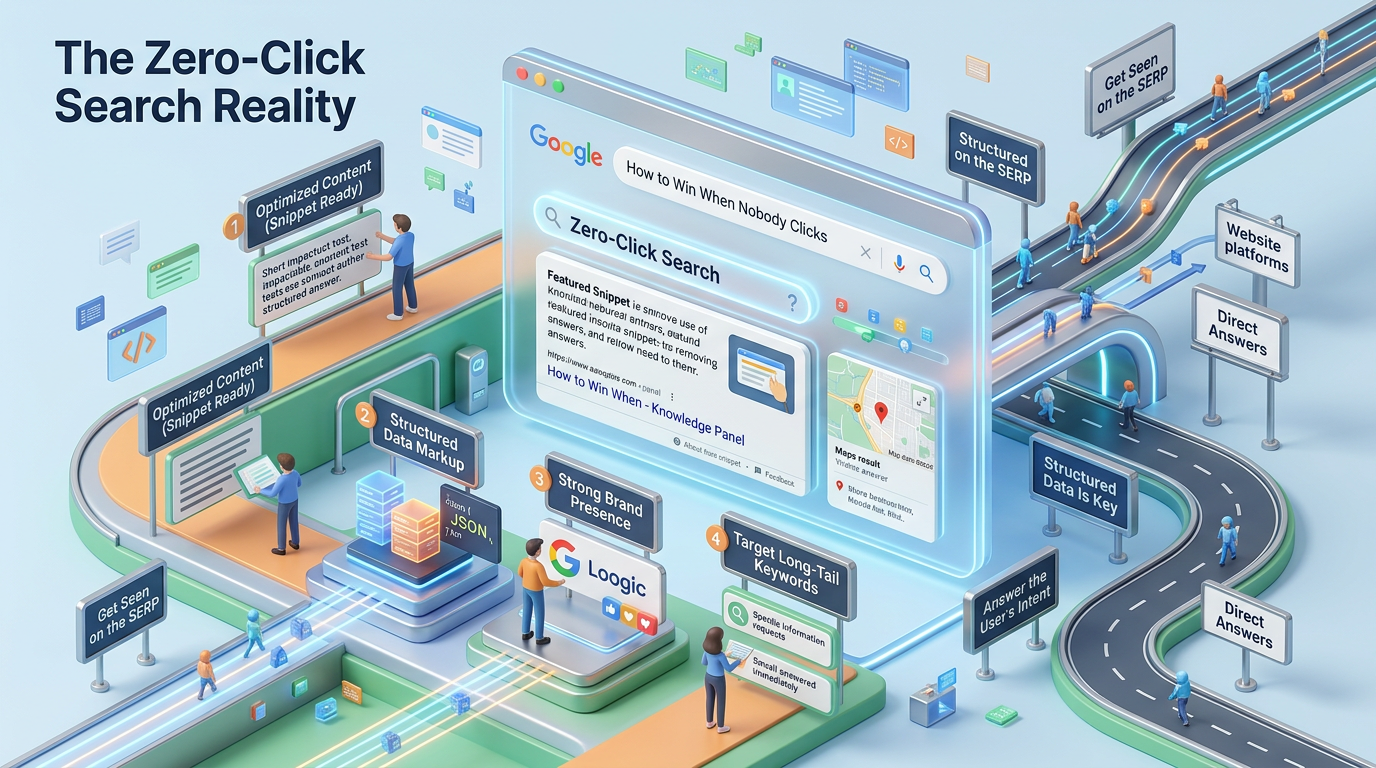
The Zero-Click Search Reality: How to Win When Nobody Clicks
Imagine someone searches for a service on Google, finds the answer at the top of the results, and leaves without visiting a single website.
Your website might rank on the first page, but the visitor never clicks it.
Welcome to the world of Zero-Click Search.
Search behaviour is changing. Google AI Overviews, featured snippets, knowledge panels, local business listings, and AI-powered search platforms are answering users’ questions directly on the results page.
For businesses, this creates a new challenge: How do you generate visibility, build trust, and attract customers when people don’t click your website?
The answer is to stop measuring SEO success through website traffic alone and start focusing on search visibility, brand recognition, and customer engagement.
What Is Zero-Click Search?
Zero-click search happens when users find the information they need directly on a search engine results page (SERP) without clicking through to an external website.
For example, imagine someone searches:
- What is the capital of Australia?
- What is the GST registration limit in India?
- Best digital marketing agency in Bangalore.
- How much does website development cost?
Google may display the answer through featured snippets, AI Overviews, maps, business listings, or other search features.
Users get the information they need without necessarily visiting the websites that provided it.
This means your content can influence a customer’s decision even when it doesn’t generate a website visit.
Why Are Zero-Click Searches Increasing?
Search engines are evolving from simple link directories into answer platforms.
Several developments are contributing to this shift.
1. AI Overviews Are Changing Search Behaviour
Google AI Overviews provide AI-generated summaries at the top of eligible search results.
Instead of opening multiple websites, users can understand a topic through a single summary.
For example, someone searching for SEO strategies might receive an overview covering keyword research, technical SEO, content optimisation, and link building.
Websites referenced in these answers can gain visibility even when users don’t click through.
2. Featured Snippets Provide Instant Answers
Featured snippets highlight relevant information from webpages directly within search results.
They commonly appear for questions such as:
- What is technical SEO?
- How does GST registration work?
- What is an Innovator Founder Visa?
If your content provides a clear and direct answer, it may become eligible for featured snippet placement.
3. Local Search Results Reduce Website Visits
When users search for local services, Google may display business profiles, reviews, contact information, directions, and operating hours.
For example, someone searching for a CA firm near them may directly call a business through its Google Business Profile.
The customer converts without visiting the company’s website.
4. AI Search Platforms Provide Consolidated Answers
Platforms such as ChatGPT, Perplexity, and Google’s AI-powered search experiences are changing how people discover information.
Users increasingly ask complete questions instead of searching with individual keywords.
For example:
“Which UK visa options are suitable for entrepreneurs who want to establish an innovative business?”
AI platforms may generate a detailed response using information from multiple online sources.
This makes brand visibility across AI-generated answers an increasingly important part of digital marketing.
How Does Zero-Click Search Affect Your Business?
Zero-click search creates both challenges and opportunities.
The challenges:
- Organic website traffic may decline for certain informational keywords.
- Traditional SEO traffic metrics may not reflect actual brand visibility.
- Businesses may struggle to measure the value of appearing in AI-generated answers.
- Competitors can gain attention directly through search features.
- Website rankings alone may not guarantee customer enquiries.
The opportunities:
- Your brand can reach potential customers without a website visit.
- Featured snippets can establish topical authority.
- AI citations can introduce your business to new audiences.
- Google Business Profile visibility can generate direct calls and enquiries.
- Consistent brand mentions can improve recognition and trust.
The important shift is understanding that visibility is valuable even when it doesn’t immediately produce a click.
7 Strategies to Win in a Zero-Click Search Environment
Traditional SEO is still important, but businesses need a broader search visibility strategy.
Here are seven practical ways to adapt.
1. Optimise Content for Direct Answers
Create content that answers specific customer questions clearly.
Instead of writing lengthy introductions before addressing a topic, provide a concise answer near the beginning of the relevant section.
For example:
Question: What is an Innovator Founder Visa?
Answer: The UK Innovator Founder Visa is a visa route for entrepreneurs who want to establish and operate an innovative, viable, and scalable business in the United Kingdom, subject to endorsement and other eligibility requirements.
Follow this with detailed explanations, examples, eligibility criteria, and supporting information.
This structure makes your content easier for search engines and AI systems to understand.
2. Build a Strong Google Business Profile
For local businesses, Google Business Profile is one of the most important zero-click visibility opportunities.
Optimise your profile by:
- Maintaining accurate business information.
- Selecting relevant primary and secondary categories.
- Adding updated photographs.
- Publishing useful business updates.
- Collecting genuine customer reviews.
- Responding to customer questions and reviews.
- Keeping contact details and operating hours accurate.
A well-maintained profile can help potential customers discover and contact your business directly from search results.
3. Create Content Around Customer Questions
People search for answers, not just keywords.
Identify the questions your target audience asks before making a purchase or choosing a service provider.
For example, an accounting firm could create content around:
- How much does GST registration cost?
- When is income tax return filing required?
- What documents are needed for company registration?
- How does NRI property taxation work?
Build dedicated content around these questions.
A strong FAQ section can also help search engines understand the specific topics your website covers.
4. Optimise Your Content for AI Search and GEO
Generative Engine Optimisation (GEO) focuses on improving the visibility of your content across AI-powered search and answer platforms.
To improve your chances of being referenced:
- Publish original and useful information.
- Include accurate statistics with credible sources.
- Use descriptive headings.
- Explain technical concepts in simple language.
- Include real-world examples and case studies.
- Maintain consistent business information across platforms.
- Demonstrate expertise through detailed, trustworthy content.
Remember, there is no guaranteed method to secure an AI citation. The objective is to make your information accurate, accessible, useful, and easy to understand.
5. Build Brand Authority Beyond Your Website
Your website should not be the only place where people discover your business.
Develop a consistent brand presence through:
- LinkedIn articles and professional updates.
- Industry publications.
- Relevant business directories.
- Guest contributions.
- Expert interviews.
- Customer testimonials.
- Educational social media content.
When people repeatedly encounter your brand across credible platforms, recognition and familiarity can increase.
Focus on genuine expertise and relevant mentions rather than creating artificial brand references.
6. Implement Structured Data
Structured data helps search engines interpret important information about your website.
Relevant schema types may include:
- Organization Schema
- LocalBusiness Schema
- Article Schema
- Product Schema
- Service Schema
- BreadcrumbList Schema
For example, Organization Schema can help search engines understand your business name, website, logo, and official contact information.
However, structured data does not guarantee rich results or AI citations. It supports content understanding and search engine interpretation.
7. Track Visibility Beyond Website Traffic
One of the biggest mistakes businesses make is measuring SEO performance only through sessions and clicks.
In a zero-click environment, you need additional performance indicators.
Track:
- Search impressions.
- Organic click-through rate (CTR).
- Featured snippet visibility.
- Google Business Profile calls and website actions.
- Brand search volume.
- AI platform mentions and citations.
- Referral traffic from AI platforms.
- Qualified leads and conversions.
Google Search Console can help monitor impressions, clicks, CTR, and search queries.
Google Business Profile Performance can provide insights into customer interactions.
You can also maintain a simple spreadsheet to track whether your brand appears in relevant AI-generated answers.
Zero-Click SEO vs Traditional SEO: What’s the Difference?
Traditional SEO focuses heavily on attracting visitors through organic search rankings.
Zero-click SEO expands that objective to include visibility and brand recognition directly within search experiences.
| Traditional SEO | Zero-Click SEO |
|---|---|
| Focuses on website clicks | Focuses on search visibility |
| Measures organic traffic | Measures impressions and brand presence |
| Targets keyword rankings | Targets answers and search features |
| Optimises website pages | Optimises websites and external profiles |
| Tracks CTR and sessions | Tracks visibility, mentions, calls, and leads |
| Focuses on search engine results | Includes AI-powered search experiences |
These approaches should work together rather than replace one another.
Website traffic remains valuable, particularly for businesses selling complex services, products, or solutions that require detailed evaluation.
How to Measure Zero-Click Search Performance
Measuring zero-click visibility requires combining multiple data sources.
Here is a practical measurement framework.
1. Google Search Console
Monitor:
- Search impressions.
- Click-through rates.
- Query-level performance.
- Changes in organic visibility.
2. Google Business Profile
Monitor:
- Business profile views.
- Calls.
- Website clicks.
- Direction requests.
3. AI Visibility Tracking
Create a list of 10–20 questions your potential customers might ask AI platforms.
For example:
- Which companies provide SEO services for startups?
- What are the best visa consultancy options for UK entrepreneurs?
- Which CA firms provide NRI tax services in Bangalore?
Test these questions periodically across relevant AI platforms.
Record:
- Whether your brand appears.
- Whether your website is cited.
- Which competitors appear.
- Which sources are referenced.
This helps you understand your brand’s visibility beyond traditional search rankings.
Common Zero-Click SEO Mistakes to Avoid
Businesses adapting to this new search environment should avoid several mistakes.
Ignoring traditional SEO: Zero-click search does not mean website optimisation is unnecessary. Search engines and AI systems still need accessible, useful information.
Publishing content only for AI: Content written exclusively to attract AI citations may become repetitive and unhelpful. Prioritise the actual needs of your audience.
Chasing every search feature: Not every keyword needs a featured snippet or AI Overview strategy. Focus on search opportunities relevant to your business goals.
Ignoring conversions: Impressions and brand mentions are useful, but they should ultimately support business outcomes.
Expecting guaranteed AI citations: No SEO agency or strategy can guarantee that a particular AI platform will mention your brand.
The Future of SEO: From Ranking to Being the Answer
Search is moving beyond the traditional ten blue links.
People want immediate answers, reliable recommendations, and relevant solutions. Search engines and AI platforms are adapting to these expectations.
For businesses, this means SEO success will increasingly involve three important objectives:
- Be discoverable: Make your content accessible to search engines and AI platforms.
- Be credible: Demonstrate genuine expertise through useful information, reliable sources, and consistent brand signals.
- Be memorable: Build a brand that customers recognise and trust when they are ready to make a decision.
The goal is no longer just to bring someone to your website. It is also to make sure your business becomes part of the customer’s discovery and decision-making journey.
Frequently Asked Questions (FAQs)
1. What is zero-click search in SEO?
Zero-click search occurs when users obtain answers directly from search results without clicking an external website. Featured snippets, AI Overviews, knowledge panels, and local business listings are common examples.
2. Does zero-click search mean SEO is dead?
No. SEO remains essential for organic visibility, website discovery, and brand authority. However, businesses need to optimise for search visibility and customer engagement beyond website traffic.
3. How can businesses appear in Google AI Overviews?
Publish accurate, original, helpful content with clear explanations, relevant headings, credible references, and strong website accessibility. However, Google does not guarantee AI Overview inclusion.
4. What is the difference between zero-click SEO and GEO?
Zero-click SEO focuses on gaining visibility within search results where users may not click external links. GEO focuses on improving the chances of content and brands being referenced in generative AI responses. They overlap but are not identical.
5. Can zero-click searches generate leads?
Yes. Local business listings, contact details, reviews, and other search features can encourage users to call, request directions, or contact a business without visiting its website.
6. How do I track zero-click search performance?
Use Google Search Console for impressions and CTR, Google Business Profile Performance for customer interactions, and manual or specialised AI visibility tracking to monitor brand mentions and citations.
7. Should businesses stop focusing on organic traffic?
No. Organic traffic remains an important performance indicator. Businesses should combine traffic measurements with impressions, brand visibility, qualified leads, and conversions.
Conclusion
The zero-click search reality is not the end of SEO. It is a change in how businesses need to approach online visibility.
A website ranking on Google’s first page is valuable, but appearing in an AI-generated answer, a featured snippet, or a local business result can also influence potential customers.
Businesses that adapt early by creating useful content, building brand authority, strengthening local SEO, and tracking AI visibility will be better positioned for the changing search landscape.
At GotMeNow, the focus is on helping businesses build visibility across traditional search and AI-powered discovery. Because the next customer may discover your brand without ever clicking your website.
Leave a Reply