
Microsoft Just Made AI Transcription Much Cheaper: How to Turn It Into a Business
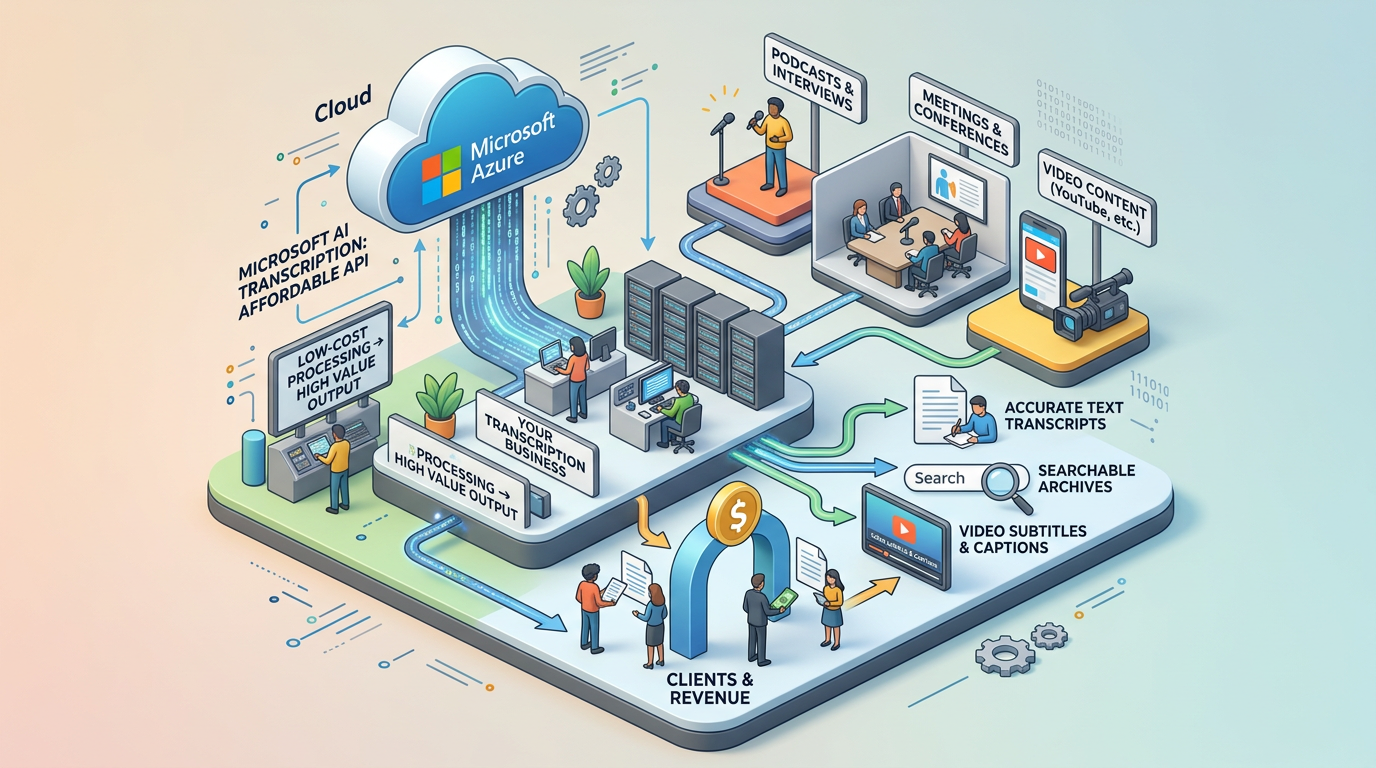
Imagine starting a digital service business without buying expensive equipment, hiring a team, or developing your own AI software. Your business could help podcasters, YouTubers, coaches, and online educators turn audio and video into searchable text, subtitles, and repurposed content.
Microsoft’s MAI-Transcribe-2 speech-to-text model presents an opportunity worth exploring. Microsoft announced an introductory price of $0.10 per hour of audio, compared with the previous price of $0.36 per hour. The model supports 60 languages and includes features such as speaker identification and word-level timestamps.
For aspiring entrepreneurs, the interesting part is not simply the lower price. It is the possibility of building a service business around affordable AI technology and charging customers for a polished, ready-to-use result.
Let’s explore how this business works, what you can sell, and how to get started.
What Is Microsoft’s MAI-Transcribe-2?
A Lower-Cost AI Tool for Converting Speech Into Text
MAI-Transcribe-2 is Microsoft’s AI speech-recognition model. It converts spoken audio into written text, helping businesses process recordings without manually typing every word.
Potential applications include:
- Podcast transcription and show notes.
- YouTube video transcripts and subtitle preparation.
- Online course and webinar transcripts.
- Interview transcription.
- Meeting documentation.
- Multilingual content workflows.
- Searchable archives of recorded audio.
The model supports 60 languages, automatic language identification, speaker diarization, and word-level timestamps. These features can make transcripts easier to edit, organize, and align with video.
However, AI-generated transcripts still require quality checks. Accents, background noise, technical terminology, and overlapping speakers can cause errors.
Why the 72% Price Cut Matters for Entrepreneurs
Microsoft reduced the transcription price from $0.36 to $0.10 per audio hour, a reduction of approximately 72%. The announced introductory rate is scheduled to run through December 31, 2026.
Here is what the transcription charge alone could look like:
| Audio processed | AI transcription cost |
|---|---|
| 1 hour | $0.10 |
| 10 hours | $1.00 |
| 50 hours | $5.00 |
| 100 hours | $10.00 |
These are illustrative calculations using the introductory rate. They exclude taxes, currency conversion, and any additional service charges.
This creates a potential cost advantage for businesses that process substantial amounts of audio. However, the model’s price is only one component of the total cost of delivering a professional service.
You may also spend time correcting transcripts, formatting captions, translating content, communicating with clients, and managing revisions.
The business opportunity is to use AI to reduce repetitive work and charge for the complete service rather than merely selling raw machine-generated text.
The Business Idea: AI-Powered Transcription and Video Content Services
The business is straightforward: customers send you their audio or video, AI generates the transcript, and you deliver a professionally edited content package.
You do not need to create an AI model yourself. Your value comes from making the output accurate, readable, properly formatted, and ready to publish.
1. Podcast Transcription
Podcasters regularly produce long-form audio content that can be converted into written material.
You can offer:
- Corrected podcast transcripts.
- Speaker-labelled dialogue.
- Podcast show notes.
- Key takeaways and episode summaries.
- Searchable text archives.
Illustrative starting price: $25–$75 per episode, depending on length and complexity.
2. YouTube Captions and Subtitles
YouTubers need captions to improve accessibility and help viewers follow their videos.
Your services could include:
- Corrected video transcripts.
- Subtitle files in SRT or VTT formats.
- Timestamped captions.
- Speaker identification where appropriate.
- Subtitle formatting and quality checks.
Illustrative starting price: $30–$100 per video, depending on the deliverables.
3. Online Course Content Repurposing
Coaches, educators, and course creators often have hours of recorded lessons that can be converted into useful learning materials.
You can turn their recordings into:
- Written lesson transcripts.
- Study notes.
- Lesson summaries.
- Frequently asked questions.
- Searchable course documentation.
Illustrative starting price: $50–$150 per video package, depending on scope.
4. Multilingual Content Support
Creators may want to make their content accessible to audiences who speak different languages.
You can offer:
- Transcripts prepared for translation.
- Translated subtitles.
- Multilingual caption packages.
- Localized written summaries.
- Coordination of AI-assisted dubbing workflows.
Illustrative starting price: $50–$150 or more per project, depending on the languages and services required.
These prices are suggested starting points, not verified market averages. Actual pricing depends on video length, language, audio quality, editing requirements, turnaround time, and client expectations.
Important distinction: MAI-Transcribe-2 converts speech into text. It does not, by itself, provide a complete translation, subtitle-editing, or dubbing service. Those deliverables require additional tools and human quality checks.
How to Start This Business in 7 Days
You can validate the idea in one week without building a website or purchasing expensive equipment.
Day 1: Choose One Customer Niche
Start with one group, such as podcasters, YouTubers, coaches, or online course creators.
A specific niche makes your offer easier to explain and market. For example, you could focus exclusively on providing transcripts and subtitles for independent YouTube creators.
Day 2: Test the Transcription Tool
Experiment with MAI-Transcribe-2 using a suitable testing environment.
Test recordings with different accents, background noise levels, speaking speeds, and technical vocabulary.
Evaluate the accuracy of the transcript, speaker identification, punctuation, and timestamps before using the output in a paid project.
Day 3: Create a Sample Deliverable
Prepare a sample transcript with:
- Corrected punctuation and formatting.
- Speaker labels where appropriate.
- Timestamps if required.
- A clean document layout.
- A final accuracy check.
Use audio that you own or have permission to process.
The sample should demonstrate the quality of your finished service rather than simply showing unedited AI output.
Day 4: Define a Simple Service Package
Create a clear offer with specific deliverables.
For example, your starter package could include one corrected transcript, one subtitle file, and one revision.
Define the maximum recording length, delivery time, language, and revision policy in advance. This helps avoid misunderstandings with clients.
Day 5: Contact Potential Clients
Reach out to small creators, podcast producers, marketing agencies, and coaches.
Offer a short sample to demonstrate your work. Explain how your service can save them time and make their content easier to reuse.
Avoid promising guaranteed results or offering unlimited free work.
Day 6: Deliver a Pilot Project
Complete a small project for an interested customer.
Check names, numbers, technical terms, punctuation, speaker labels, and subtitle timing. Ask the client for feedback on accuracy, readability, and turnaround time.
Use that feedback to improve your workflow.
Day 7: Convert the Sample Into a Paid Offer
Use the feedback to refine your package, establish pricing, and follow up with interested prospects.
With the client’s permission, you can also use a completed project as a portfolio example.
Your goal during the first week is to validate demand, not to build a complicated business infrastructure.
The AI Tool Stack You Need
You can begin with a small collection of tools rather than paying for a large software stack.
| Business requirement | Tool or approach |
|---|---|
| Speech-to-text | Microsoft MAI-Transcribe-2 |
| Testing and experimentation | An available MAI testing environment |
| Transcript cleanup | A text editor and optional AI writing assistant |
| Subtitle creation | A subtitle editor supporting SRT or VTT files |
| Translation and localization | A suitable translation tool with human review |
| Client acquisition | Email, professional social networks, and creator communities |
| File delivery | Cloud document delivery or secure file-sharing tools |
| Invoicing | An invoicing and payment management tool |
Start with the smallest stack that can fulfil your first client’s requirements. Add paid subscriptions only when they solve a real workflow problem.
A technical consideration is that MAI-Transcribe-2 has been described as a public-preview service. Before making it the foundation of a paid business, verify its current availability, reliability, regional access, usage terms, and suitability for production workloads.
Do not build a high-volume service around a tool without testing its limitations and understanding the implications of any changes to pricing or availability.
How Much Could You Earn?
Let’s consider a hypothetical scenario. Suppose you sell a transcription and caption package for $75 per video.
Assume you complete 20 paid videos in a month.
| Particulars | Amount |
|---|---|
| Number of videos | 20 |
| Price per video | $75 |
| Monthly revenue | $1,500 |
| Audio hours per video | 1 hour |
| Transcription cost per video | $0.10 |
| Total transcription cost | $2.00 |
In this simplified example, the transcription API charge is only $2 for 20 one-hour recordings at the introductory rate.
However, this does not mean the business costs only $2 to operate.
You must also account for:
- Your time spent correcting transcripts.
- Subtitle editing and formatting.
- Other software subscriptions.
- Marketing and customer acquisition.
- Payment processing charges.
- Revisions and customer support.
- Taxes and general business expenses.
The actual amount you retain depends on your total costs and the time required to deliver each project.
The key takeaway is that transcription API costs can be small compared with the selling price. However, low software costs do not guarantee high profits. Your ability to find customers, manage revisions, and deliver consistent quality will determine whether the business is viable.
Also, recheck the API price before building a long-term financial plan because the introductory rate is time-limited.
How to Find Your First Paying Customers
Your initial challenge is not the technology. It is proving that people will pay for the result.
1. Target Creators Who Publish Regularly
Look for podcasters, coaches, educators, and YouTubers who release content consistently but do not appear to provide complete transcripts or captions.
These creators may have recurring requirements, making them potential customers for monthly service packages.
2. Sell an Outcome, Not an AI Tool
Instead of saying, “I use AI to transcribe videos,” offer a concrete benefit.
For example:
- A corrected transcript ready to publish.
- Captions prepared for video editing.
- A searchable archive of podcast episodes.
- Lesson notes created from recorded courses.
- Written content repurposed from existing recordings.
Customers are generally purchasing convenience, accuracy, and a finished deliverable rather than access to a particular AI model.
3. Use a Sample as Your Sales Pitch
Choose a short recording with permission and prepare a sample transcript.
Show the difference between raw AI output and your finished work. Demonstrate the formatting, corrections, and usability of the final deliverable.
Agree on the scope before offering free work, and limit the sample to a manageable length.
4. Build Recurring Packages
A creator who publishes weekly may need help every month.
You can offer packages based on a defined number of videos, audio hours, or deliverables, with clear revision limits and turnaround times.
Recurring clients can make revenue more predictable, although renewals are never guaranteed.
5. Ask for Referrals and Testimonials
Once you have delivered satisfactory work, ask clients for feedback and referrals.
Positive client experiences can help build credibility, especially when you are entering a competitive market without an established portfolio.
What About Translation and AI Dubbing?
Multilingual services can create a larger offer than transcription alone.
For example, a creator could ask you to prepare an English transcript, translate it into another language, create subtitles, and produce a localized version of the video.
However, these are separate tasks:
- Transcription: Converts speech into text.
- Translation: Converts meaning into another language.
- Subtitling: Formats and synchronizes text with video.
- Dubbing: Replaces or overlays speech with recorded or AI-generated voices.
MAI-Transcribe-2 handles the transcription task. The remaining tasks require additional tools and review.
For Indian-language creators, you could explore regional content workflows involving Malayalam, Hindi, Tamil, Kannada, or Telugu after verifying the specific language support and testing real recordings.
Do not assume that a model’s broad multilingual support guarantees equal performance in every language or dialect. Human review is particularly important when the content includes regional expressions, specialized vocabulary, or culturally specific references.
Risks and Mistakes to Avoid
Before launching, keep the following points in mind.
Do Not Promise Perfect Accuracy
Human review is essential for names, numbers, technical terms, and unclear speech. A transcript that looks readable may still contain errors that change the meaning of a statement.
Do Not Confuse Transcription With Translation
A speech-to-text model does not automatically provide a complete multilingual content service. Quote additional services separately and make the deliverables clear.
Do Not Ignore Privacy
Obtain client authorization before uploading recordings to third-party services. Follow appropriate data-handling practices, protect confidential information, and establish clear policies for storing and deleting files.
Do Not Depend Entirely on a Promotional Price
Calculate your margins using the applicable standard rate and consider alternative providers. Your business should remain viable even if software costs increase.
Do Not Promise Guaranteed Earnings
Revenue depends on customer demand, competition, pricing, delivery quality, and your ability to acquire and retain clients.
Do Not Build Around an Untested Preview Service
Validate reliability and access before accepting high-volume or time-sensitive projects. Consider backup tools and a contingency plan for service interruptions.
Frequently Asked Questions
Is AI Transcription a Good Business Idea for Beginners?
It can be a relatively low-cost service business to test because you can start with a narrow offer and use AI for much of the initial speech-to-text work.
Success still depends on finding customers, delivering reliable results, and pricing your services appropriately.
How Much Does Microsoft MAI-Transcribe-2 Cost?
Microsoft announced an introductory rate of $0.10 per audio hour, compared with the previous price of $0.36 per hour. The introductory rate is scheduled to run through December 31, 2026.
Verify the current pricing and service terms before using these figures in a business plan.
Can I Start Without Coding?
Yes. You can begin by testing the model through an available testing interface and manually preparing deliverables using document and subtitle-editing tools.
More advanced automation through APIs may require technical knowledge or assistance, but coding is not necessarily required to validate the service idea.
Can I Charge $50–$150 Per Video?
You can test that pricing range if the scope and quality justify it.
A simple transcript may command less than a package that includes editing, captions, summaries, and localization. Validate pricing with real prospects and adjust it according to the work involved.
Does MAI-Transcribe-2 Support 60 Languages?
Microsoft states that the model supports 60 languages, alongside automatic language identification and additional transcription features.
Actual results vary according to recording conditions, accents, vocabulary, and language.
Can This Become Passive Income?
Not automatically. Client acquisition, quality assurance, communication, and revisions require work.
Automation and recurring contracts can reduce some manual effort, but this is best treated initially as a service business rather than a guaranteed passive-income opportunity.
Do I Need to Register a Business Immediately?
Your legal and tax obligations depend on your location, business structure, turnover, and the nature of your activities.
Before accepting regular payments, understand the applicable registration, invoicing, taxation, and data-protection requirements.
Final Thoughts: Sell the Service, Not Just the Software
The opportunity behind Microsoft’s transcription price reduction is simple: when the cost of a technical capability falls, small businesses can experiment with services that previously required more expensive infrastructure.
You do not need to compete with Microsoft or build your own AI model. You need to identify a specific customer problem, use the right tools, deliver a better finished result, and charge a price that covers your time and costs.
Start with one niche, one sample, and one clearly defined package. Get feedback from real customers before investing in a complex website or automated platform.
The best first milestone is not reaching a particular income target. It is securing a paying customer who values your work enough to return.
Financial Disclaimer: This article is for educational and informational purposes only. Business examples, prices, and revenue calculations are illustrative, not guarantees of income or profitability. Technology pricing and features may change. Verify current terms, test performance, and assess your costs and market demand before investing.

Leave a Reply