
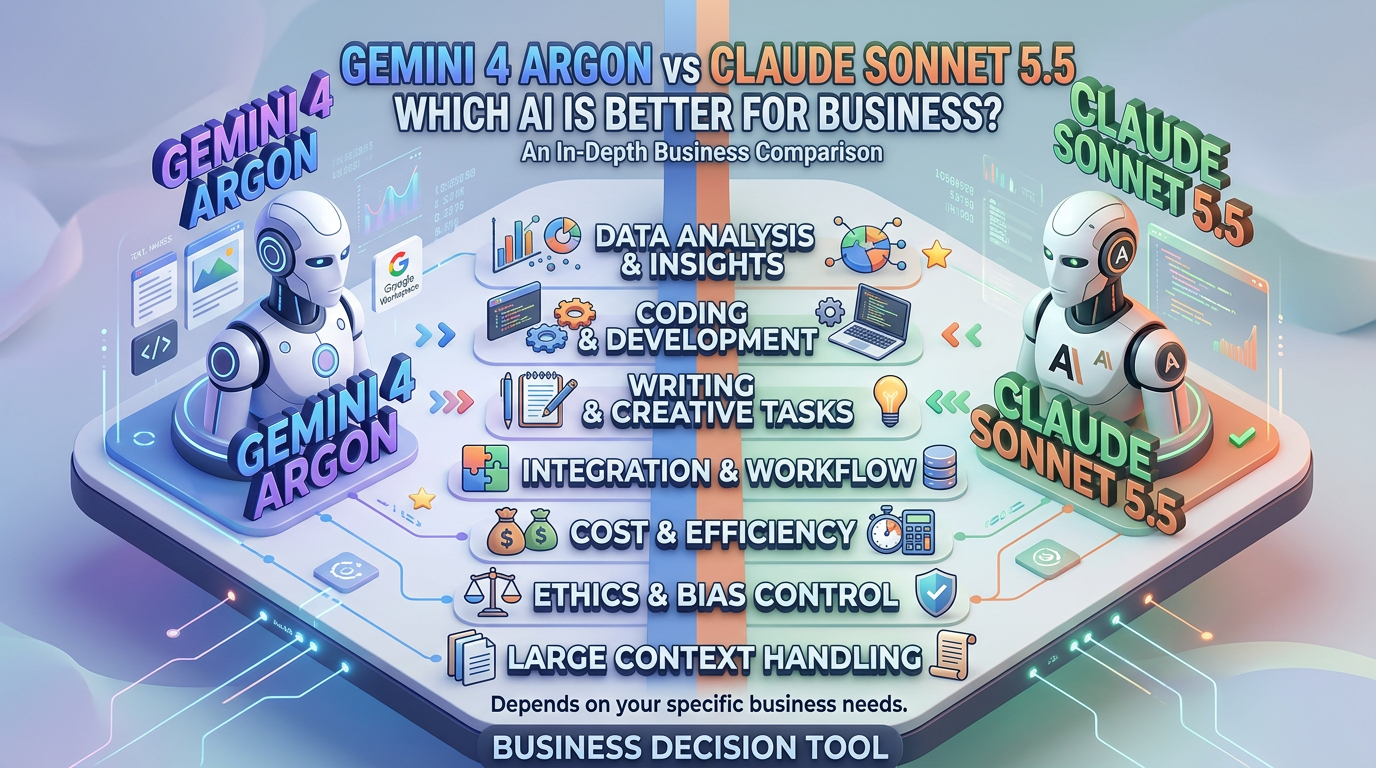
Gemini 4 Argon vs Claude Sonnet 5.5: Which AI Is Better for Business?
Two major AI companies are competing to build tools that help businesses work faster, automate repetitive tasks and make better decisions. But when it comes to choosing between Gemini 4 Argon and Claude Sonnet 5.5, which one actually delivers better results?
For business owners, startup founders, marketers, freelancers and developers, the answer depends on what you need AI to do.
Instead of choosing a model based on hype, this comparison focuses on three practical business tasks: content creation, coding and business analysis. We will also examine speed, cost and overall usefulness to help you determine which AI deserves a place in your workflow.
What Are Gemini 4 Argon and Claude Sonnet 5.5?
Gemini 4 Argon
Google’s Gemini 4 Argon is positioned for complex reasoning, coding and multi-step professional workflows. Businesses evaluating it may be interested in its ability to handle large amounts of information and support demanding tasks.
Potential business applications include:
- Analysing documents and business information.
- Supporting content creation and research.
- Assisting with coding and troubleshooting.
- Automating multi-step workflows.
- Summarising information for decision-making.
Claude Sonnet 5.5
Anthropic’s Claude Sonnet 5.5 is another model to evaluate for professional work, including software development, writing and document-based workflows.
Potential business applications include:
- Drafting reports and marketing content.
- Reviewing and improving code.
- Organising information into structured documents.
- Supporting research and analysis.
- Assisting with repetitive knowledge-work tasks.
Important: Product announcements and model descriptions do not establish which model performs better in practice. The most reliable approach is to test both using identical prompts and evaluate the actual results.
Gemini 4 Argon vs Claude Sonnet 5.5: Three Real Business Tests
Test 1: Content Writing and Marketing
Imagine you need a blog introduction, an SEO-friendly article outline and an Instagram caption for a new product.
Give both models the same instructions, including your target audience, tone, keywords and word limit.
Evaluate each response on:
- Content quality and readability.
- SEO keyword integration.
- Originality and audience relevance.
- Factual accuracy.
- Editing required before publication.
How to choose the winner: Select the model that consistently produces useful, accurate content with less editing. A longer response does not necessarily mean a better result.
Test 2: Coding and Quick Fixes
Suppose your website has a technical issue or your application produces an error. You want AI to identify the problem and suggest a working fix.
Give both models the same code snippet, error message and expected outcome.
Evaluate each response on:
- Accuracy of the diagnosis.
- Whether the proposed solution works.
- Quality of the explanation.
- Potential side effects.
- Time and number of prompts required.
How to choose the winner: Prioritise working code and reliable troubleshooting over confident-sounding explanations. Test every proposed fix before deploying it.
Test 3: Business Analysis and Decision-Making
Imagine you have a spreadsheet containing monthly sales, marketing expenses and customer acquisition costs.
Ask both models to identify trends, calculate key metrics and recommend three actions to improve business performance.
Evaluate each response on:
- Accuracy of calculations.
- Quality of insights.
- Practicality of recommendations.
- Clear distinction between facts and assumptions.
- Usefulness for business decisions.
How to choose the winner: The stronger model is the one that produces verifiable calculations and actionable recommendations rather than generic business advice.
How to Rate Gemini 4 Argon vs Claude Sonnet 5.5 Out of 10
A fair comparison requires a consistent scoring system.
Use the following framework to rate each model after completing your tests.
| Criterion | What to evaluate | Score |
|---|---|---|
| Speed | Time taken to deliver a usable result | 0–10 |
| Cost | Cost of completing the task successfully | 0–10 |
| Content writing | Clarity, relevance and accuracy | 0–10 |
| Coding | Working solutions and reliability | 0–10 |
| Business analysis | Correct calculations and useful insights | 0–10 |
| Overall usefulness | Output quality relative to effort required | 0–10 |
These are evaluation criteria, not verified performance scores for either model. Do not assign a winner without testing both models under comparable conditions.
For a more reliable result, use the same prompts, record response times, verify outputs and measure the amount of human editing required.
Which AI Wins for Each Business Task?
There is no reason to assume that one model will win every category.
For content creation
Compare the quality of the first draft, SEO relevance, tone consistency and editing time. Choose the model that best matches your brand and audience.
For coding and technical work
Evaluate whether the model identifies errors correctly, produces working code and explains its reasoning clearly. Reliability matters more than a polished explanation.
For business analysis
Compare calculations, evidence, assumptions and the usefulness of recommendations. Independently verify important figures before making business decisions.
For speed and productivity
Measure the time required to reach a satisfactory result, including retries and corrections. A fast initial response may not save time if it requires substantial rework.
Gemini 4 Argon vs Claude Sonnet 5.5: Which Is More Cost-Effective?
Price is an important consideration when AI becomes part of your daily operations.
However, the cheapest model per request is not necessarily the cheapest model to use. Your actual cost depends on several factors:
- Subscription fees or API charges.
- Input and output token usage.
- Frequency of use.
- Repeated prompts and failed attempts.
- Integration and automation costs.
- Human review and correction time.
For example, if one model generates a usable report in one attempt while another requires several revisions, the first could offer better value even if its nominal usage cost is higher.
Practical tip: Calculate the cost per successful task rather than comparing advertised prices alone. Check the providers’ current official pricing pages before making a purchasing decision.
Common Mistakes to Avoid When Choosing an AI Tool
- Judging by a single prompt: One test cannot establish overall performance.
- Confusing speed with quality: A quick but inaccurate answer may create additional work.
- Ignoring total cost: Subscriptions, retries and integrations affect the final expense.
- Trusting every answer: AI-generated financial, legal, technical and factual claims require verification.
- Following launch-day hype: Choose based on your business requirements and measurable results.
Frequently Asked Questions
Is Gemini 4 Argon better than Claude Sonnet 5.5?
The answer depends on the task. Compare both models using the same prompts and evaluate accuracy, speed, cost and the amount of editing required.
Which AI is better for business content writing?
Test both with your actual content briefs. Consider readability, brand voice, SEO relevance, factual accuracy and how much revision is necessary.
Which AI is better for coding?
Use real coding problems and test whether the suggested fixes work. A model’s general reputation is not a substitute for task-specific testing.
Which AI is cheaper?
Compare the subscription or API plan you intend to use. Usage limits, token consumption, repeated attempts and integration expenses can change the total cost.
Can small businesses use both AI tools?
Yes. Businesses can use different models for different tasks if doing so improves results enough to justify the additional cost and complexity.
How do I choose the right AI model for my business?
Identify your most frequent tasks, test both models on identical examples, score their results and choose the model that offers the best combination of quality, speed and cost.
Final Verdict: Choose the AI That Delivers Better Business Results
The best AI model for your business is not necessarily the one receiving the most attention. It is the one that consistently helps you complete real tasks accurately, efficiently and cost-effectively.
Compare Gemini 4 Argon and Claude Sonnet 5.5 on content creation, coding and business analysis. Record the results, verify the outputs and calculate the cost of completing each task successfully.
You may find that one model works better for technical tasks while the other fits your content or documentation workflow. Let the evidence determine your choice.
Leave a Reply