
5 Passive Income Ideas That Actually Worked for Me in 2026
For years, the traditional formula for earning money seemed simple: work more hours, earn more money.
But there is a problem with that model. Your income is often directly tied to your time.
In 2026, I decided to test a different approach.
Instead of constantly trading time for money, I experimented with five different passive income models over the course of a year. The goal wasn’t to find a magical “get rich quick” method. It was to discover income streams that could continue generating revenue without requiring me to actively work on them every single day.
The results were mixed.
Three out of the five models eventually became profitable long-term.
Here’s what I learned from the experiment.
What Does Passive Income Really Mean?
Passive income is money generated from an asset, system, product, or business model that requires significantly less ongoing active work after the initial setup.
That doesn’t mean completely effortless income.
Most legitimate passive income ideas require:
- Initial research
- Time and effort to build
- Testing and optimization
- Marketing
- Occasional maintenance
- Financial or business investment
The key difference is leverage.
Instead of being paid only when you work, you create something that can potentially generate revenue repeatedly.
Why I Started Testing Passive Income Ideas
My biggest motivation was simple: I was tired of trading time for money.
An active income model generally has a ceiling.
If you work 8 hours a day, there are only so many additional hours you can work. Passive or semi-passive income can potentially break that connection between hours worked and income generated.
I also wanted to:
- Build diversified income streams
- Reduce dependence on one source of income
- Create assets that could generate recurring revenue
- Experiment with digital business models
- Find opportunities that could scale without proportionally increasing my workload
So I tested five different models rather than putting all my effort into one idea.
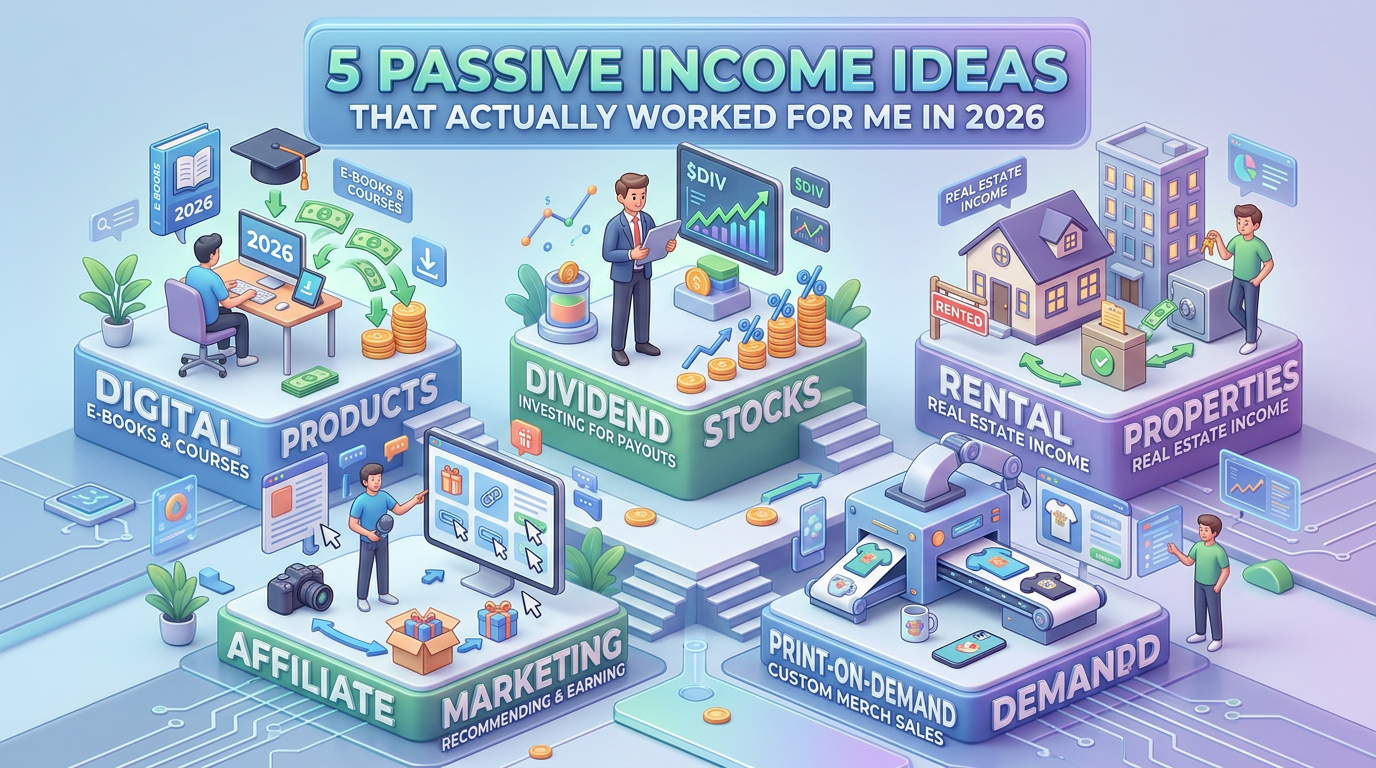
Passive Income Idea #1: Digital Products
One of the first models I tested was selling digital products.
The basic concept is straightforward.
You create a product once and sell copies of it repeatedly.
Examples include:
- E-books
- Templates
- Checklists
- Spreadsheets
- Digital planners
- Business documents
- Online resources
- Educational guides
- Design assets
The major advantage is that there is no physical inventory to manufacture, package, or ship.
What Worked
The biggest lesson was that solving a specific problem worked better than creating a generic product.
For example, instead of creating a broad productivity planner, a more targeted product could be:
“30-Day Social Media Content Planner for Small Businesses.”
The narrower product has a clearer audience and a clearer problem to solve.
The Passive Income Potential
Once the product was created and the sales process was automated, each additional sale required relatively little additional work.
However, marketing remained important.
Verdict: Profitable long-term.
Passive Income Idea #2: Affiliate Marketing
The second experiment was affiliate marketing.
Affiliate marketing involves recommending another company’s product or service and receiving a commission when someone makes a qualifying purchase through your referral.
The model can work through:
- Blogs
- YouTube
- Websites
- Newsletters
- Comparison content
- Tutorials
- Search-focused articles
The important part is that the content should provide genuine value rather than simply pushing affiliate links.
What Worked
Search-focused content performed particularly well when it answered questions people were already asking.
For example:
- “Best AI tools for small businesses”
- “How to automate social media content”
- “Best accounting software for freelancers”
- “How to choose an email marketing platform”
The content attracted people who were already researching a purchase decision.
The Biggest Lesson
Affiliate income is rarely immediate.
It can take months to build:
- Search visibility
- Audience trust
- Content volume
- Referral traffic
- Conversion data
But once older content continues bringing visitors, it can become a relatively low-maintenance source of revenue.
Verdict: Profitable long-term.
Passive Income Idea #3: Content Repurposing
Another experiment involved creating content once and distributing it across multiple platforms.
For example, a single long-form piece of content could be transformed into:
- Instagram Reels
- YouTube Shorts
- Blog posts
- Pinterest content
- LinkedIn posts
- Email newsletters
The idea isn’t completely passive, but it creates content leverage.
Instead of producing five completely different pieces of content, you create one useful piece and repurpose it.
Why It Worked
The biggest advantage was efficiency.
One research session could produce multiple pieces of content.
This reduced the amount of time required to maintain a consistent online presence.
Over time, older content could continue attracting:
- Views
- Website visitors
- Leads
- Affiliate clicks
- Product sales
Verdict: Profitable when connected to another monetization model.
Passive Income Idea #4: Stock Digital Assets
Another model I experimented with was creating digital assets that could be sold repeatedly.
Depending on your skills, these could include:
- Stock photographs
- Video footage
- Graphics
- Presentation templates
- Icons
- Fonts
- Music
- Sound effects
- AI-assisted creative assets where permitted by platform licensing rules
The basic strategy is to build a library rather than depend on a single product.
One asset may generate very little.
But hundreds of useful assets can potentially create a larger cumulative revenue stream.
What Didn’t Work as Expected
This was one of the models where expectations didn’t match reality.
Uploading assets alone wasn’t enough.
Some assets generated sales while others received almost no attention.
The biggest challenge was discoverability.
Creating the asset was only one part of the process. Keywords, titles, descriptions, quality, demand and platform competition also mattered.
Verdict: Not profitable enough for me as a standalone long-term model.
Passive Income Idea #5: Automated Online Services
The final model was slightly different.
Instead of selling a traditional product, I explored services that could be partially automated.
Examples include:
- Automated reporting
- AI-assisted content services
- Digital marketing systems
- Lead-generation systems
- Automated design workflows
- Business templates combined with implementation tools
This isn’t truly passive income because customers still require support.
However, automation can significantly reduce the amount of manual work required per customer.
Why This Model Was Interesting
The strongest advantage was the ability to combine recurring revenue with automation.
Instead of completing every task manually, systems could handle repetitive processes.
That meant the business could potentially serve more customers without increasing workload at the same rate.
Verdict: Profitable long-term.
The 3 Models That Actually Worked
After testing all five approaches, three stood out as the strongest long-term models:
| Model | Result | Main Reason |
|---|---|---|
| Digital Products | Profitable | Create once, sell repeatedly |
| Affiliate Marketing | Profitable | Evergreen content can generate recurring referrals |
| Automated Online Services | Profitable | Automation + recurring revenue |
| Content Repurposing | Supportive | Worked best when connected to monetization |
| Stock Digital Assets | Not profitable enough | High competition and discoverability challenges |
The biggest surprise was that the “passive” models still required work.
The difference was where the work happened.
Instead of constantly working to produce income, much of the effort went into building assets and systems that could continue producing results later.
What I Would Do Differently If I Started Again
If I were starting from zero in 2026, I wouldn’t launch five different passive income projects simultaneously.
I would choose one audience, one problem and one monetization method first.
For example:
Audience: Freelancers
Problem: Managing their finances and productivity
Asset: Digital toolkit
Traffic: SEO + social media
Monetization: Product + relevant affiliate recommendations
This creates a connected ecosystem rather than five unrelated side hustles.
The Biggest Passive Income Mistakes to Avoid
A lot of passive income content online focuses only on potential earnings.
That’s misleading.
Before starting, consider these common mistakes:
Expecting Immediate Income
Most legitimate passive income models take time to build.
If someone promises guaranteed money quickly with almost no effort, treat the claim cautiously.
Starting Too Many Ideas
Five unfinished projects are usually less valuable than one properly developed income stream.
Focus is a major advantage.
Ignoring Distribution
A great product without an audience can struggle.
Marketing, SEO, social media, partnerships and email lists can be just as important as the product itself.
Confusing Passive With Effortless
Passive income doesn’t mean “do nothing and get paid.”
Think of it as front-loaded effort followed by potentially lower ongoing effort.
Chasing Trends Without a Business Model
A trending AI tool, platform or side hustle isn’t automatically a sustainable business.
Always ask:
Who pays? Why do they pay? Can the revenue continue? What happens when the trend disappears?
How to Choose the Right Passive Income Idea
Before investing your time or money, ask yourself five questions:
- What skill or knowledge do I already have?
- What problem can I solve?
- Who is willing to pay for that solution?
- Can the solution be delivered repeatedly with limited additional effort?
- Can I build an audience or distribution channel around it?
If you can answer all five clearly, you have a much stronger starting point.
The Real Secret Behind Passive Income
The biggest lesson from testing these five models wasn’t a particular platform or tool.
It was leverage.
The strongest opportunities allowed one unit of effort to create multiple outcomes.
For example:
One piece of content → multiple platforms → website traffic → affiliate revenue → product sales → email subscribers.
That’s far more powerful than simply working another hour for another payment.
Final Takeaway
After testing five passive income ideas throughout 2026, three became profitable long-term.
But the experiment also proved something important:
Passive income isn’t about making money without working. It’s about building systems and assets that can keep working after the initial effort.
Digital products, affiliate marketing and automated online services were the strongest models from my experiment.
The right choice for you, however, depends on your skills, audience, available capital, risk tolerance and willingness to invest time upfront.
Start with one model. Validate the demand. Build the system. Automate what you can. Then scale what actually works.
That is a much more realistic path to building diversified income than chasing every “passive income” trend you see online.

Leave a Reply