
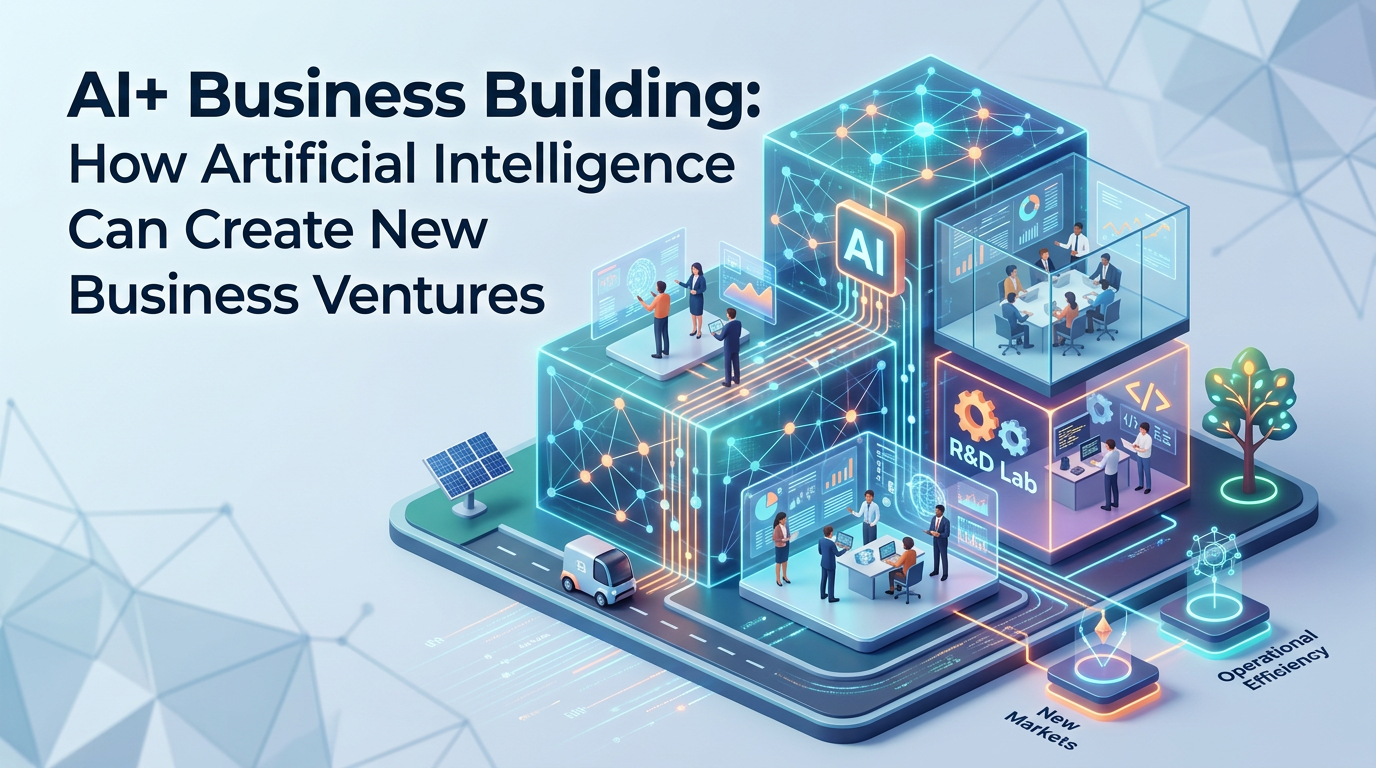
AI+ Business Building: How Artificial Intelligence Can Create New Business Ventures
Artificial intelligence is no longer just a tool for automating tasks or generating content. It is increasingly becoming a business-building technology.
The emerging idea of AI+ business building is simple: instead of using AI only to make an existing company more efficient, businesses can use AI to identify opportunities, build new services, launch new revenue streams, and potentially create entirely new ventures.
This model can work for a large corporation, a startup, or even a small local business.
The key difference is that AI becomes part of the business creation process, rather than simply being another software subscription.
What Is AI+ Business Building?
AI+ business building refers to using artificial intelligence alongside an existing business, industry expertise, customer base, data, and operational infrastructure to create a new business opportunity.
Think of it as:
Existing business + AI capability + New problem to solve = New business opportunity
For example, a company might already have thousands of customers but lack a digital customer-support system.
Instead of simply purchasing an AI chatbot, the company could develop an AI-powered customer-service solution specifically for its industry.
That solution could eventually become a separate revenue-generating business.
From AI Tool to AI-Powered Business
Many companies currently approach AI from a software perspective.
They ask:
- Which AI tool should we subscribe to?
- Can AI reduce our employee workload?
- Can AI automate customer service?
- Can AI create marketing content?
- Can AI analyse our data?
These are useful questions, but AI+ business building takes the thinking one step further.
The Bigger Question
Instead of asking:
“How can we use AI in our business?”
A company can ask:
“What new business can we build because AI now makes it possible?”
That shift can create significantly different opportunities.
An AI system could become:
- A new service
- A subscription product
- A technology platform
- A managed service
- A new business division
- A joint venture
- A spin-off company
- A licensing opportunity
Why Existing Companies Have an Advantage
A new AI startup may have excellent technology but struggle to find customers.
An established company often has the opposite advantage.
It may already have:
- Customers
- Industry knowledge
- Employees
- Distribution channels
- Brand recognition
- Supplier relationships
- Operational processes
- Customer data
- Market credibility
AI can provide an additional layer of technology on top of these existing assets.
The AI Advantage
Imagine a local accounting firm with 1,000 business clients.
The firm could build an AI-powered compliance assistant that helps clients identify upcoming regulatory deadlines, organise documents, and answer basic compliance questions.
The firm already has the customers.
It already understands the problems.
AI provides the technology layer.
Instead of simply paying for an AI tool, the company could potentially turn the solution into a new recurring-revenue service.
AI+ Is Not Only for Large Corporations
One of the most important aspects of this model is that it does not require a billion-dollar company.
A local business can also experiment with AI-powered business creation.
Consider a small restaurant.
The restaurant could use AI to analyse:
- Customer ordering patterns
- Popular menu items
- Delivery data
- Customer reviews
- Seasonal demand
The business could then create an AI-assisted menu optimisation or demand forecasting service.
Initially, this may simply improve the restaurant’s own operations.
But if the system works well, the business could potentially offer the same solution to other restaurants.
The restaurant has now moved from using AI internally to creating a business around AI.
The Local Business Partnership Model
Another interesting approach is combining an AI provider with an established local business.
Instead of the local business purchasing an expensive technology solution outright, the parties could structure a commercial partnership.
For example:
Local business provides:
- Industry expertise
- Existing customers
- Operational infrastructure
- Market access
- Business credibility
AI partner provides:
- AI technology
- Development
- Automation
- Technical expertise
- Product maintenance
The parties can then negotiate a commercial arrangement based on the value each side contributes.
Monthly Fee vs. Business Participation
One possible structure could involve an AI provider charging a monthly service fee.
Another model could involve a smaller recurring fee combined with a negotiated ownership or revenue-sharing arrangement.
For example, instead of paying ₹1,00,000 every month for an AI solution, a business might negotiate:
- A smaller monthly technology fee
- Performance-based compensation
- Revenue sharing
- Equity participation in a newly created venture
The exact structure depends on the parties, the jurisdiction, valuation, risk, tax implications, and legal agreements.
This is not automatically a better arrangement than paying a normal technology fee. It simply creates another model that businesses can consider.
How an AI+ Business Could Be Built
The process does not need to begin with complicated technology.
Step 1: Identify an Expensive Problem
Start with a business problem rather than an AI tool.
Ask:
- What takes employees too much time?
- What do customers repeatedly ask?
- Where are businesses losing money?
- Which process is difficult to scale?
- What service is currently expensive?
- What information is difficult to analyse?
A strong business opportunity usually starts with a meaningful problem.
Step 2: Determine Whether AI Can Solve It
Not every business problem requires AI.
AI may be useful when the problem involves:
- Large amounts of information
- Repetitive decisions
- Customer communication
- Pattern recognition
- Document processing
- Forecasting
- Personalisation
- Content generation
- Data analysis
- Workflow automation
The objective is not to add AI because it is fashionable.
The objective is to use AI where it creates measurable economic value.
Step 3: Build a Small Prototype
Instead of spending months building a complete product, create a minimum viable solution.
For example:
A local real-estate company could test an AI assistant that helps qualify property enquiries.
The first version might only handle:
- Customer enquiry
- Property preference
- Budget
- Location
- Lead qualification
- Sales-team notification
If the system demonstrates value, the company can expand it.
Step 4: Measure the Business Impact
AI projects should be evaluated using business metrics.
Useful measurements include:
- Revenue generated
- Costs reduced
- Employee hours saved
- Customer response time
- Conversion rate
- Customer retention
- Average transaction value
- Recurring revenue
- Customer acquisition cost
An AI system that looks impressive but produces no measurable business benefit is not necessarily a good business.
Creating a New Venture From an Existing Business
Once an AI solution demonstrates demand, the company can consider whether it should remain an internal tool or become a separate business.
Internal Tool
The AI solution is used only by the existing company.
Example:
A logistics company builds AI software to optimise delivery routes.
The technology reduces its own fuel and labour costs.
New Business Unit
The company begins offering the solution to other businesses.
Example:
The logistics company sells route optimisation services to other logistics operators.
Separate Venture
The company creates a separate entity around the technology.
This can allow:
- Dedicated management
- External investment
- Separate financial reporting
- New shareholders
- Independent branding
- Different commercial partnerships
The appropriate structure should be determined with professional legal, tax, accounting, and corporate advice.
Why Ownership Matters
One of the most important questions in AI+ business building is:
Who owns what?
This becomes particularly important when an AI partner and an existing company collaborate.
Before starting the project, the parties should clearly document ownership of:
- Software
- Source code
- AI models
- Prompts
- Training data
- Customer data
- Databases
- Brand
- Domain names
- New intellectual property
- Existing intellectual property
- Improvements developed during the partnership
Existing IP vs. New IP
Suppose an AI company already owns its underlying software.
A local business then works with that company to create a specialised application.
The agreement should clarify whether the new application belongs to:
- The AI company
- The local business
- Both parties
- A newly created venture
This distinction can become extremely important if the project becomes commercially successful.
Revenue Sharing and Equity Are Different
Businesses should also understand the difference between revenue sharing and equity participation.
Revenue Sharing
A partner receives an agreed percentage of revenue generated by the product or service.
For example:
A business generates ₹10 lakh in qualifying revenue, and the agreement provides a 10% revenue share.
The partner receives ₹1 lakh, subject to the contract’s definitions and deductions.
Equity Participation
A partner receives an ownership interest in a company.
If the new company grows significantly, the equity could potentially become valuable.
However, equity also comes with uncertainty.
There may be:
- No dividends
- Dilution
- Governance considerations
- Investor rights
- Transfer restrictions
- Valuation disputes
- Exit uncertainty
Therefore, a business should not exchange equity for technology services without understanding the commercial and legal implications.
A Simple Example
Consider a local healthcare business with several branches.
The company receives hundreds of repetitive customer enquiries every day.
An AI partner proposes an automated patient enquiry and appointment system.
The system can:
- Answer frequently asked questions
- Collect basic appointment information
- Route enquiries
- Send reminders
- Escalate complex questions to staff
The initial objective is operational efficiency.
After six months, the system proves successful.
The company discovers that other healthcare businesses have the same problem.
Now there is a potential new business opportunity.
The parties could create a dedicated healthcare AI service and sell it to other clinics.
The original business contributes:
- Industry knowledge
- Testing environment
- Customer insights
- Market credibility
The technology partner contributes:
- AI development
- Infrastructure
- Product development
- Technical support
The result could be a new commercial venture.
The Role of AI Agents
The rise of AI agents makes this model even more interesting.
Traditional software usually waits for a user to perform an action.
AI agents can potentially:
- Interpret information
- Make decisions within defined boundaries
- Execute workflows
- Communicate with customers
- Retrieve information
- Trigger business processes
- Coordinate multiple tools
This can allow businesses to build services that previously required significant human intervention.
However, businesses should establish appropriate human oversight, security controls, access permissions, and escalation mechanisms—particularly where AI can affect customers, finances, compliance, or regulated decisions.
Risks Businesses Should Consider
AI+ business building can create opportunities, but it also introduces significant risks.
Technology Risk
The AI solution may not perform consistently enough for real-world operations.
Data Risk
Sensitive business or customer information may be exposed if data governance is weak.
Intellectual Property Risk
Unclear ownership can create disputes when the project becomes valuable.
Commercial Risk
A technically successful product may still have insufficient market demand.
Partnership Risk
If responsibilities are not clearly defined, disagreements can arise over development costs, revenue, ownership, or decision-making.
Regulatory Risk
AI applications operating in regulated industries may create additional compliance obligations.
A Practical AI+ Business Building Framework
Businesses can use a simple framework before committing significant capital.
Problem
What expensive or recurring problem are we solving?
AI
Why is AI the right technology for solving it?
Customers
Who will pay for the solution?
Economics
How much does it cost to build and operate?
Revenue
Will the business earn through subscriptions, transactions, licensing, services, revenue sharing, or another model?
Ownership
Who owns the technology, data, IP, brand, and resulting venture?
Scale
Can the solution be sold beyond the original business?
Risk
What legal, regulatory, cybersecurity, operational, and financial risks exist?
Why This Model Could Become More Important
The cost of experimenting with technology is falling.
At the same time, AI capabilities are becoming accessible to businesses that previously could not afford large technology teams.
This creates an interesting combination.
A small business with strong industry knowledge can potentially collaborate with a technology provider and experiment with products that would previously have required a large development team.
The competitive advantage may therefore shift from simply having AI to knowing where to apply AI to create economic value.
AI Is Becoming a Business-Creation Layer
The biggest opportunity may not be another AI chatbot or automation tool.
It may be the ability to combine:
Industry expertise + existing customers + proprietary knowledge + AI + distribution
That combination can create businesses that are difficult for generic technology companies to replicate.
A local company understands its customers.
An AI partner understands the technology.
Together, they may be able to build something neither could create as efficiently alone.
Conclusion
AI+ business building represents a shift from using AI as a tool to using AI as a foundation for creating new businesses.
The model can work at multiple levels—from a local business introducing a small AI-powered service to an established company creating an entirely new venture.
The most important lesson is that businesses should not begin with the question:
“Which AI tool should we buy?”
Instead, they should ask:
“Which valuable problem can we solve with AI, and can that solution become a scalable business?”
For companies with existing customers, industry expertise, and distribution, AI could become more than an efficiency tool. It could become a business-building engine.
The opportunity is significant, but successful AI ventures still require proper market validation, financial modelling, intellectual-property ownership, data governance, contracts, and professional legal and tax advice before moving from an experiment to a formal commercial arrangement.

Leave a Reply