
AI SEO in 2026: How Ads, Blog Posts, Important Pages, Sitemaps, llms.txt and Markdown Mirrors Work Together
Getting a website onto Google Page One is no longer simply about publishing a few blog posts and waiting for rankings.
In 2026, businesses are dealing with several different discovery systems at the same time:
- Traditional Google Search
- Google AI Overviews and other AI-powered search experiences
- ChatGPT and other answer engines
- Paid Google Ads
- Social and referral traffic
- Website visitors who need clear service and offer pages
This creates an important distinction:
SEO, paid advertising and AI visibility are related, but they are not the same thing.
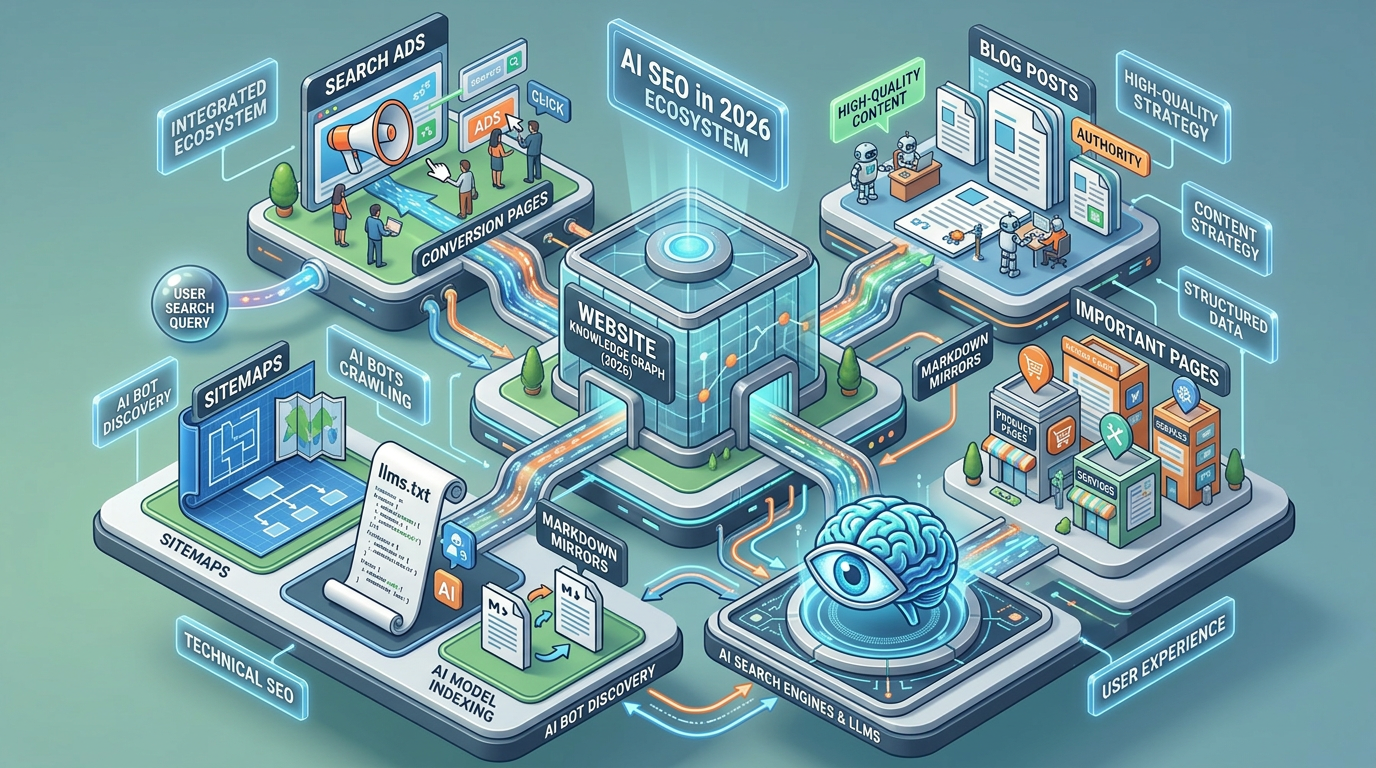
An XML sitemap helps search engines discover URLs. Well-written pages and internal links help search engines understand a website. Blog content can build topical authority and answer informational queries. Meanwhile, technologies such as llms.txt and Markdown mirrors are being explored as ways to make website information easier for AI systems and agents to consume.
However, businesses should not treat every new AI file as a guaranteed Google ranking factor. Current discussions around llms.txt and Markdown mirrors specifically distinguish AI discoverability from traditional Google rankings.
Here is how the entire system fits together.
Google Page One Is a System, Not a Single SEO Trick
There is no single file, plugin or shortcut that guarantees a Page One ranking.
Google needs to be able to:
- Discover your pages.
- Crawl them.
- Understand their content.
- Determine whether they are relevant to a search.
- Evaluate their usefulness and quality.
- Decide how they should appear in search results.
That means a website needs a strong underlying structure.
The basic SEO foundation
A business website should normally have:
- A crawlable website
- Clear page URLs
- Useful page titles
- Relevant meta descriptions
- Proper heading hierarchy
- Helpful original content
- Internal links
- Descriptive image information where appropriate
- Structured data where relevant
- An XML sitemap
- Appropriate robots directives
- Fast, usable pages
- Mobile-friendly design
- Clear business information
An XML sitemap is particularly useful for helping search engines discover important URLs, but having a sitemap does not automatically make a page rank on Page One.
Google Ads and SEO Serve Different Purposes
One common mistake is treating Google Ads as an alternative to SEO.
They solve different problems.
Google Ads = paid visibility
SEO = organic visibility
For example, imagine a CA firm wants to generate leads for:
“NRI property tax consultant Bangalore”
The business could create a Google Ads campaign targeting that search.
At the same time, it could build an organic landing page explaining:
- NRI property taxation
- TDS on property transactions
- Section 197
- 15CA/15CB or applicable current forms
- DTAA considerations
- Common compliance mistakes
- Frequently asked questions
The advertisement can generate immediate paid traffic while the organic content works toward long-term search visibility.
The two channels can therefore support the same business objective without being the same ranking mechanism.
Why Important Website Pages Matter
Businesses sometimes concentrate heavily on blog posts and neglect their core website pages.
That is a mistake.
Your service pages are often the pages closest to commercial intent.
For example, an accounting firm could have:
Important service pages
- Income Tax Services
- GST Services
- Tax Audit Services
- NRI Tax Services
- ROC Compliance
- Startup Registration
- Company Incorporation
- LLP Registration
- Bookkeeping and Accounting
- Virtual CFO Services
These pages explain what the business actually provides.
A blog might answer:
“What is GST Input Tax Credit?”
A service page might answer:
“How can our firm help your business with GST compliance?”
Both are useful, but they serve different search intents.
Blog Posts Build Topical Coverage
Blogging is still an important part of a search strategy when the content genuinely answers questions people search for.
Instead of publishing random articles, build topic clusters.
For example:
Main topic: NRI Taxation
Supporting articles could include:
- NRI Property Sale Tax in India
- TDS on Sale of Property by NRIs
- Section 197 Certificate for Lower TDS
- DTAA Benefits for NRIs
- Form 15CA and 15CB Explained
- Capital Gains Tax on Property
- NRI Tax Filing Guide
- Tax Deducted on Property Purchase from NRI
- Common NRI Property Tax Mistakes
Each article can link naturally to the main NRI tax service page.
This creates a stronger topical structure than publishing unrelated articles.
How Many Blog Posts Do You Need?
There is no universal number such as “20 posts guarantees Page One.”
The better question is:
How completely does your website cover the search intent around its important topics?
For one commercial topic, you might need:
- One main service page
- Several supporting informational articles
- FAQ content
- Case-study or example content where appropriate
- Strong internal linking
- Relevant external references
- Regular updates when laws or regulations change
Twenty excellent, highly relevant articles can be more useful than hundreds of thin articles.
The Role of AI in Content Strategy
AI can dramatically increase the speed of research, content planning and content production.
But publishing AI-generated text at scale is not itself an SEO strategy.
A better workflow is:
Research → outline → expert input → AI-assisted drafting → fact checking → editing → internal linking → publishing → monitoring
This is especially important for subjects such as:
- Tax
- Finance
- Law
- Healthcare
- Immigration
- Compliance
These topics require accurate and current information.
For example, if tax legislation changes, an old AI-generated article can become misleading unless somebody verifies and updates it.
AI Search Is Creating Another Visibility Layer
Traditional SEO asks:
“Can my webpage appear in Google Search?”
AI visibility asks a slightly different question:
“Can an AI system understand my business and use my information when answering a user’s question?”
This is where concepts such as AI Search, Answer Engine Optimization (AEO), Generative Engine Optimization (GEO), structured content and machine-readable website information are becoming increasingly discussed.
However, it is important not to confuse these concepts with guaranteed Google ranking factors.
What Is llms.txt?
llms.txt is a proposed convention intended to give AI systems a structured overview of a website.
It can provide a curated list of important resources and pages.
For example, a website might conceptually organize its important content into:
- About
- Services
- Pricing
- Documentation
- Important guides
- Contact information
But llms.txt should not be presented as a guaranteed Google ranking signal.
Current discussions distinguish it from an XML sitemap: an XML sitemap is designed for search-engine URL discovery, whereas llms.txt is intended as a machine-readable guide for AI systems.
What Are Markdown Mirrors?
A Markdown mirror is essentially a cleaner text representation of an existing webpage.
Instead of presenting:
- Navigation
- Menus
- JavaScript
- Tracking code
- Visual layout
- Pop-ups
- Footer elements
the Markdown version focuses on the actual content.
For example:
HTML page
example.com/gst-input-tax-credit/
Possible Markdown representation
example.com/gst-input-tax-credit.md
The HTML page should generally remain the canonical webpage.
Markdown mirrors can potentially provide a cleaner machine-readable representation, particularly for documentation-heavy or JavaScript-heavy websites. But there is currently no basis for treating Markdown itself as a guaranteed Google ranking boost.
XML Sitemap vs llms.txt vs Markdown
These technologies should not be treated as interchangeable.
| Technology | Primary purpose |
|---|---|
| XML Sitemap | Help search engines discover URLs |
| robots.txt | Give crawler access/disallow instructions |
| HTML | Primary human-facing webpage |
| Structured Data | Communicate machine-readable entities and page information |
| llms.txt | Curated machine-readable website guidance |
| Markdown mirror | Cleaner text representation of existing content |
The important point is that each serves a different function.
Why Your Most Important Pages Should Come First
Before creating dozens of technical AI files, make sure your actual website is strong.
Start with the pages that matter commercially.
For a service business, this could be:
Core website architecture
Home
→ Services
→ Income Tax
→ GST
→ NRI Tax
→ Tax Audit
→ ROC Compliance
→ Startup Services
→ Industries
→ IT
→ SaaS
→ Healthcare
→ Real Estate
→ Fintech
→ Resources
→ Blog
→ Guides
→ FAQs
→ About
→ Contact
This structure gives users and search engines a logical way to understand the business.
Internal Linking Connects Everything
Internal links are one of the simplest ways to connect your website’s content.
Suppose you publish:
“TDS on Sale of Property by NRIs”
Within the article, you could naturally link to:
- NRI Tax Services
- Capital Gains Tax Guide
- Section 197 explanation
- DTAA guide
- Contact/service page
Then another article about DTAA for NRIs can link back to the NRI tax service page.
Over time, your content becomes a connected information network rather than a collection of isolated articles.
Create Content Around Search Intent
Not every search requires the same type of page.
Informational intent
Examples:
- What is GST ITC?
- What is Section 197?
- What is a tax audit?
Best format:
Detailed guide/blog
Commercial investigation
Examples:
- Best GST consultant for startups
- NRI tax consultant
- Tax audit services for companies
Best format:
Service page + supporting educational content
Transactional intent
Examples:
- Hire GST consultant
- Book tax consultation
- File income tax return
Best format:
Conversion-focused service/contact page
Navigational intent
Examples:
- Certicom Group Chartered Accountants
- Certicom GST services
Best format:
Strong branded website presence
Build an AI-Readable Website Without Destroying the Human Experience
One important principle should remain:
Do not build a website exclusively for machines.
Humans still need to use your website.
Your main HTML pages should remain:
- Easy to read
- Well structured
- Fast
- Mobile friendly
- Accessible
- Easy to navigate
- Conversion focused
Machine-readable formats can supplement the website rather than replace it.
Recent technical discussions around Markdown mirrors similarly emphasize keeping HTML as the canonical representation while using Markdown as an alternate machine-readable representation where appropriate.
A Practical 2026 SEO + AI Visibility Framework
A strong implementation can be divided into six layers.
Layer 1: Technical SEO
Check:
- Indexability
- Canonicals
- Robots.txt
- XML sitemap
- Broken links
- Redirects
- Core page performance
- Mobile usability
- HTTPS
- JavaScript rendering
Layer 2: Important Commercial Pages
Build strong pages for:
- Main services
- Locations
- Industries
- Products
- Solutions
- Contact/conversion journeys
Layer 3: Topical Content
Create:
- Guides
- FAQs
- Blog posts
- Case studies
- Explainers
- Comparison content
- Regulatory updates
Layer 4: Entity and Structured Information
Use appropriate:
- Organization information
- Local business information where applicable
- Author information
- Article structured data
- Service information
- Breadcrumbs
Structured data should accurately represent the visible page rather than being used to insert unsupported claims.
Layer 5: AI Discoverability
Consider:
- Clear semantic HTML
- Well-structured content
- Descriptive headings
- Concise answers
- Strong entity information
llms.txtwhere appropriate- Markdown representations where technically useful
- Accessible important content
- Clear internal linking
These should be treated as AI discoverability measures, not guaranteed Google ranking hacks.
Layer 6: Measurement
Monitor:
- Google Search Console
- Organic clicks
- Impressions
- Query positions
- Indexed pages
- Conversion rate
- Organic leads
- Brand searches
- Referral traffic
- AI referral/citation visibility where measurable
What About an “AI SEO Offer”?
Agencies are increasingly packaging services around terms such as:
- AI SEO
- GEO
- AEO
- AI visibility
- LLM optimization
- AI search optimization
The underlying work can be legitimate, but businesses should examine what is actually being delivered.
A useful offer should specify concrete deliverables such as:
- Technical SEO audit
- Important-page optimization
- Content strategy
- Topic mapping
- Internal-link architecture
- Structured data implementation
- Sitemap configuration
- AI-readability improvements
- Content updates
- Search Console monitoring
- Reporting
Be cautious with offers that promise:
“Guaranteed Google Page One through llms.txt.”
That claim mixes different technologies and search systems.
A Better Website Growth Formula
For many businesses, the practical framework looks like this:
Paid Ads
→ Immediate targeted traffic
Important Service Pages
→ Commercial search intent
Blog Content
→ Informational search demand
Internal Linking
→ Connects the topic ecosystem
XML Sitemap
→ Helps discovery of important URLs
Technical SEO
→ Makes the site crawlable and understandable
Structured Data
→ Adds machine-readable context where applicable
AI-Friendly Content
→ Makes information easier for retrieval and summarization systems to process
Measurement
→ Shows what is actually producing traffic and leads
Common Mistakes to Avoid
Mistake 1: Believing one file will produce Page One rankings
A sitemap, llms.txt, or Markdown file cannot substitute for strong content and technical SEO.
Mistake 2: Publishing hundreds of generic AI articles
More pages do not automatically mean more organic traffic.
Focus on useful, original and relevant content.
Mistake 3: Ignoring service pages
A business should not depend entirely on blog traffic.
The pages that explain what you sell need to be strong.
Mistake 4: Creating duplicate Markdown pages without a plan
If Markdown mirrors are used, maintain the relationship between the canonical HTML page and its alternate representation carefully. Some implementations explicitly use canonical signals and keep mirrors out of XML sitemaps to avoid treating them as separate search pages.
Mistake 5: Confusing AI visibility with Google rankings
This is one of the biggest conceptual mistakes.
A technique can potentially help an AI system consume your content without being a Google ranking factor.
The Recommended Priority Order
If a business is starting from scratch, the practical order is:
1. Important pages
Build the core service/product/location pages.
2. Technical SEO
Make sure search engines can crawl and understand the site.
3. XML sitemap
Create and maintain an accurate sitemap.
4. Internal linking
Connect important pages and supporting content.
5. High-quality blog content
Build topical authority around commercially relevant subjects.
6. Structured data
Implement appropriate schema accurately.
7. AI readability
Improve semantic structure and machine readability.
8. llms.txt / Markdown mirrors
Consider these as additional AI-oriented infrastructure where there is a clear technical reason to use them.
9. Paid advertising
Use Google Ads when immediate paid visibility and lead generation justify the spend.
10. Continuous measurement
Use actual performance data to decide what deserves more investment.
Final Takeaway
The future of website visibility is not simply SEO vs Ads vs AI.
A strong digital strategy connects all three.
Google Ads can provide paid visibility.
SEO can build organic search visibility.
Important service pages capture commercial intent.
Blog posts answer informational searches and expand topical coverage.
XML sitemaps help search engines discover URLs.
Structured content makes information easier to understand.
llms.txt and Markdown mirrors can be considered as additional machine-readable infrastructure for AI-oriented workflows, but they should not be marketed as guaranteed Google ranking shortcuts.
The strongest approach is therefore not to chase a single “Google Page One hack.”
Instead, build a website where humans can understand it, search engines can crawl it, and AI systems can accurately interpret its information.
That foundation is much more durable than relying on any one SEO trend or technical file.

Leave a Reply