
Search Intent Matching: Why Your #1 Ranking Page Isn’t Generating Leads
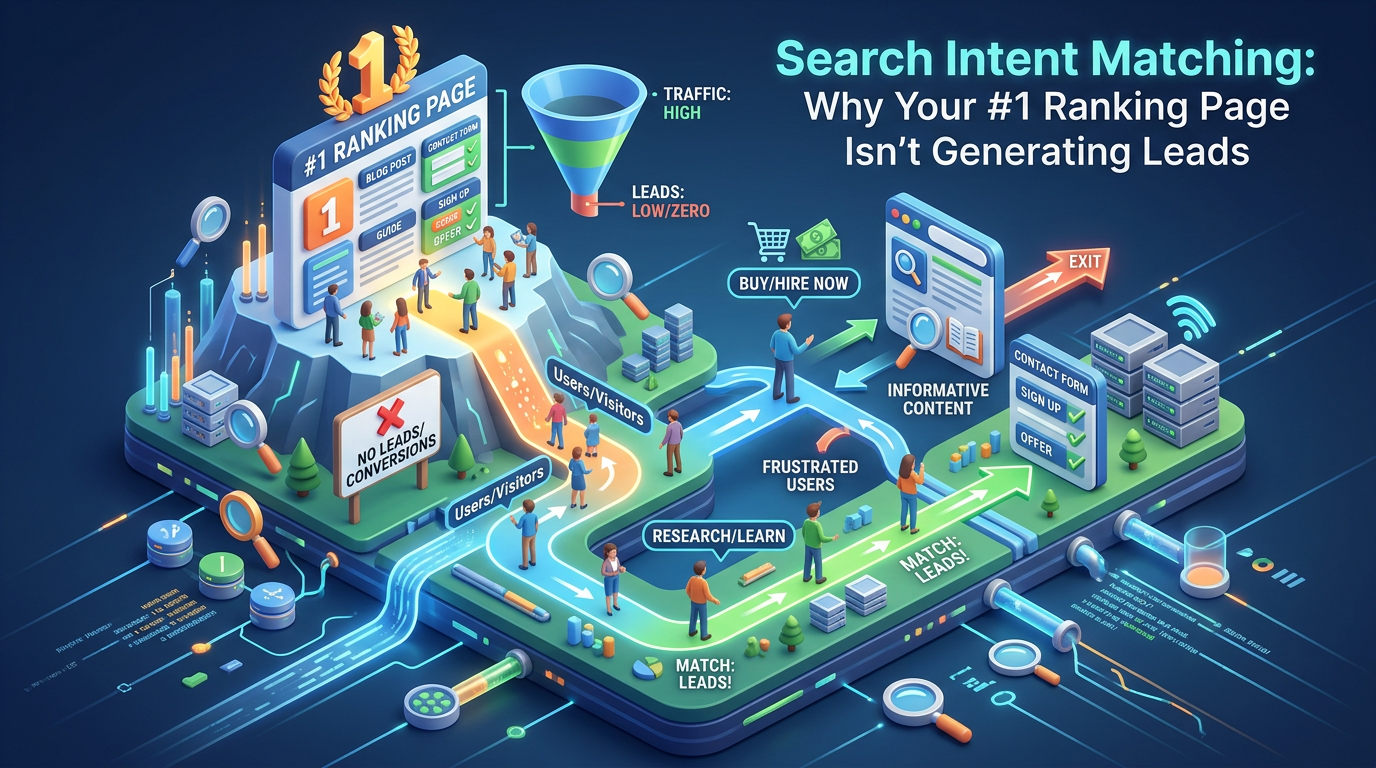
Ranking #1 on Google does not guarantee business growth. Your website might attract thousands of visitors every month, rank for competitive keywords and receive consistent organic traffic, yet generate very few enquiries or sales.
This is one of the most common problems businesses face with SEO. They focus on keyword rankings and website traffic but overlook a more important question: Are the people visiting their website actually looking to buy?
The difference often comes down to search intent matching.
Search intent matching means creating content that satisfies the actual reason behind a user’s search. When your content matches what visitors expect to find, it becomes easier to attract qualified traffic, build trust and convert visitors into leads.
Let’s understand why high Google rankings sometimes fail to generate business and how to fix the problem.
What Is Search Intent and Why Does It Matter for SEO?
Search intent refers to the purpose behind a search query. It explains what a person expects to accomplish when they type something into Google.
For example, someone searching for “what is SEO” is probably looking for information. Someone searching for “best SEO agency for SaaS companies” is likely comparing service providers.
Although both searches relate to SEO, their commercial value is very different.
Google aims to deliver results that satisfy the user’s search intent. If your page provides information when the user expects a service recommendation, it may attract clicks without generating enquiries.
Understanding search intent helps businesses:
- Attract visitors who are genuinely interested in their services.
- Create content that matches customer expectations.
- Improve engagement and user experience.
- Target keywords with stronger commercial potential.
- Turn organic traffic into qualified leads.
The Four Main Types of Search Intent
Understanding the four major search intent categories is essential for building a conversion-focused SEO strategy.
1. Informational Intent
Users want to learn something or find answers to specific questions.
Examples:
- What is digital marketing?
- How does GST registration work?
- How to improve website SEO?
- What is an Innovator Founder Visa?
Best content formats:
- Educational blog posts
- How-to guides
- Tutorials
- Frequently asked questions
- Explainer articles
These searches are useful for building awareness and attracting potential customers early in their buying journey.
2. Navigational Intent
Users are searching for a particular website, brand or online destination.
Examples:
- Certicom CA website
- GotMeNow login
- Google Search Console
- HubSpot pricing page
Best content formats:
- Brand landing pages
- Login pages
- Contact pages
- Dedicated service pages
For businesses, maintaining accurate brand information and easily accessible website pages helps users reach the right destination.
3. Commercial Investigation Intent
Users are researching different products or services before making a purchase decision.
Examples:
- Best SEO agency for startups
- SEO vs Google Ads
- Top accounting firms in Bangalore
- Best AI SEO tools for businesses
Best content formats:
- Comparison articles
- Product reviews
- Service comparisons
- Case studies
- Buyer guides
This is a valuable category because visitors are already considering a purchase, even if they are not ready to make a decision immediately.
4. Transactional Intent
Users are ready to take action, purchase a product or hire a service.
Examples:
- Hire an SEO consultant
- Book GST registration services
- Buy accounting software
- Schedule an SEO audit
Best content formats:
- Service landing pages
- Pricing pages
- Booking pages
- Consultation pages
- Product pages
These pages should make the next step clear with strong calls to action, transparent information and trust signals.
Why Your #1 Ranking Page Isn’t Generating Leads
A high ranking is only one part of an effective SEO strategy. Several issues can prevent visitors from becoming customers.
1. You Are Targeting the Wrong Keywords
High-volume keywords look attractive because they promise significant traffic. However, search volume does not necessarily indicate buying intent.
Imagine an SEO agency ranking first for the keyword “SEO”.
The keyword might attract:
- Students learning about SEO.
- Marketing professionals researching SEO.
- Business owners looking for SEO services.
- People searching for SEO tools and courses.
Only a small percentage of these visitors may be potential customers.
Instead of targeting only broad keywords, businesses should identify more specific commercial queries.
For example:
| Broad keyword | High-intent keyword |
|---|---|
| SEO | SEO agency for startups |
| Accounting | Chartered accountant for startups |
| Website design | Website development company for SaaS |
| Visa | UK Innovator Founder Visa consultancy |
The objective is not simply to attract more visitors. It is to attract visitors who are more likely to become customers.
2. Your Content Doesn’t Match What Visitors Expect
Imagine someone searching for “best GST consultant in Bangalore”.
They are probably looking for a service provider, not a 2,000-word explanation of what GST means.
If your page only provides general educational information, visitors may leave without contacting you.
Before creating or optimising a page, analyse the current Google search results.
Check:
- What type of pages are ranking?
- Are they service pages, blog posts or comparison articles?
- What questions are they answering?
- What information appears above the fold?
- What actions are they encouraging visitors to take?
Your content should satisfy the dominant search intent rather than simply include the target keyword multiple times.
3. You Are Sending High-Intent Traffic to Informational Blog Posts
A common SEO mistake is directing all organic traffic to blog articles.
Blog posts are excellent for attracting visitors, but they are not always designed to generate enquiries.
Consider someone searching for “SEO audit services for small businesses”.
A dedicated SEO audit landing page would generally be more appropriate than an educational article explaining how SEO audits work.
Create dedicated landing pages for important commercial keywords.
A strong service landing page should include:
- A clear service description.
- The problems your service solves.
- Your process and deliverables.
- Relevant experience and expertise.
- Client testimonials or case studies.
- Pricing information or consultation details, where appropriate.
- A visible contact or booking option.
4. Your Call-to-Action Is Weak or Missing
Visitors may find your content useful but still have no idea what to do next.
A generic “Contact Us” button may not provide enough motivation.
Instead, use action-oriented calls to action that communicate a clear benefit.
Examples:
- Book Your Free Strategy Session.
- Get a Free Website SEO Audit.
- Speak With a Tax Consultant.
- Request a Custom SEO Proposal.
- Schedule a Consultation.
Place relevant CTAs naturally throughout the page, especially after explaining the service, demonstrating expertise and addressing customer concerns.
The goal is to make taking the next step easy.
5. Your Content Builds Traffic but Not Trust
People rarely purchase professional services simply because a website ranks well.
They want evidence that the business understands their problems and can deliver results.
This is particularly important for industries such as finance, accounting, legal services, healthcare and business consulting.
Strengthen your website’s credibility through:
- Detailed author profiles.
- Professional qualifications and certifications.
- Real client testimonials.
- Relevant case studies.
- Demonstrable industry experience.
- Clear business contact information.
- Accurate and regularly updated content.
Google’s E-E-A-T framework (Experience, Expertise, Authoritativeness and Trustworthiness) provides a useful way to evaluate the credibility and quality of your content.
Remember, trust is not built through claims alone. It requires supporting evidence.
6. Your Website Experience Creates Conversion Barriers
Even visitors with strong purchase intent may leave if your website makes it difficult to take action.
Common conversion barriers include:
- Slow-loading pages.
- Poor mobile experience.
- Complicated enquiry forms.
- Unclear service descriptions.
- Too many pop-ups.
- Hidden contact details.
- Broken buttons or links.
- Lack of pricing or process information.
Review your website from the perspective of a first-time visitor.
Can someone understand your offering within a few seconds? Can they find your contact details easily? Is the enquiry process straightforward?
A technically optimised website should support both search visibility and user experience.
How to Identify Search Intent Mismatches on Your Website
You do not need to start your SEO strategy from scratch. Your existing Google rankings and traffic data can reveal where improvements are necessary.
Step 1: Analyse Google Search Console
Open Google Search Console and navigate to the Performance report.
Review the following metrics:
- Total clicks
- Total impressions
- Average CTR
- Average position
- Search queries
- Landing pages
Identify pages receiving significant impressions and clicks but generating little business interest.
Look beyond average position. A page ranking first for an informational query may be less commercially valuable than a page ranking fifth for a high-intent service keyword.
Step 2: Classify Your Existing Keywords by Intent
Export your top-performing search queries and categorise them into informational, navigational, commercial and transactional intent.
For example:
| Search query | Intent | Recommended page |
|---|---|---|
| What is SEO? | Informational | Educational blog |
| Best SEO agency in Bangalore | Commercial | Comparison or service page |
| SEO agency pricing | Commercial | Pricing page |
| Hire SEO consultant | Transactional | Service landing page |
This exercise helps identify whether your website has the right content for each stage of the customer journey.
Step 3: Compare Rankings with Lead Data
Google Analytics 4 and CRM data can help you understand what happens after visitors arrive.
Track:
- Organic landing page sessions.
- Contact form submissions.
- Phone call clicks.
- Consultation bookings.
- WhatsApp enquiries.
- Qualified leads.
- Actual conversions.
Connect website analytics with your CRM wherever possible to understand which landing pages generate genuine business opportunities.
Step 4: Review the Search Results Manually
Search your target keywords in Google and examine the pages currently ranking.
Compare their content structure, page format, messaging and calls to action with your own page.
If Google consistently displays service pages but your website offers only an informational blog, you may have an intent mismatch.
Step 5: Optimise or Create the Right Page
Once you identify the mismatch, decide whether to improve the existing page or create a dedicated landing page.
For example:
- Update informational articles to answer user questions more effectively.
- Add relevant internal links to service pages.
- Create comparison content for commercial investigation queries.
- Build dedicated landing pages for transactional keywords.
- Add relevant CTAs based on the visitor’s stage in the buying journey.
Avoid creating multiple pages targeting the same intent without a clear content strategy. This can create keyword cannibalisation and confuse your website’s content structure.
How to Build a Search Intent-Based Content Strategy
A successful SEO strategy should connect different types of content instead of treating every blog post as an independent traffic opportunity.
Consider the following approach.
1. Build Content Around the Customer Journey
Map your content to the different stages of the buying process.
| Customer stage | Search intent | Content strategy |
|---|---|---|
| Awareness | Informational | Guides, tutorials and educational blogs |
| Consideration | Commercial | Comparisons, reviews and case studies |
| Decision | Transactional | Service pages, pricing and consultation pages |
| Retention | Informational / Navigational | Support articles, FAQs and resources |
This creates a structured content ecosystem that supports potential customers from their first search to their final purchase decision.
2. Create Topic Clusters
Instead of publishing unrelated blog posts, organise content around core service topics.
For example, an SEO agency could create a central service page targeting “SEO Services for Businesses”.
Supporting blog topics could include:
- How SEO Works for Small Businesses.
- SEO vs Google Ads: Which Is Better?
- How Much Does SEO Cost?
- Technical SEO Checklist.
- How to Measure SEO Performance.
- Common SEO Mistakes Businesses Make.
Each supporting article should link naturally to relevant service pages and related resources.
This internal linking structure helps visitors discover more useful information while establishing clear topical relationships across your website.
3. Match Your CTA to Search Intent
Not every visitor is ready to purchase immediately.
A person reading an introductory guide may respond better to a free checklist or detailed resource than an immediate sales consultation.
Similarly, someone searching for a service provider may prefer a direct booking or enquiry option.
Examples:
- Informational: Download a Free SEO Checklist.
- Commercial: Compare Our SEO Packages.
- Transactional: Book a Free Consultation.
Matching your CTA to the visitor’s intent creates a more natural conversion journey.
4. Use Conversion Data to Improve Content
SEO optimisation should not stop after publishing a page.
Regularly analyse which pages generate:
- The highest number of qualified leads.
- The strongest organic conversion rates.
- The most consultation bookings.
- The lowest cost per organic lead.
- The highest customer acquisition value.
Use these insights to prioritise content updates and improve underperforming landing pages.
SEO Metrics You Should Track Beyond Keyword Rankings
If your business measures SEO success only through keyword positions and organic traffic, you may be overlooking the metrics that actually matter.
Consider tracking the following:
| SEO Metric | What It Measures |
|---|---|
| Organic traffic | Visitors arriving through search engines |
| Organic CTR | Percentage of impressions generating clicks |
| Engagement rate | Meaningful visitor engagement |
| Conversion rate | Percentage of visitors completing a desired action |
| Qualified leads | Enquiries that match your target customer profile |
| Organic lead rate | Percentage of organic visitors becoming leads |
| Lead-to-customer rate | Percentage of leads converting into customers |
The Role of AI in Search Intent Matching
AI-powered SEO tools are making it easier to understand search behaviour, classify keywords and identify content gaps.
Businesses can use AI to:
- Group thousands of keywords by search intent.
- Identify informational and transactional opportunities.
- Analyse competing pages and content formats.
- Discover missing topics within existing content clusters.
- Generate relevant FAQ ideas.
- Identify internal linking opportunities.
- Review landing page messaging against target search queries.
AI can accelerate research and analysis, but human expertise remains important.
A tool may identify that a keyword has commercial intent, but understanding customer objections, industry requirements and the actual reasons people choose a service provider requires deeper business knowledge.
The best approach combines AI-powered analysis with genuine customer insights and conversion data.
Practical Example: Turning SEO Traffic into Qualified Leads
Imagine a chartered accountancy firm ranking well for the keyword “GST registration”.
Its blog receives 3,000 organic visitors every month, but only five enquiries.
What could be wrong?
The article might explain GST registration requirements in detail but fail to communicate that the firm offers professional GST registration services.
A better strategy would include:
1. Keep the informational blog: Continue answering questions about GST registration, eligibility, documents and procedures.
2. Create a dedicated service page: Target commercial searches such as “GST registration consultant in Bangalore”.
3. Add relevant internal links: Direct readers from the educational article to the professional service page.
4. Strengthen credibility: Highlight professional expertise, service processes and relevant experience.
5. Improve CTAs: Add clear options such as “Get GST Registration Assistance” and “Speak to a GST Consultant”.
6. Track actual enquiries: Measure qualified leads rather than relying only on traffic and rankings.
The objective is to build a connection between what people search for, what your website offers and what your business wants to sell.
Frequently Asked Questions (FAQs)
1. Why is my website ranking #1 on Google but not generating leads?
Your page may be attracting visitors with informational intent rather than commercial or transactional intent. Other possible reasons include weak CTAs, unclear service offerings, poor website experience and insufficient trust signals.
2. Does search intent affect Google rankings?
Yes. Google’s ranking systems aim to provide results that satisfy users’ search needs. Content that closely matches the intent behind a query has a better opportunity to perform well, although rankings depend on several other factors.
3. How do I identify the search intent of a keyword?
Analyse the keyword wording, the search results appearing on Google and the type of content ranking for that query. You can also use keyword research tools to classify queries into informational, navigational, commercial and transactional categories.
4. Should I target high-volume or high-intent keywords?
A balanced strategy is best. High-volume informational keywords can build awareness, while specific commercial and transactional keywords can attract visitors closer to making a purchase decision.
5. Can informational blog posts generate leads?
Yes. Informational content can attract potential customers and build trust. Relevant internal links, useful resources and contextual CTAs can guide readers towards your service pages and conversion opportunities.
6. How often should I review search intent?
Review important landing pages whenever search behaviour, customer requirements or business priorities change. A quarterly content and conversion audit is a practical starting point for many businesses.
7. What is the difference between SEO traffic and qualified organic traffic?
SEO traffic refers to visitors arriving through organic search results. Qualified organic traffic consists of visitors whose needs, interests and requirements align with the products or services your business provides.
Conclusion: Stop Chasing Rankings and Start Attracting Customers
Ranking first on Google is valuable, but rankings alone do not generate revenue.
A successful SEO strategy must go beyond keyword positions and traffic growth. It should understand what potential customers are searching for, why they are searching and what information they need before making a decision.
Start by reviewing your existing keywords, analysing search intent, improving landing pages and connecting informational content with relevant service offerings.
Most importantly, measure SEO performance through qualified enquiries, conversions and business outcomes rather than traffic alone.
The real objective of SEO is not simply to bring more people to your website. It is to bring the right people and give them a compelling reason to choose your business.


Leave a Reply