
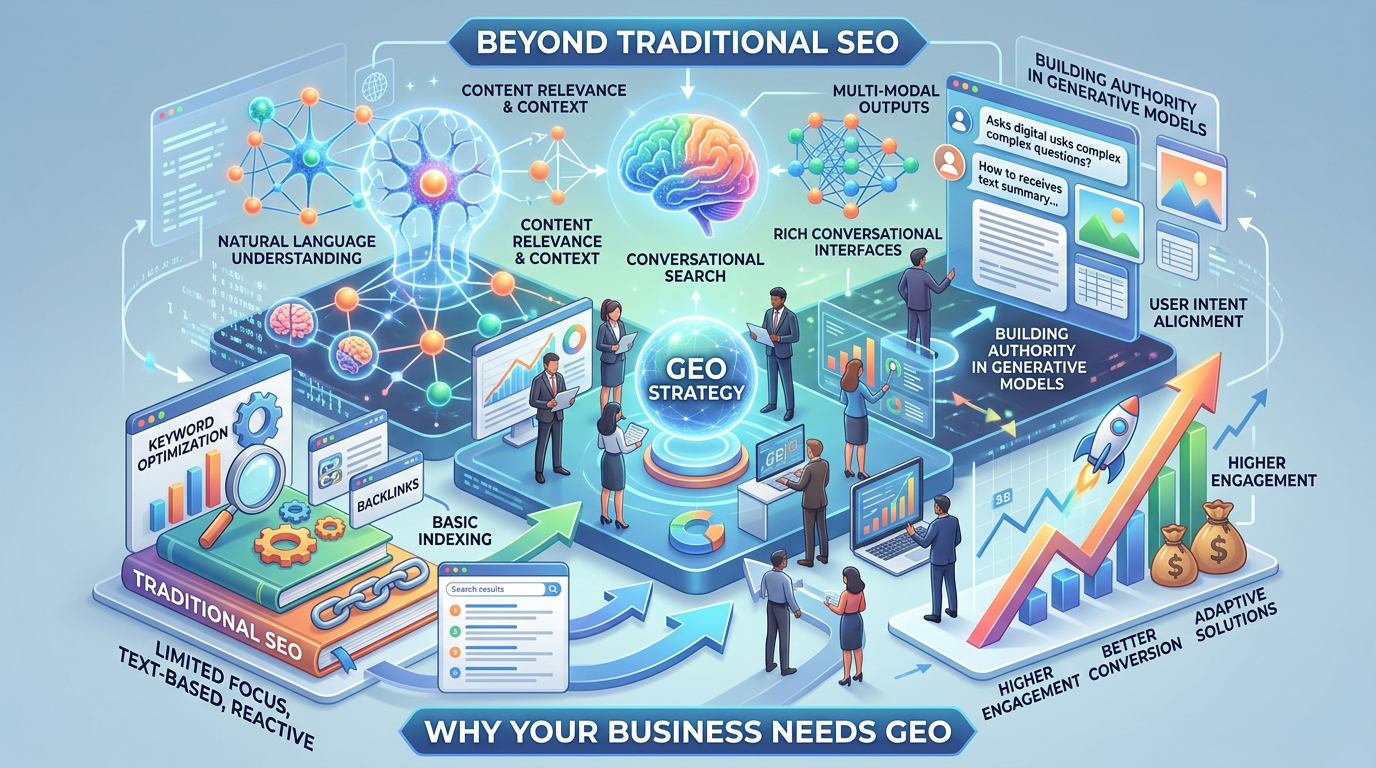
Beyond Traditional SEO: Why Your Business Needs GEO (Generative Engine Optimization)
Search behaviour is changing rapidly. Earlier, people searched on Google, clicked through multiple websites and compared information before making a decision. Today, users increasingly turn to AI-powered platforms like ChatGPT, Google Gemini and Perplexity to get direct answers, discover businesses and find recommendations.
This shift is creating a new opportunity for businesses: Generative Engine Optimization (GEO).
Traditional SEO remains important, but businesses can no longer depend entirely on ranking in Google’s search results. They must also focus on making their websites, brand information and content understandable, trustworthy and useful to AI-powered search platforms.
Let’s understand what GEO is, why it matters and how your business can prepare for the future of search.
1. The Shift: Why Traditional SEO Alone Is No Longer Enough
Traditional SEO focuses on improving website visibility in search engine results pages (SERPs). Businesses optimise keywords, backlinks, technical performance and website content to achieve higher rankings.
However, AI-powered search is changing how users discover information.
Direct Answers Instead of Multiple Website Visits
AI search tools can generate summarised answers by combining information from multiple sources. Instead of clicking ten different websites, users may get the information they need directly through an AI-generated response.
For example, someone searching for:
“Which is the best digital marketing agency for a small business in Bangalore?”
may receive an AI-generated list of recommendations, along with explanations and supporting sources.
If your business is not mentioned or referenced in these answers, you could miss potential customers even if your website performs well in traditional search results.
The Business Impact
This shift creates new challenges and opportunities:
- Website traffic may be affected by zero-click searches.
- Brand mentions across trusted websites become increasingly valuable.
- Businesses need to establish authority beyond their own websites.
- Content must answer specific customer questions.
- Visibility in AI-generated recommendations is becoming an additional digital marketing objective.
Traditional SEO is not dead. Instead, it is expanding to accommodate new ways of searching.
2. How AI Reads the Web: ChatGPT vs. Traditional Google Search
Understanding how AI-powered platforms discover and present information is essential for developing an effective GEO strategy.
Traditional Search Engines
Traditional search engines such as Google use automated crawlers to discover and index web pages. Their ranking systems evaluate multiple factors, including:
- Content relevance
- Keyword relevance
- Backlink quality
- Website usability
- Page experience
- Technical SEO
- Content quality and authority
When someone searches for a keyword, Google displays relevant results based on its ranking systems.
AI-Powered Search Platforms
AI-powered search platforms approach information discovery differently.
Depending on the platform and search mode, they may use web search, retrieved documents, indexed information and language models to generate answers.
They focus on understanding:
- The meaning behind a user’s question.
- The context of the information.
- Relationships between topics and entities.
- The reliability and relevance of available sources.
- Whether the content directly answers the user’s query.
For example, instead of simply searching for “GST consultant Bangalore”, a user might ask:
“How can a startup find a reliable GST consultant who handles registration, return filing and compliance?”
AI-powered search can interpret the complete requirement and identify information that matches the user’s intent.
The key difference: Traditional SEO helps search engines discover and rank your pages, while GEO focuses on making your brand and content more useful, understandable and citable in AI-generated responses.
3. What Is GEO (Generative Engine Optimization)?
Generative Engine Optimization, commonly known as GEO, is the process of improving your website and online brand presence so that generative AI platforms can understand, retrieve, reference and potentially recommend your business.
It involves more than adding keywords to website content.
GEO focuses on presenting accurate, structured, relevant and trustworthy information that AI-powered systems can use when generating answers.
How GEO Works
An effective GEO strategy involves several important elements:
- Creating content that answers specific questions.
- Organising information with meaningful headings.
- Establishing brand authority through credible mentions.
- Using structured data where appropriate.
- Publishing accurate and regularly updated information.
- Building a consistent brand identity across online platforms.
- Supporting important claims with reliable sources.
SEO vs. GEO: Understanding the Difference
| Traditional SEO | GEO |
|---|---|
| Focuses on search engine rankings | Focuses on visibility in generative AI responses |
| Targets keywords and search queries | Targets questions, context and user intent |
| Builds website backlinks | Builds broader brand authority and credible mentions |
| Optimises web pages for search engines | Makes information understandable and useful to AI systems |
| Measures rankings and organic traffic | Also examines AI citations, mentions and recommendations |
Both strategies complement each other. A strong digital marketing strategy should combine traditional SEO with GEO rather than treating them as competing approaches.
4. Actionable Steps: How to Optimise Your Website for GEO
Implementing GEO does not require completely rebuilding your website. You can start by improving your existing content and online presence.
1. Create Clear Question-and-Answer Content
AI search users often ask complete questions rather than entering individual keywords.
Create content that directly addresses these questions.
For example:
- What is GST registration?
- How can startups register a private limited company?
- What are the tax benefits of investing in mutual funds?
- How can businesses improve their local SEO?
Use clear headings followed by direct, informative answers.
Avoid unnecessarily complicated explanations. Make important information easy to understand.
2. Implement Structured Data and Schema Markup
Structured data helps search engines understand the information available on your website.
Schema markup can describe different types of content, including:
- Organisation information
- Local business details
- Products and services
- Articles and blog posts
- Events
- Breadcrumb navigation
For example, adding accurate Organisation and LocalBusiness schema can help communicate your business name, website, contact information and other relevant details.
However, structured data does not guarantee that AI platforms will cite or recommend your business. It is one part of a broader optimisation strategy.
3. Build Brand Mentions Across Trusted Websites
Your website should not be the only place where your business is discussed.
Build a credible online presence through:
- Industry-related publications.
- Guest articles on relevant websites.
- Business directories with accurate information.
- Professional interviews and expert contributions.
- Industry associations and relevant partnerships.
- Genuine customer reviews and testimonials.
For example, if your digital marketing agency is mentioned in reputable marketing publications, industry discussions and relevant business resources, it can strengthen your brand’s overall online presence.
Focus on genuine, relevant mentions rather than generating large numbers of low-quality backlinks or artificial brand references.
4. Publish Original and Experience-Based Content
AI-generated content is becoming increasingly common. Publishing generic articles that repeat information already available online may not help your business stand out.
Instead, focus on creating original content based on your knowledge and experience.
Include:
- Real business examples.
- Expert opinions.
- Case studies.
- Original research and statistics.
- Practical step-by-step guides.
- Frequently asked customer questions.
For example, a financial consultancy can publish a detailed guide explaining common GST filing mistakes based on practical industry experience.
Original insights make your content more valuable to readers and provide useful information that other websites may reference.
5. Improve Your Website’s Technical SEO
Technical SEO continues to play an important role in search visibility.
Make sure your website has:
- Fast-loading pages.
- Mobile-friendly design.
- Secure HTTPS connections.
- Clean website architecture.
- Proper internal linking.
- XML sitemaps.
- Accessible and crawlable content.
- Correct canonical tags.
- No unnecessary indexing restrictions.
Search and AI systems need access to relevant information to discover and use it. Review crawler access and platform-specific documentation rather than assuming every AI platform accesses websites in the same way.
6. Strengthen Your Brand’s Online Identity
Consistency is essential when building brand recognition.
Make sure your business information is accurate across:
- Your official website.
- Google Business Profile.
- LinkedIn.
- Facebook.
- Instagram.
- Relevant business directories.
- Industry-specific platforms.
Use consistent business names, descriptions, service information and contact details.
A clear digital identity makes it easier for customers and information systems to understand what your business does.
7. Optimise Content for Conversational Search
People increasingly interact with AI tools using natural language.
Instead of searching for “SEO services”, someone might ask:
“How can I improve my small business website’s visibility on Google and ChatGPT?”
Your website should address these conversational search patterns.
Create dedicated sections covering:
- What the service includes.
- Who needs the service.
- How the process works.
- Common problems and solutions.
- Pricing factors.
- Frequently asked questions.
This helps your content address the actual needs behind customer searches.
5. How to Measure Your GEO Performance
One of the biggest challenges with GEO is measuring its performance because AI visibility is not represented by one universal ranking metric.
Businesses should track multiple indicators.
Important GEO performance metrics include:
- AI Brand Mentions: How frequently your business appears in relevant AI-generated answers.
- AI Citations: Whether AI search platforms reference your website as a source.
- Referral Traffic: Visitors arriving through AI-powered platforms.
- Branded Search Growth: Changes in searches for your business name.
- Website Engagement: How visitors interact with your website content.
- Conversion Rate: Whether improved visibility generates enquiries, leads or sales.
You can manually test relevant customer questions across platforms such as ChatGPT, Gemini and Perplexity and record whether your business appears in the responses.
Remember that AI-generated answers can vary depending on the query, location, platform and time. A single test does not establish consistent visibility.
6. Common GEO Mistakes Businesses Should Avoid
While adopting GEO, businesses should avoid shortcuts that can damage their online credibility.
1. Publishing Generic AI Content
Simply generating hundreds of AI-written articles without original insights will not establish authority.
2. Ignoring Traditional SEO
GEO does not replace technical SEO, quality content, indexing or website optimisation.
3. Creating Artificial Brand Mentions
Mass-producing irrelevant brand mentions and low-quality backlinks can damage your online reputation.
4. Ignoring Content Accuracy
Incorrect statistics, outdated information and unsupported claims reduce the reliability of your content.
5. Focusing Only on Keywords
Keyword optimisation is still useful, but content must also address context, search intent and customer questions.
6. Expecting Instant AI Recommendations
GEO is a long-term visibility strategy. No agency or business can guarantee that a particular AI platform will recommend its website.
7. The Future of Digital Marketing: SEO + GEO
The future of online visibility will involve multiple discovery channels.
Customers may discover your business through:
- Traditional Google search results.
- Google AI Overviews and AI Mode.
- ChatGPT search.
- Google Gemini.
- Perplexity.
- Social media recommendations.
- Online communities and industry publications.
Businesses that focus only on traditional keyword rankings may overlook these emerging discovery opportunities.
A combined SEO and GEO strategy helps build a stronger digital presence by improving website discoverability, content quality, brand credibility and relevance across different search experiences.
Conclusion: Is Your Business Ready for the GEO Revolution?
The way customers search for information is evolving, and businesses must evolve with it.
Traditional SEO remains the foundation of online visibility, but GEO introduces another important dimension: making your business discoverable and understandable in AI-powered search experiences.
Start by creating helpful content, implementing structured data, building genuine brand mentions, publishing original insights and maintaining a technically strong website.
Most importantly, focus on becoming a trusted source of information in your industry rather than simply trying to rank for more keywords.
The future of search is not just about being found on Google. It is also about building a brand that customers and AI-powered platforms can recognise, understand and trust.
Is your website optimised for both SEO and GEO?
Want to improve your website’s visibility across Google, ChatGPT and other AI-powered search platforms? Explore smarter SEO and GEO strategies with GotMeNow. Visit gotmenow.com and take the next step towards building your digital presence.


Leave a Reply