
This Company Builds AI-Powered Businesses and Lets Its Clients Own Them: What Vantora Teaches Us
Imagine building an AI-powered business without starting from scratch, finding every customer yourself, or spending years developing a product. Now imagine doing that for another company and letting that company own the business you create.
That is the idea behind Vantora, a venture-building company that develops AI-powered businesses for established companies. Its approach offers an interesting lesson for entrepreneurs, freelancers, and anyone exploring AI business ideas.
But the most useful takeaway is not simply that a startup raised more than $100 million. It is the business model behind the story — building solutions around a customer’s real problems instead of creating a product and hoping someone buys it.
What Is Vantora, and How Does Its AI Business Model Work?
Vantora, previously known as UP.Labs, is a venture-building company that works with established businesses to identify operational problems and develop new businesses around AI-powered solutions.
Instead of operating like a traditional software company that sells the same product to everyone, Vantora works with partner companies to understand their operations and develop solutions tailored to their needs.
The Traditional Business Model vs. Vantora’s Approach
A traditional startup might follow these steps:
- Come up with a product idea.
- Invest money and time in development.
- Search for customers.
- Convince businesses to adopt the product.
- Generate revenue through subscriptions or sales.
Vantora takes a different route:
- Find a real business problem: Identify an operational challenge inside an established company.
- Build a solution: Use AI, software, engineering, and industry expertise to develop a venture around that problem.
- Work with the customer: The partner company collaborates on the venture and may become its first customer.
- Enable ownership: The partner can potentially bring the venture into its core business under an agreed ownership arrangement.
This model helps businesses develop technology that fits their operations while creating opportunities to build new ventures.
The precise ownership arrangement depends on the venture and partnership. It does not mean every client automatically receives an entire company for free.
Why Are Companies Investing in AI Ventures?
Businesses are not just looking for AI chatbots that answer questions. They want technology that can solve measurable problems.
For example, an industrial company might need to:
- Predict when machinery is likely to fail.
- Reduce fuel consumption and logistics costs.
- Automate repetitive administrative work.
- Improve inventory forecasting.
- Analyse operational data to make faster decisions.
An AI solution that saves a business significant time or money can become a valuable business asset.
The key insight is that companies may be willing to invest in a purpose-built solution when the problem is important enough and the expected business value is clear.
The Bigger Opportunity: You Don’t Need $100 Million to Copy This Model
You do not need to create a venture studio, hire a large engineering team, or build advanced industrial AI systems to apply the underlying principle.
A freelancer, solo entrepreneur, or small agency can start with a much simpler version: identify one business problem, build an AI-powered solution, and agree on how you will be paid.
Here are three practical ways to get started.
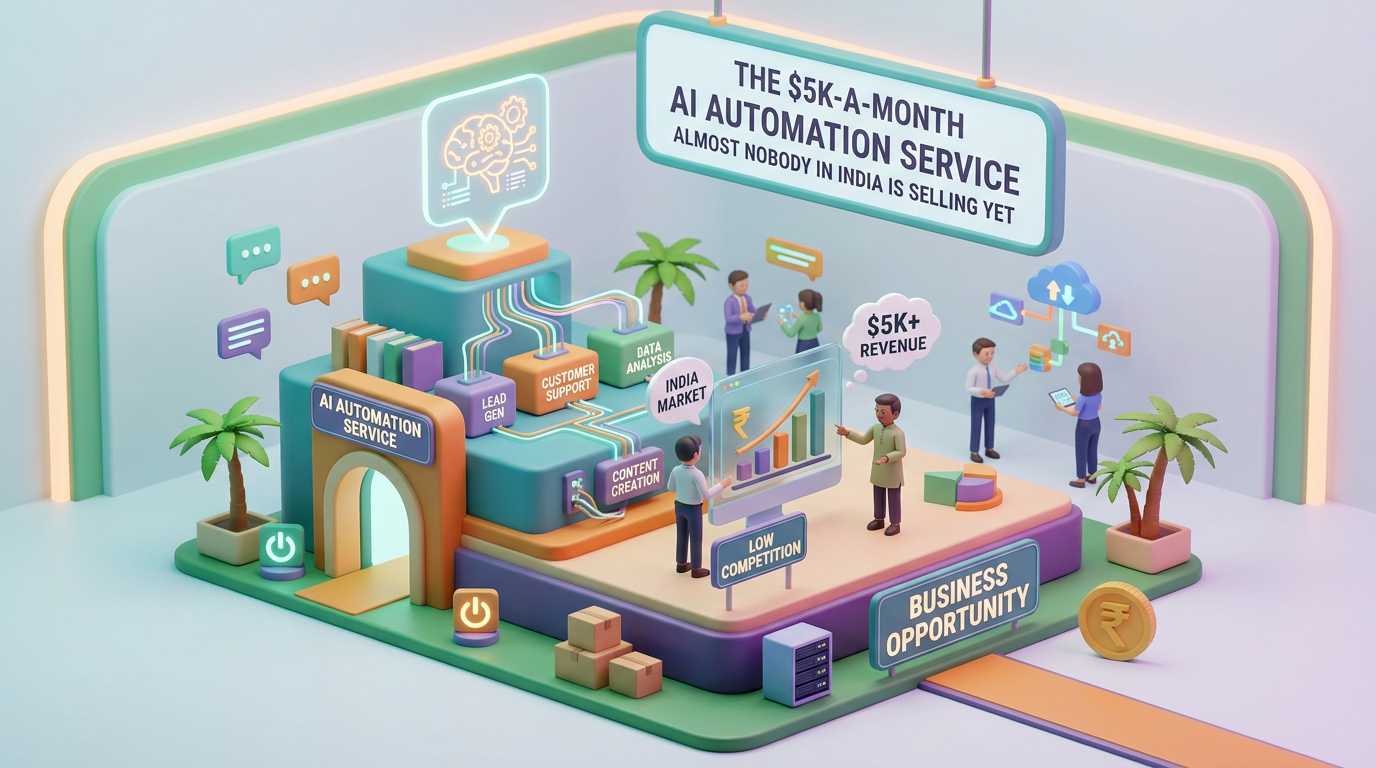
1. Build an AI Automation Service for a Local Business
Many small businesses still manage enquiries, appointments, follow-ups, and customer records manually.
You could build a simple system that automates one of these processes.
Example: A local clinic receives dozens of appointment enquiries every day. You create an automated workflow that collects enquiries, organises them in a spreadsheet, and sends appointment reminders with the clinic’s approval.
Tools such as AI assistants, workflow automation platforms, forms, and spreadsheets can help you build an initial solution without developing every component from scratch.
Your business model could include:
- A one-time setup fee.
- A monthly maintenance fee.
- A performance-based payment, where measurable results can be tracked.
- A revenue-sharing agreement, if appropriate for the service.
Start with a specific problem rather than selling a vague promise of AI transformation.
2. Build a Small AI Tool for One Industry
Instead of developing a generic AI application for everyone, focus on one industry and one recurring task.
Here are some examples:
| Target customer | Potential AI solution |
|---|---|
| Real estate agents | Lead qualification and follow-up automation |
| Digital marketing agencies | Campaign reporting and content workflow tools |
| Accountants | Document collection and client reminder systems |
| Online stores | Product description and customer enquiry assistance |
| Recruitment agencies | CV information extraction and candidate organisation |
You can use existing AI APIs and no-code or low-code platforms to develop an initial version.
The goal is not to build a huge application immediately. It is to find a customer willing to test a useful solution and provide feedback.
The business lesson: A small tool that solves a costly problem for ten customers may be more commercially useful than a complicated application that nobody wants to pay for.
For sensitive industries, particularly finance and healthcare, design appropriate data protection, access controls, and human review into the system.
3. Partner With a Business and Negotiate a Share of the Value
This is the closest everyday version of Vantora’s approach.
Instead of charging only for your time, you could negotiate a partnership in which you build and maintain an AI-powered solution in exchange for a share of the revenue it generates.
For example, imagine an online retailer wants to improve its customer enquiry process.
You develop an AI-assisted system that helps organise enquiries and supports faster responses. The retailer provides access to the relevant workflow, tests the solution, and pays you according to an agreed commercial arrangement.
Possible structures include:
- Fixed fee: The business pays you to build the solution.
- Recurring fee: The business pays for ongoing access, support, and maintenance.
- Revenue share: You receive an agreed percentage of revenue attributable to the solution.
- Equity partnership: You receive an ownership stake in a separate venture, subject to a negotiated agreement.
These arrangements are not interchangeable. Revenue share does not automatically mean equity ownership, and equity does not guarantee future income.
If you choose a partnership model, document who owns the software, source code, data, intellectual property, and customer relationships. Define payment calculations, responsibilities, termination rights, and what happens if the business stops using the solution.
How to Pitch Your First AI Business Idea
Having an AI tool is only one part of building a business. You also need to identify the right customer and explain why your solution is worth paying for.
Step 1: Find a Repetitive, Expensive Problem
Speak with five to ten businesses in one industry.
Ask questions such as:
- Which task consumes the most time every week?
- Where do leads or customers get lost?
- Which process involves repetitive manual data entry?
- What would you automate first if a reliable solution existed?
Look for a problem that happens frequently and has a measurable cost.
Step 2: Build a Small Demonstration
Create a basic working prototype that shows how the solution could work.
You might use an AI assistant, an automation platform, a spreadsheet, and a form. You do not need to build a fully featured software product before speaking with potential customers.
Use sample or authorised data during demonstrations, especially when customer information is sensitive.
Step 3: Sell the Business Outcome
Avoid pitching your service as simply “AI automation.”
Explain the result you want to deliver, such as reducing manual follow-ups, improving response times, or reducing repetitive administrative work.
Where possible, measure the current process first and compare it with the results after implementation. Do not guarantee savings or revenue before you have evidence.
Step 4: Agree on the Commercial Model
Once a business is interested, decide whether the best arrangement is a fixed project fee, recurring service, revenue share, or equity partnership.
Start with a limited pilot and clear success criteria. Expand only when the results justify the investment.
Is This a Good AI Side Hustle for Beginners?
It can be, particularly if you combine basic AI skills with an understanding of business operations.
You do not necessarily need to become a machine learning engineer. Depending on the problem, useful skills may include:
- Prompt design and AI-assisted research.
- Workflow automation.
- API and no-code integrations.
- Spreadsheet and database management.
- Customer discovery and sales.
- Basic software testing and data privacy.
However, AI tools do not guarantee that a business will succeed. Finding customers, delivering reliable results, maintaining the solution, and earning enough to cover your costs remain essential.
A beginner should usually start with a small service rather than attempting to replicate Vantora’s enterprise-scale business model immediately.
Frequently Asked Questions
What Is Vantora?
Vantora is a venture-building company, formerly known as UP.Labs, that develops AI-powered businesses and solutions in collaboration with established corporate partners.
How Much Funding Did Vantora Raise?
Vantora announced more than $100 million in growth investment in September 2026 to support its expansion, AI development, and corporate partnerships.
Can an Individual Build an AI Business Without Coding?
Yes. No-code tools, workflow automation platforms, and existing AI services can help individuals develop simple AI-powered solutions. More complex applications may still require programming or specialist support.
How Can I Make Money Building AI Tools for Businesses?
Potential revenue models include setup fees, monthly service fees, software subscriptions, and negotiated revenue-sharing agreements. The best option depends on the customer’s needs, the value delivered, and the costs of operating the solution.
Can I Build an AI Tool for a Business in Exchange for Equity?
Potentially, if the business agrees to the arrangement and the terms are properly documented. However, equity is not guaranteed income, and a revenue-sharing agreement is different from owning shares in a company.
Conclusion: The Future May Belong to People Who Solve Business Problems
Vantora’s story highlights an important shift in how AI businesses can be created. Rather than building a product first and searching for customers later, entrepreneurs can start by identifying a real business problem and building a solution around it.
You can apply that principle on a much smaller scale.
Choose one industry. Find one repetitive problem. Build one useful AI-powered solution. Demonstrate its value and negotiate a fair commercial arrangement.
You do not need to build the next billion-dollar AI company to get started. You need to solve a problem that someone genuinely wants solved.


Leave a Reply