
Wall Printing Machine Business: How to Start a Profitable Wall Art Printing Venture in India
What if you could turn an ordinary wall into a customized work of art using a digital printing machine?
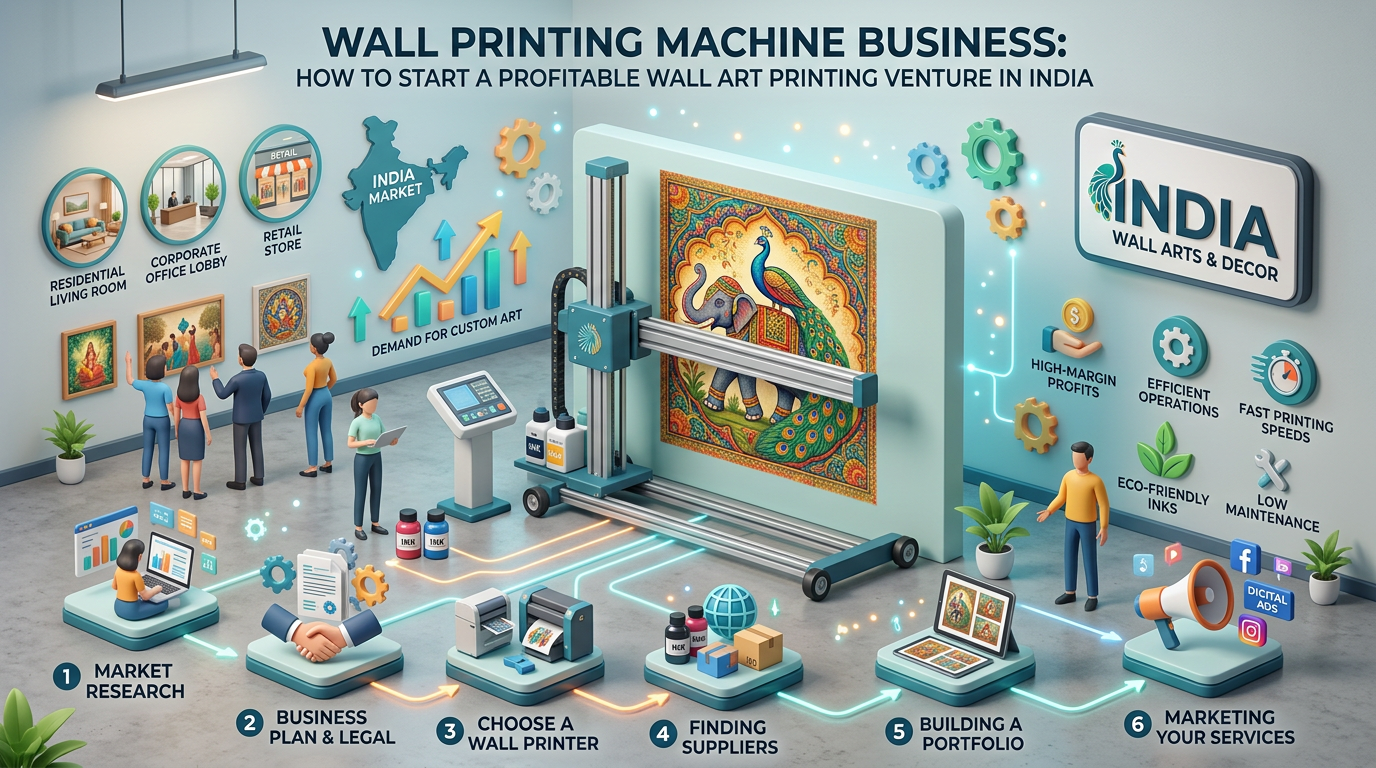
The wall printing machine business is an emerging service concept that combines digital printing, interior decoration and commercial branding. Instead of applying wallpaper or flex sheets, this technology prints designs, images, logos and graphics directly onto suitable wall surfaces.
From cafés and gyms to schools, offices and luxury villas, businesses and property owners may pay for customized wall designs that make their spaces more attractive and memorable.
With an illustrative ink cost of ₹50 per square foot and a potential selling price of ₹400 per square foot, the business model may look attractive. However, actual profitability depends on equipment costs, customer demand, operating expenses and local competition.
Let’s explore how the business works, its potential earnings, startup requirements and the steps to launch it.
What Is a Wall Printing Machine Business?
A wall printing machine is a specialized digital printer that transfers customized graphics directly onto suitable vertical surfaces using inkjet technology.
Unlike traditional wallpaper installation, direct wall printing creates the design on the wall itself without requiring a separate printed sheet.
Common applications include:
- Café and restaurant wall art
- Gym branding and motivational quotes
- School murals and educational graphics
- Villa and residential interior decoration
- Corporate office logos and reception walls
- Retail stores and commercial showrooms
- Hotels, salons and entertainment spaces
- Personalized murals for homes and studios
The business model involves acquiring or accessing a suitable machine, finding customers, preparing their designs and charging for the printing service.
How Does the Wall Printing Business Work?
Step 1: Identify Potential Customers
Find businesses and property owners who want customized wall decoration or branding. Cafés, gyms, interior designers, architects, schools and commercial property developers are potential customers.
Step 2: Prepare Customized Designs
Work with the customer to select a logo, mural, illustration or graphic. Prepare the digital artwork based on the wall dimensions and the machine’s technical requirements.
Step 3: Print Directly on the Wall
Inspect the wall, prepare the surface if necessary, calibrate the equipment and print the approved design. Surface compatibility is important for achieving the desired result.
Step 4: Charge for the Printing Service
Charge customers based on the printable area, design complexity, travel, setup requirements and any additional surface preparation.
This model allows entrepreneurs to serve both small residential projects and larger commercial assignments.
Wall Printing Business: Cost and Profit Calculation
One of the most interesting aspects of this business idea is the difference between the estimated ink cost and the proposed selling price.
For this example, assume the following figures:
| Particulars | Estimated amount |
|---|---|
| Customer price per sq. ft. | ₹400 |
| Ink cost per sq. ft. | ₹50 |
| Balance after ink cost | ₹350 |
| Ink-only contribution margin | 87.5% |
The 87.5% figure represents the margin after ink alone. It is not the net profit margin, because the business must also pay for labour, transportation, maintenance, machine depreciation, design, marketing and other expenses.
Example: Earnings From a 100 Sq. Ft. Project
Suppose a client hires you to print a customized mural covering 100 square feet.
| Particulars | Amount |
|---|---|
| Printing area | 100 sq. ft. |
| Selling rate | ₹400 per sq. ft. |
| Total revenue | ₹40,000 |
| Estimated ink cost | ₹5,000 |
| Balance after ink cost | ₹35,000 |
The remaining ₹35,000 must cover the other project costs before the business generates a net profit.
Monthly Revenue Potential
The following table illustrates how printing volume affects revenue and ink expenditure.
| Monthly printing volume | Revenue | Ink cost | Balance after ink |
|---|---|---|---|
| 500 sq. ft. | ₹2,00,000 | ₹25,000 | ₹1,75,000 |
| 1,000 sq. ft. | ₹4,00,000 | ₹50,000 | ₹3,50,000 |
| 2,000 sq. ft. | ₹8,00,000 | ₹1,00,000 | ₹7,00,000 |
These figures are hypothetical illustrations, not guaranteed earnings. Actual results depend on the number of customers, achievable pricing, project sizes, machine utilization and operating expenses.
The key to success is securing a consistent flow of profitable projects rather than relying only on a high selling price per square foot.
What Is the Investment Required to Start?
The initial investment depends on the machine model, print quality, maximum printing dimensions, portability, warranty and after-sales support.
Before investing, consider the following expenses:
- Wall printing machine: The main equipment investment.
- Ink and consumables: Printing ink, cleaning materials and compatible supplies.
- Computer and design software: For preparing customer artwork.
- Transportation: Moving the machine to customer locations.
- Training: Learning machine operation, calibration and troubleshooting.
- Marketing: Website development, social media promotion and demonstrations.
- Maintenance: Servicing, replacement parts and repairs.
- Working capital: Funds for daily operations while building a customer base.
Request a complete quotation from multiple suppliers. Confirm whether the price includes taxes, shipping, installation, training, software, warranty and spare parts.
Avoid choosing a machine based on purchase price alone. Reliable service support and consistent print quality can significantly affect long-term business performance.
Who Are the Best Customers for a Wall Printing Business?
1. Cafés and Restaurants
Cafés and restaurants may use customized murals to create distinctive interiors and attractive photo backgrounds. Unique wall art can contribute to their branding and social media presence.
2. Gyms and Fitness Studios
Fitness centres can use motivational quotes, sports graphics and branded designs to create a more engaging workout environment.
3. Schools and Educational Institutions
Schools may commission educational illustrations, alphabet walls, science graphics and themed learning spaces.
4. Villas and Residential Properties
Homeowners may want personalized artwork for living rooms, bedrooms, children’s rooms and entertainment areas.
5. Offices and Commercial Establishments
Corporate offices, retail stores, hotels and showrooms can use printed logos, brand graphics and customized wall designs to improve their interiors.
Business development tip: Build relationships with interior designers, architects, contractors and branding agencies. A single partnership may generate multiple projects over time.
Is There Really Zero Competition?
It may be possible to find local markets with few direct wall printing service providers. However, it is risky to assume that the business has zero competition.
Potential alternatives include:
- Traditional mural artists
- Wallpaper installation businesses
- Vinyl printing and signage companies
- Interior painting contractors
- Other direct wall printing providers
Some customers may prefer conventional decoration methods because of their cost, familiarity or suitability for particular surfaces.
How to Validate Local Demand
Before purchasing equipment:
- Search online for wall printing businesses in your city.
- Check local directories and social media for existing service providers.
- Contact cafés, gyms, schools and interior designers.
- Compare direct printing with wallpaper, vinyl graphics and hand-painted murals.
- Ask potential customers about their budgets and design requirements.
- Identify customer segments that are underserved in your area.
A market with few competitors may represent an opportunity, but it could also indicate low customer awareness or limited demand. Validate willingness to pay before committing substantial capital.
How to Start a Wall Printing Business Step by Step
Step 1: Validate the Business Idea
Speak to at least 15–20 potential customers, including cafés, gyms, schools, interior designers and builders.
Show them sample designs, explain the service and determine whether they would pay for it.
Step 2: Compare Wall Printing Machines
Evaluate suppliers based on:
- Print resolution and output quality
- Supported wall surfaces
- Printing speed and ink consumption
- Maximum printable height and width
- Portability and setup time
- Software compatibility
- Training and warranty
- Availability of spare parts and technical support
Request a live demonstration and test the machine on a surface similar to those you expect to print on.
Step 3: Build a Portfolio
Create sample designs for cafés, offices, gyms, schools and homes. Use actual demonstration prints or clearly identified mock-ups to help customers understand the final result.
Step 4: Develop Business Partnerships
Approach interior designers, architects, contractors, property developers and advertising agencies.
Offer a professional portfolio, transparent pricing and a straightforward quotation process.
Step 5: Promote the Service Online
Create a website and business profile showcasing your services, project photographs, customer testimonials and demonstration videos.
Relevant SEO keywords include:
- Wall printing machine business in India
- Direct wall printing services
- Wall printing cost per square foot
- Custom wall mural printing
- Commercial wall branding services
- Wall printing services in Kochi, Bengaluru or your target city
Publish useful content explaining the technology, pricing, suitable surfaces and differences between direct wall printing and wallpaper.
Step 6: Track Project Costs and Profitability
For every project, record revenue, printing area, ink consumption, labour, transportation, design time, machine usage and maintenance expenses.
This will help you identify your most profitable customer segments and refine your pricing.
Important Challenges to Consider
Wall Surface Compatibility
Different surfaces have different textures, coatings and moisture levels. Some require preparation, while others may not be compatible with a particular ink system.
Print Quality and Durability
Print quality and longevity depend on the ink, wall material, environmental conditions and any protective treatment required. Verify supplier claims through documentation and testing.
Customer Acquisition
Customers unfamiliar with direct wall printing may need demonstrations before they understand its value compared with conventional alternatives.
Machine Downtime
Equipment failures can delay projects and affect customer satisfaction. Reliable technical support and spare parts are essential.
Hidden Operating Costs
Travel, labour, setup time, design revisions and small jobs can reduce profitability if they are not included in the quotation.
Copyright and Branding Permissions
Obtain appropriate authorization before printing commercial logos, copyrighted artwork or other protected designs.
Frequently Asked Questions
Is the wall printing machine business profitable in India?
It can be profitable if demand, pricing, machine utilization and operating costs support the business model. The illustrative ₹400 selling rate and ₹50 ink cost leave ₹350 per square foot before other expenses. Actual net profit will be lower.
How much does wall printing cost per square foot?
Pricing depends on location, design complexity, wall condition, printing quality and project size. The ₹400 per square foot figure used here is an example, not a guaranteed market rate.
Is wall printing suitable for beginners?
It may suit beginners willing to learn equipment operation, digital design, customer acquisition and project costing. Proper training and reliable supplier support are important.
Who buys wall printing services?
Potential customers include cafés, restaurants, gyms, schools, offices, hotels, villas, retail stores, architects and interior designers.
Can wall printing replace wallpaper?
It can be an alternative for certain customized murals and graphics. Wallpaper, vinyl graphics and traditional painting may be more suitable for other designs, budgets or surfaces.
Is this a passive-income business?
No. Wall printing is primarily a service business involving sales, design coordination, equipment operation, transportation and customer support. It can become more scalable through trained operators and standardized processes, but it is not automatically passive income.
Final Thoughts: Is the Wall Printing Business Worth Exploring?
The wall printing machine business offers an interesting opportunity for entrepreneurs interested in digital printing, customized interior decoration and commercial branding.
Its main advantage is the ability to print personalized designs directly onto suitable walls, offering customers an alternative to traditional wallpaper, flex and painting methods.
The illustrative pricing model is attractive: charging ₹400 per square foot with an estimated ink cost of ₹50 leaves ₹350 per square foot before other expenses. However, actual profitability depends on customer demand, machine utilization, operating costs and local competition.
The smartest approach is to validate demand, compare suppliers, test print quality and calculate the full cost of delivering each project before investing.
Rather than relying on claims of zero competition or guaranteed high margins, build a business around proven demand, reliable service and profitable customer relationships.

Leave a Reply