
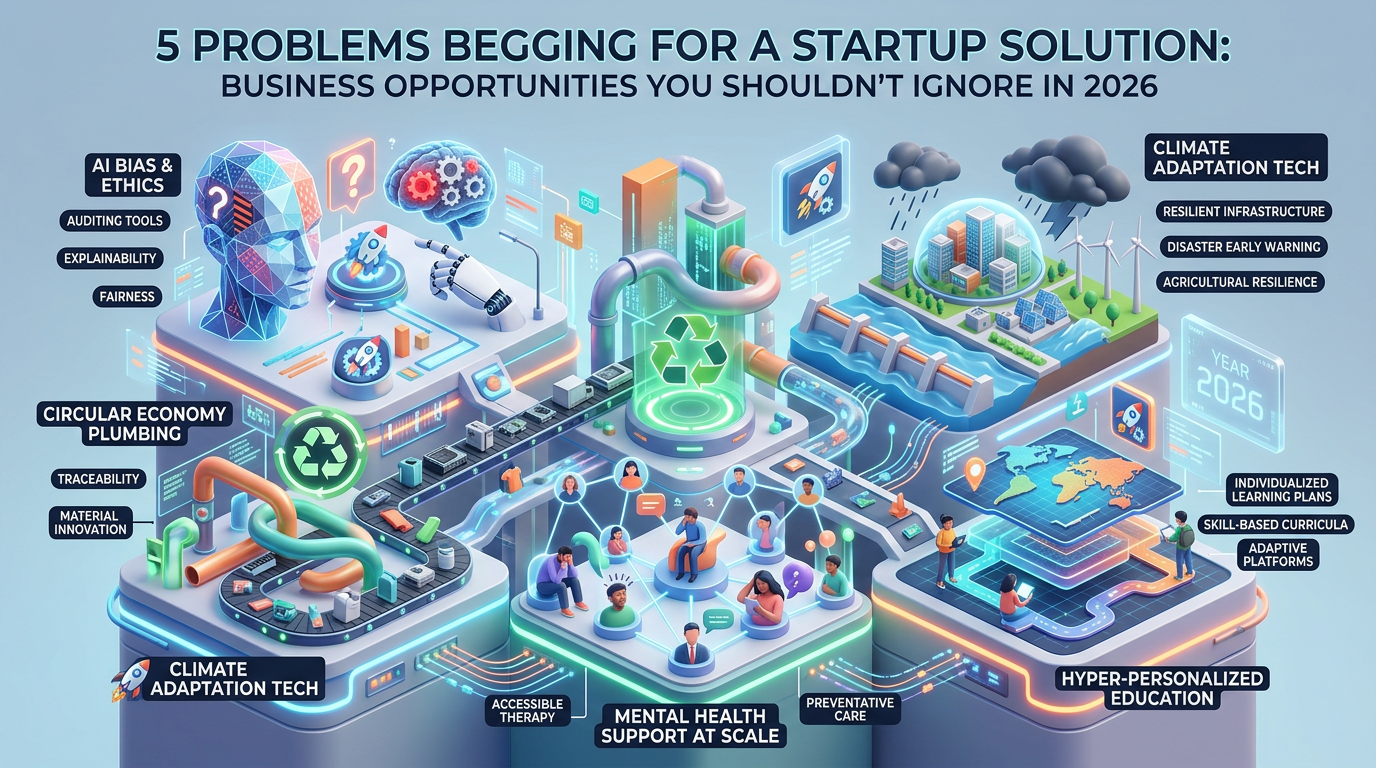
5 Problems Begging for a Startup Solution: Business Opportunities You Shouldn’t Ignore in 2026
Every successful startup begins with a problem worth solving. While many aspiring entrepreneurs spend months searching for a unique business idea, some of the best opportunities are hidden in everyday frustrations that people experience repeatedly.
Think about it: people waste hours on repetitive tasks, struggle to find trustworthy services, spend money on inefficient processes, and deal with problems that existing businesses have failed to solve properly.
These challenges can become opportunities for entrepreneurs who are willing to understand customer needs and build practical solutions.
If you’re looking for startup ideas in 2026, here are five real-world problems that could inspire your next business venture.
1. Small Businesses Struggle with Affordable Digital Tools
The problem
Many small businesses, freelancers, and local entrepreneurs still manage their operations using spreadsheets, notebooks, WhatsApp messages, and multiple disconnected applications.
They may struggle with:
- Tracking customer enquiries and following up on leads.
- Managing invoices, payments, and expenses.
- Maintaining customer records.
- Creating social media content consistently.
- Automating repetitive administrative tasks.
Enterprise software can be expensive or complicated, while basic tools may not offer everything a business needs.
The startup opportunity
Build a simple, affordable digital platform that helps small businesses manage essential operations in one place.
Potential solutions include:
- An AI-powered WhatsApp assistant for customer enquiries.
- A lightweight CRM for local service providers.
- Automated invoice reminders and payment tracking.
- A social media content planner for small businesses.
- An easy-to-use business dashboard that combines sales and customer information.
Example: Imagine a tool designed specifically for independent beauty salons. It manages appointments, sends reminders, tracks repeat customers, and helps recover missed bookings.
Instead of building a complicated platform for every industry, you could focus on one customer segment and solve its most important problems.
How can you make money?
Possible revenue models include monthly subscriptions, pay-per-use pricing, premium features, and business setup fees.
2. People Don’t Know Which Online Information to Trust
The problem
The internet contains millions of articles, videos, product reviews, and recommendations. However, finding reliable information has become increasingly difficult.
Consumers may struggle to determine whether a product is worth buying, whether a course delivers real value, or whether an online recommendation is biased.
AI-generated content has made information more accessible, but it has also increased the need for verification and trustworthy sources.
The startup opportunity
Create a platform that helps people make better decisions by organizing, comparing, and verifying information.
Possible startup ideas include:
- A verified comparison platform for online courses.
- A review platform focused on specific local services.
- A tool that compares software pricing, features, and limitations.
- An AI research assistant that provides traceable sources.
- A platform that helps customers compare service providers based on transparent criteria.
Example: Instead of building another general review website, create a platform that compares accounting software for Indian small businesses based on GST functionality, pricing, ease of use, and customer support.
A narrow focus can help your platform become more useful than a generic competitor.
How can you make money?
Potential models include paid subscriptions, premium comparison reports, business listings, and clearly disclosed referral commissions.
Trust must remain central to the business. Recommendations should be transparent, and paid placements should never be presented as independent rankings.
3. Finding Reliable Local Service Providers Is Still Difficult
The problem
Finding a trustworthy electrician, plumber, home tutor, cleaning service, mechanic, or repair technician can be surprisingly frustrating.
Customers often face inconsistent pricing, uncertain availability, poor communication, and limited accountability.
Meanwhile, skilled local professionals may struggle to attract customers without spending heavily on advertising or relying entirely on word-of-mouth referrals.
The startup opportunity
Build a local service platform that connects customers with verified professionals and makes the entire booking process easier.
Potential features include:
- Verified professional profiles.
- Transparent service pricing or estimates.
- Appointment scheduling.
- Customer reviews and complaint resolution.
- Digital invoices and service warranties where applicable.
- Repeat booking and maintenance reminders.
Example: Start with home appliance repair in one city or neighbourhood. Verify technicians, standardize common service charges where feasible, and make booking and follow-up simple.
You don’t need to launch across an entire country. A focused service in one location can help you test demand and improve the customer experience.
How can you make money?
You could charge a commission per completed booking, offer subscriptions to service providers, or introduce premium business profiles.
The biggest challenge is maintaining service quality. A large directory of providers is not enough; customers need reliable outcomes.
4. People Want to Learn New Skills but Struggle to Apply Them
The problem
Online education has made learning more accessible than ever. Yet many learners finish courses without knowing how to apply their knowledge to real projects or earn opportunities from their skills.
Common challenges include:
- Too much theory and too little practical experience.
- Difficulty choosing which skills are worth learning.
- Lack of personalized feedback.
- Limited access to mentors.
- Difficulty building a portfolio without previous experience.
This creates an opportunity to bridge the gap between learning and doing.
The startup opportunity
Create a practical learning platform that focuses on helping users complete real-world projects rather than simply watching lessons.
Potential ideas include:
- AI-assisted learning paths tailored to career goals.
- Short, project-based courses for specific job skills.
- Portfolio-building challenges with expert feedback.
- Mentor-led communities for beginners.
- Platforms connecting learners with small businesses that need project support.
Example: A beginner learning AI video editing could follow a structured path, complete three sample projects, receive feedback, and build a portfolio suitable for approaching potential clients.
The platform should help learners demonstrate actual capability instead of promising guaranteed employment or income.
How can you make money?
Possible models include course fees, cohort-based programs, mentorship subscriptions, and employer-sponsored training.
Start with one clearly defined audience, such as beginner video editors, entry-level data analysts, or small-business marketing assistants.
5. People Waste Time Managing Everyday Personal and Household Tasks
The problem
Modern life involves coordinating multiple responsibilities, from household shopping and bill payments to appointments, maintenance, document renewals, and family schedules.
These tasks may appear small individually, but managing them together creates friction.
People often use separate apps, reminders, calendars, and messaging groups to keep everything organized.
The startup opportunity
Develop a practical service that reduces the effort required to manage recurring personal or household responsibilities.
Potential solutions include:
- A household management app with shared reminders.
- A subscription service for scheduled home maintenance.
- A platform that organizes document expiry dates and renewal reminders.
- A tool for coordinating care-related appointments and family schedules.
- A personalized assistant that helps users plan recurring errands.
Example: A household management platform could track appliance maintenance, vehicle servicing, insurance renewals, and utility bills, then send reminders before important deadlines.
The value comes from reducing missed tasks and mental effort, not simply adding another to-do list.
How can you make money?
Consider freemium subscriptions, premium family plans, service-booking commissions, or partnerships with relevant service providers.
For this category, privacy and data security are particularly important because users may store personal schedules, documents, and household information.
How to Choose the Right Startup Problem
Not every frustrating problem represents a profitable business opportunity. A viable startup needs a clearly defined customer, a problem that matters, and a solution people are willing to adopt or pay for.
Use these five questions to evaluate your idea:
- Is the problem frequent? Problems that occur regularly may create stronger demand for a lasting solution.
- Is the problem painful enough? Determine whether customers lose time, money, productivity, or peace of mind.
- Are people already paying for alternatives? Existing spending can indicate demand, although it does not guarantee that your solution will succeed.
- Can you reach your target customers? A useful product is difficult to grow if the intended audience is expensive or difficult to access.
- Can you build a better solution? Your advantage might be affordability, convenience, specialization, speed, or customer support.
A good startup idea doesn’t have to be completely original. Sometimes, the opportunity lies in making an existing solution simpler, more affordable, or better suited to a specific group.
How to Validate Your Startup Idea Before Building
One of the most common startup mistakes is investing months in developing a product before confirming that customers actually need it.
Instead, validate the problem first.
Step 1: Talk to potential customers
Interview 10–20 people who experience the problem. Ask how they currently handle it, what frustrates them, and what they have already tried.
Avoid asking only, “Would you use my app?” People may express interest without ever becoming customers.
Step 2: Research existing competitors
Study competing products, customer reviews, pricing, and common complaints.
Look for gaps that customers repeatedly mention. Competitors can be evidence of an existing market, not necessarily a reason to abandon your idea.
Step 3: Build a minimum viable product (MVP)
Create the simplest version that can test your main assumption.
This might be a landing page, a basic prototype, a manual service, a spreadsheet-based workflow, or a small software tool.
You do not need a complete app to discover whether customers value the solution.
Step 4: Test willingness to pay
Invite potential customers to purchase a pilot, book a paid consultation, or subscribe to an early version.
Actual buying behaviour is generally stronger evidence of demand than compliments, survey responses, or social media likes.
Step 5: Measure the results
Track meaningful indicators such as:
- Number of qualified leads.
- Customer conversion rate.
- Cost of acquiring a customer.
- Repeat usage and retention.
- Revenue per customer.
- Customer feedback and referrals.
Use the results to improve your offer, change your target market, or stop pursuing an idea that lacks sufficient demand.
Conclusion: Your Next Startup Idea Could Be Hiding in an Everyday Problem
The five opportunities explored here—affordable digital tools, trustworthy information, reliable local services, practical skill development, and household task management—illustrate how everyday frustrations can inspire businesses.
However, identifying a problem is only the starting point. The real opportunity comes from understanding who experiences it, how they currently solve it, and why they would choose your solution.
You don’t need a huge budget, a large team, or a perfect product to begin. Start with a specific customer group, investigate its biggest challenges, and test a simple solution before investing heavily.
Your next step: Choose one problem from this list and speak to five potential customers this week. Ask about their experiences before proposing your solution.
The strongest startup ideas are not always the most complicated or futuristic. They are often the ones that solve a meaningful problem in a way people genuinely value.

Leave a Reply