
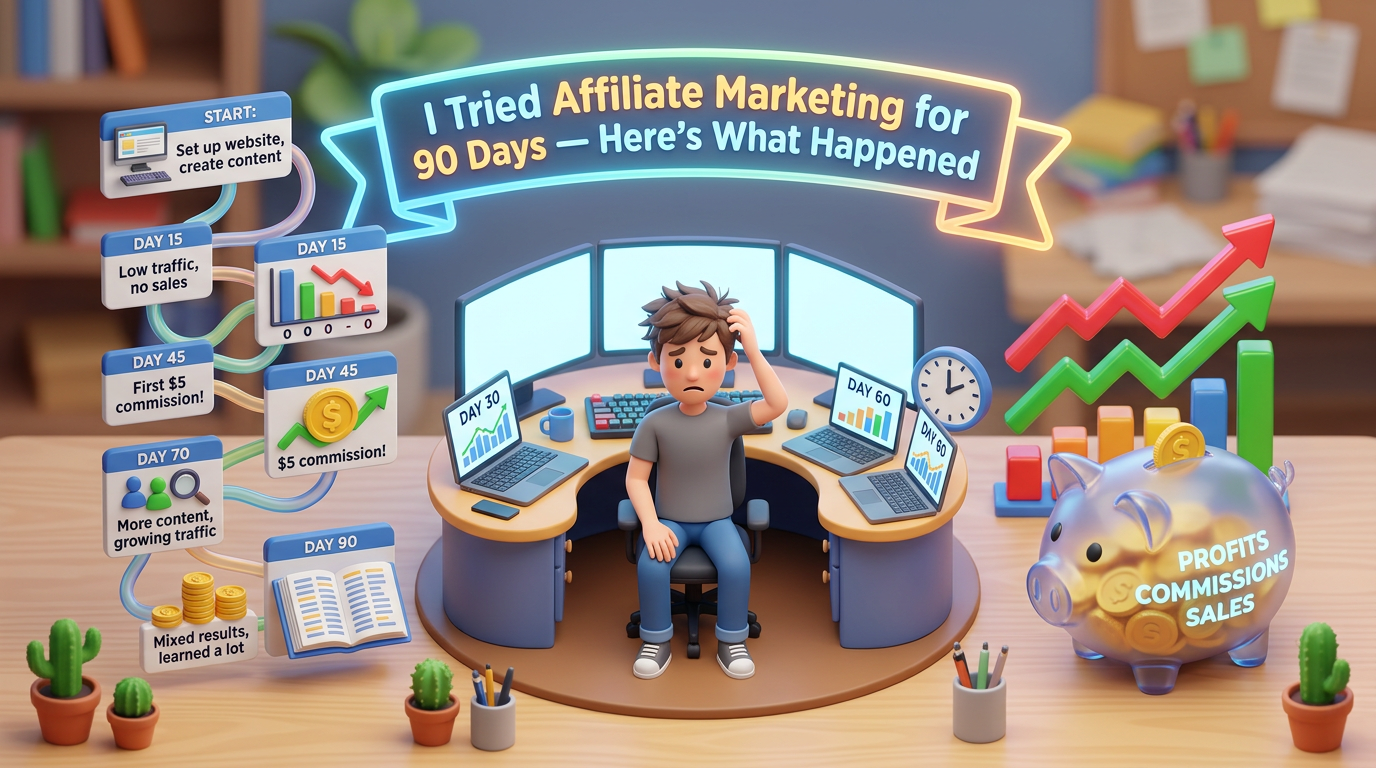
I Tried Affiliate Marketing for 90 Days — Here’s What Happened
What if you could earn money by recommending products you genuinely use, without creating your own product or managing inventory?
That is the idea behind affiliate marketing, a popular online income model that allows creators to earn commissions when people purchase products or services through their unique referral links.
But can a complete beginner make money with affiliate marketing, even without an existing audience?
Let’s explore a 90-day affiliate marketing journey, from starting with zero followers to earning a reported ₹15,000 in commissions by day 60, and the lessons that can help other beginners approach affiliate marketing more strategically.
Note: This article uses a hypothetical beginner case study to illustrate a possible journey. The ₹15,000 result is an illustrative outcome, not a guaranteed or independently verified earning claim.
What Is Affiliate Marketing, and How Does It Work?
Affiliate marketing is a performance-based marketing model in which you promote another company’s products or services and receive a commission for qualifying purchases or actions.
You don’t need to manufacture products, handle shipping, or manage customer orders. Your primary responsibility is to help potential buyers discover relevant products and make informed decisions.
Here’s how the process works:
- Choose a niche: Focus on a topic such as AI tools, personal finance, technology, fitness, or online business.
- Join an affiliate programme: Register with a company or affiliate network that offers products relevant to your audience.
- Get your affiliate link: Receive a unique tracking link that identifies referrals from your content.
- Create useful content: Publish reels, tutorials, product comparisons, reviews, or demonstrations.
- Earn commissions: Receive payment when eligible referrals meet the programme’s requirements.
For example, if you recommend a software subscription and someone purchases it through your affiliate link, you may earn a percentage of the sale or a fixed commission.
Days 1–30: Building the Foundation From Zero
The first month was about learning the basics rather than expecting immediate income.
Starting without an audience can feel discouraging. There are no existing followers to click your links, and you may not know which products people actually want.
Instead of promoting random products, the first step was to build a clear content strategy.
Step 1: Choose One Profitable, Relevant Niche
A focused niche makes it easier to attract people with similar interests.
For example, a beginner interested in digital business could focus on:
- AI tools that improve productivity
- Website builders for small businesses
- Email marketing software
- Content creation tools
- Online business resources
The key is to select a niche where you can consistently create useful content and identify products that solve real problems.
Step 2: Find Affiliate Programmes
Look for affiliate programmes that offer products you understand and can confidently recommend.
Potential options include software companies, website hosting providers, e-commerce platforms, and established affiliate networks.
Before joining, check:
- Commission rates and payment conditions
- Cookie duration and attribution rules
- Eligible countries and payment methods
- Restrictions on social media promotions
- Refund policies and commission reversals
A high commission does not automatically make a programme the best choice. Product quality, audience relevance, and conversion potential matter just as much.
Step 3: Start Creating Short-Form Content
Rather than waiting to build a large audience, the strategy was to publish educational Instagram reels consistently.
Possible content ideas included:
- Three AI tools that save time on repetitive tasks
- How to create a professional website on a budget
- A beginner’s guide to email marketing
- Free versus paid versions of a popular tool
- Common mistakes people make when choosing business software
Each reel should solve a specific problem. The affiliate recommendation should fit naturally into the content rather than feel like an unrelated advertisement.
The first month’s goal: Learn content creation, identify audience interests, and establish a consistent publishing routine.
Days 31–60: Turning Content Into Affiliate Commissions
By the second month, the focus shifted from simply publishing content to understanding which posts attracted the right audience.
Views and likes can be encouraging, but they do not necessarily translate into sales.
A reel with 2,000 views from people actively searching for a solution may generate more commissions than a viral reel viewed by people who have no interest in the product.
Step 4: Create Content That Helps People Make Decisions
Educational content builds awareness, while comparison and demonstration content can help people decide whether a product is right for them.
A useful content mix includes:
- Problem-solving reels: Explain a challenge and demonstrate a solution.
- Tutorials: Show viewers how to use a tool.
- Comparisons: Explain the differences between competing products.
- Honest reviews: Discuss features, limitations, and ideal use cases.
- Use-case examples: Show how a product fits into a real workflow.
For example, instead of saying, “This AI tool is amazing,” demonstrate how it can help a freelancer draft a client proposal in less time.
Specific demonstrations give viewers a reason to trust your recommendation.
Step 5: Make the Affiliate Link Easy to Find
When viewers are interested, they need a clear next step.
You can direct them to your profile link, a relevant resource page, or another permitted destination specified by the affiliate programme.
Keep calls to action simple:
- Explore the tool through my profile link.
- Compare the features before choosing a plan.
- Check whether the free version meets your needs.
Always disclose affiliate relationships clearly. For example: “This post contains affiliate links. I may earn a commission if you purchase through them, at no additional cost to you.”
In India, affiliate promotions should also comply with applicable advertising disclosure requirements and the relevant platform’s policies.
Step 6: Understand the Numbers Behind Affiliate Income
Affiliate earnings depend on more than follower count.
Consider this hypothetical example:
- 1,000 relevant visitors click an affiliate link.
- 3% complete a qualifying purchase.
- Each purchase generates ₹500 in commission.
That produces 30 purchases and ₹15,000 in gross commissions.
The calculation is:
1,000 clicks × 3% conversion rate × ₹500 commission = ₹15,000.
These figures are illustrative, not industry benchmarks. Actual conversion rates and commissions vary significantly by niche, product, audience, and traffic source.
This example also highlights why tracking clicks, conversions, and approved commissions is more useful than focusing exclusively on views.
Days 61–90: Optimising Content and Building Consistency
Once some content starts attracting attention, the next challenge is determining what to improve.
Affiliate marketing is not simply about posting more. It is about learning from the results and producing more of the content that genuinely helps your audience.
Step 7: Track the Metrics That Matter
Use a spreadsheet or analytics dashboard to monitor:
- Content published
- Views and engagement
- Profile visits
- Affiliate link clicks
- Conversion rate
- Approved commissions
- Refunds and reversed commissions
These metrics reveal where your strategy needs improvement.
For instance, strong views but few link clicks may indicate that the content is interesting but the product recommendation or call to action is unclear.
Many link clicks but few purchases could indicate a mismatch between audience expectations, product pricing, landing-page quality, or the offer itself.
Step 8: Improve Your Best-Performing Content
Identify the topics that attract relevant visitors and generate meaningful engagement.
Then create related content from different angles.
If a reel about an AI writing tool performs well, follow it with:
- A step-by-step tutorial
- A comparison with an alternative tool
- A discussion of its limitations
- A practical example for freelancers
- A guide to choosing the right subscription
This approach creates a connected content library rather than a collection of unrelated promotional posts.
Step 9: Build Trust Before Chasing More Sales
Long-term affiliate income depends on credibility.
Avoid recommending products solely because they offer high commissions. Explain who should use the product, who may not need it, and what limitations buyers should consider.
Where possible, test products before reviewing them. Never invent personal experiences, testimonials, or results.
Trust can take time to build, but misleading recommendations can damage your reputation and jeopardise your affiliate partnerships.
What Are the Biggest Challenges for Affiliate Marketing Beginners?
Affiliate marketing can be started with relatively little capital, but it is not effortless or guaranteed passive income.
Common challenges include:
1. Starting without an audience
You need to create useful content and give people a reason to follow your recommendations. Results may be slow during the early stages.
2. Choosing the wrong products
A popular product is not necessarily relevant to your audience. Prioritise usefulness, quality, and audience fit.
3. Inconsistent content creation
Publishing sporadically makes it harder to learn which formats and topics work. A realistic, sustainable schedule is better than an ambitious schedule you cannot maintain.
4. Low conversion rates
People may click your links without purchasing. Review the product’s relevance, pricing, sales page, and the expectations set by your content.
5. Unpredictable commissions
Affiliate programmes can change commission rates, tracking rules, and payment terms. Some commissions may be reversed after refunds or cancellations.
6. Mistaking revenue for profit
Gross commissions are not the same as take-home income. Account for software subscriptions, content production, advertising costs, applicable taxes, and other expenses.
A Practical 90-Day Affiliate Marketing Plan for Beginners
Use this framework to structure your first three months.
Month 1: Learn and launch
- Choose one niche and identify a few relevant products.
- Research affiliate programme terms.
- Set up a focused social profile.
- Publish educational content consistently.
- Learn basic analytics and disclosure practices.
Month 2: Test and refine
- Experiment with tutorials, reviews, and comparisons.
- Add clear, relevant calls to action.
- Track affiliate clicks and conversions.
- Identify the topics attracting potential buyers.
- Improve content based on the data.
Month 3: Optimise and expand
- Create follow-up content around successful topics.
- Improve your profile and resource links.
- Compare products based on audience needs.
- Build an organised content library.
- Review approved commissions, expenses, and programme performance.
You do not need to spend heavily on advertisements to begin. Organic content can help you test demand before committing money to paid promotion.
Is Affiliate Marketing Worth Trying in 2026?
Affiliate marketing can be a useful online business model for people who enjoy creating content, researching products, teaching others, or building digital audiences.
It can be particularly suitable for beginners who want to test an online income idea without developing their own product.
However, success depends on several factors:
- Selecting a clear niche
- Creating genuinely useful content
- Recommending relevant products
- Understanding audience behaviour
- Tracking performance and improving over time
- Following affiliate programme rules and disclosure requirements
Treat your first 90 days as a learning and validation period, not a deadline by which you must earn a particular amount.
Some beginners may generate commissions quickly, while others may need longer to build an audience and find a repeatable strategy. Some may never earn enough to justify their time and expenses.
Final Thoughts: Focus on Value, Not Just Commissions
The biggest lesson from a 90-day affiliate marketing experiment is that earning online is not simply about placing links beneath videos.
The real work involves understanding an audience, solving problems, selecting suitable products, and earning trust through consistent, honest content.
A reported ₹15,000 commission milestone can be an encouraging example of what a strategy might achieve, but it should never be treated as a promise of future earnings.
If you are starting from zero, begin with one niche, one platform, and a manageable publishing schedule. Learn from every post, track your results, and improve what works.
Your first goal should not be to make ₹15,000. It should be to understand why someone would trust your recommendation enough to click, evaluate, and purchase a product.
Build that foundation, and you will be in a better position to assess whether affiliate marketing can become a sustainable source of online income.

Leave a Reply