
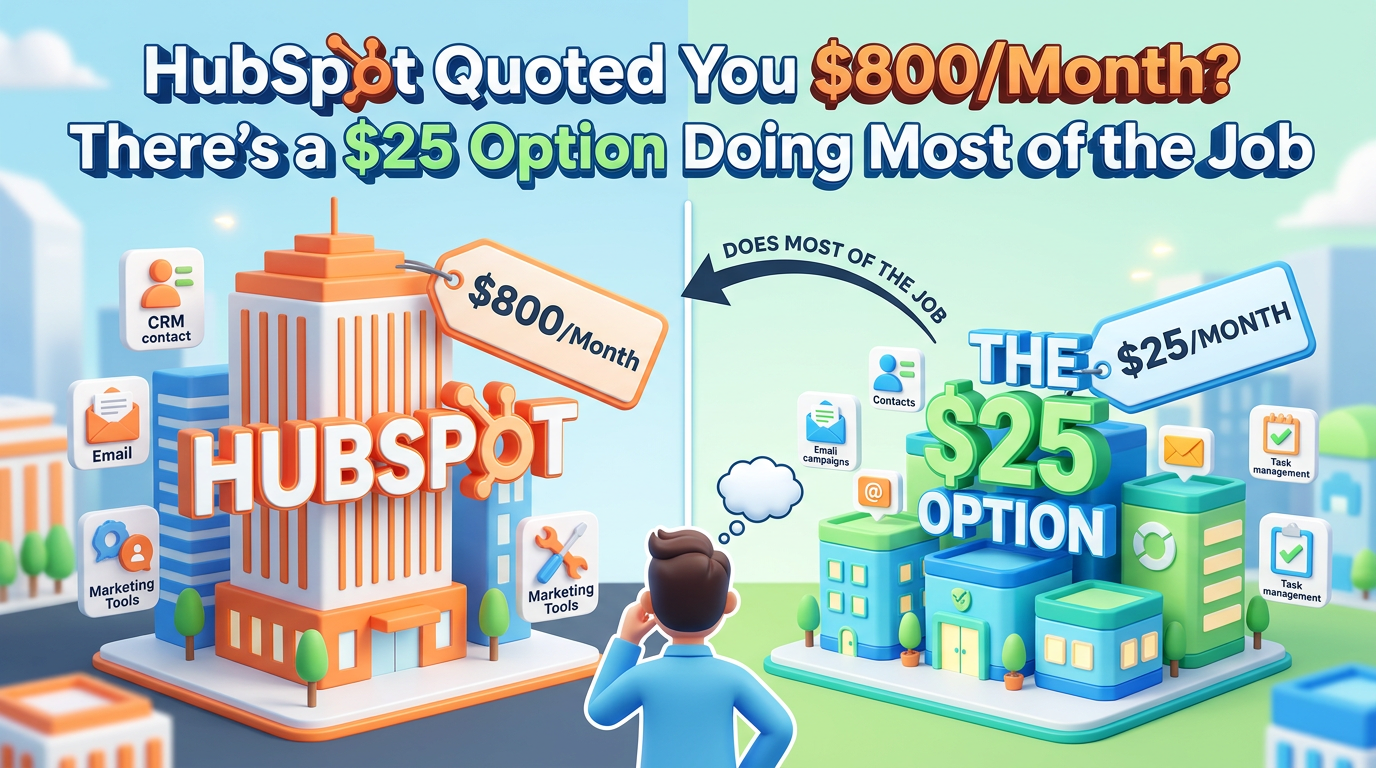
HubSpot Quoted You $800/Month? There’s a $25 Option Doing Most of the Job
If you’re a small business owner and you’ve recently looked at HubSpot Marketing Hub Professional, the price can be a serious reality check.
HubSpot currently lists Marketing Hub Professional at $800/month when billed annually, or $890/month on a monthly commitment. It also requires a one-time $3,000 Professional onboarding fee. The Professional tier includes three core seats and 2,000 marketing contacts.
Now compare that with Zoho Marketing Plus, which starts at $25 per month when billed annually. The entry subscription includes one marketer, 1,000 contacts, 10,000 website visitors, 25 webinar attendees, one brand, and 15 GB of storage.
That is not a completely apples-to-apples comparison. HubSpot Professional is the more powerful enterprise-oriented marketing platform, while Zoho Marketing Plus focuses on giving smaller teams a broad marketing stack without requiring an eight-hundred-dollar monthly commitment.
But for many small businesses, the more important question is:
Do you actually need everything that comes with the $800 plan right now?
The Price Difference Is Huge
At the published annual-billing rates:
| Platform | Starting Price | Approx. Annual Cost | Best Suited For |
|---|---|---|---|
| HubSpot Marketing Hub Professional | $800/month | $9,600/year | Scaling marketing teams |
| Zoho Marketing Plus | $25/month | $300/year | Small marketing teams |
| Difference | $775/month | $9,300/year | Potential savings |
And remember, HubSpot’s Professional plan also has a required $3,000 one-time onboarding fee.
So a small company could potentially spend thousands more on HubSpot before it has even reached the stage where it can fully utilize the platform.
What Are You Actually Paying For?
Price alone doesn’t determine which marketing platform is better.
HubSpot Marketing Hub Professional is designed for marketing teams that want sophisticated omnichannel campaigns, automation, reporting, and a scalable demand-generation engine.
Zoho Marketing Plus takes a different approach.
Instead of focusing on one flagship marketing application, it brings several marketing functions together into a unified workspace.
That includes:
- Email marketing
- Social media marketing
- Marketing automation
- Surveys
- Webinars
- Website performance
- Events
- Analytics
- Landing pages
- Marketing project management
- Team collaboration
- SMS campaigns
Zoho’s current feature documentation confirms these capabilities are part of Marketing Plus.
Where Zoho Marketing Plus Can Cover the Basics
Email Marketing
For a small business, email marketing often means building lists, creating newsletters, sending campaigns, setting up autoresponders, and monitoring opens and clicks.
Zoho Marketing Plus supports regular and advanced email campaigns, templates, scheduling, integrations, and campaign reporting.
If that’s what your business needs, you may not need an expensive enterprise marketing stack just to send effective email campaigns.
Marketing Automation
Automation is one of the major reasons companies consider HubSpot Professional.
But automation isn’t exclusive to HubSpot.
Zoho Marketing Plus includes a dedicated Marketing Automation component for creating automated marketing activities and customer journeys.
For example, a small online business could build a simple journey like:
Website signup → Welcome email → Educational email → Product offer → Follow-up
That can eliminate repetitive manual work without requiring an $800 monthly software budget.
Social Media Management
Small businesses rarely want to log into five different social platforms every morning.
Zoho Marketing Plus lets marketers connect channels such as Facebook, Instagram, LinkedIn, YouTube and Google Business Profile, then create, schedule, monitor and analyze social content from the platform.
For a small marketing team, having these tools in one workspace can be considerably more practical than assembling multiple separate applications.
Website Analytics and Optimization
Zoho Marketing Plus also includes PageSense capabilities for understanding website behavior.
You can work with tools such as:
- Funnel analysis
- Heatmaps
- Form analytics
- Session recordings
- Website activity tracking
- A/B testing
These capabilities are included in Zoho’s current Marketing Plus feature list.
For a small company trying to understand why visitors aren’t converting, that can be more valuable than simply having a larger software platform.
Webinars, Surveys and Events Are Included Too
This is where the “$25 option” becomes interesting.
Marketing Plus isn’t simply an email newsletter tool.
Its feature set also includes webinars, surveys and event management.
The base subscription includes webinar hosting for up to 25 attendees, with additional attendee capacity available as an add-on.
You can also create customer surveys, collect responses and analyze feedback through the integrated Survey functionality.
For a small consultancy, SaaS company, training business or agency, those additional capabilities can reduce the need for several separate marketing tools.
A Simple Small-Business Example
Imagine you’re running a five-person SaaS startup.
Your marketing requirements are:
- Capture leads from your website
- Send welcome emails
- Automate follow-ups
- Publish on LinkedIn and Instagram
- Track website visitors
- Run occasional webinars
- Collect customer feedback
- Analyze campaign performance
You might assume you need HubSpot Professional.
But look at the actual requirements.
Zoho Marketing Plus can cover email campaigns, marketing automation, social media, website analytics, webinars, surveys and unified marketing analytics in one platform.
If you aren’t using advanced HubSpot functionality, paying $800 every month could mean paying for capacity your business hasn’t yet grown into.
But Is Zoho Really “80% of HubSpot”?
This claim needs an important qualification.
No, not literally.
There is no objective measurement showing that Zoho Marketing Plus delivers exactly 80% of HubSpot Professional’s functionality.
The “80%” idea is better understood as a small-business use-case argument.
If your marketing requirements consist primarily of email, social media, basic-to-moderate automation, lead nurturing, website optimization, webinars, surveys and campaign analytics, Zoho can cover a substantial portion of the everyday work you may actually perform.
HubSpot Professional still has capabilities and ecosystem depth that may matter greatly to more sophisticated marketing organizations.
So the better question isn’t:
“Which platform has more features?”
It’s:
“Which platform gives my business the capabilities it needs without paying for capabilities it doesn’t use?”
When HubSpot Professional Makes More Sense
HubSpot can absolutely be the right choice.
Consider it if you have:
- A large marketing operation
- Complex customer journeys
- Advanced reporting requirements
- Significant marketing automation needs
- A growing demand-generation team
- Multiple stakeholders working inside the platform
- A need for deeper HubSpot ecosystem integrations
- Budget for enterprise-grade marketing infrastructure
HubSpot itself positions Professional toward teams running omnichannel campaigns, automation and reporting at scale.
In other words, $800/month isn’t necessarily expensive if the software is generating significantly more than $800 in incremental value.
When Zoho Marketing Plus Makes More Sense
Zoho becomes particularly compelling when you’re a:
- Small business
- Startup
- Solo marketer
- Small agency
- Early-stage SaaS company
- Consultant
- Local business
- Lean ecommerce operation
If your marketing team primarily needs to execute campaigns rather than build a highly sophisticated marketing operation, the lower entry price can make a major difference.
Zoho’s annual starting price of $25/month works out to just $300 per year, before applicable taxes and any additional usage or add-ons.
That’s a dramatically different software budget.
Don’t Ignore the Cost of Switching Tools
There’s another factor businesses often overlook.
Changing platforms takes time.
You may need to migrate:
- Contacts
- Email templates
- Automation workflows
- Landing pages
- Forms
- Social accounts
- Analytics
- Campaign history
So don’t switch simply because one number is smaller.
Instead, audit your current HubSpot usage.
Ask your team:
Which HubSpot Professional features do we actually use every week?
Then divide those features into three categories:
Must have: The business cannot operate without them.
Useful: They save time but aren’t mission-critical.
Unused: They’re included in the subscription but rarely touched.
If most of your $800/month subscription falls into categories two and three, that’s when a lower-cost alternative deserves serious consideration.
The Real Cost Comparison
The biggest difference isn’t really HubSpot vs. Zoho.
It’s buying infrastructure for your current business vs. buying infrastructure for the business you hope to become.
A small company doesn’t necessarily need an enterprise-grade marketing stack on day one.
If your marketing operation is still relatively simple, spending $9,600 a year on the platform alone—and potentially another $3,000 for Professional onboarding—may not be the most efficient allocation of capital.
That money could instead go toward:
- Paid advertising
- Content creation
- SEO
- Sales
- Customer acquisition
- Product development
- Hiring
- Improving your website
The software should support growth—not consume the budget you need to create it.
Final Verdict: Do You Need the $800 Plan Yet?
Probably not if you’re a small team with straightforward marketing requirements.
HubSpot Marketing Hub Professional is a powerful platform, and companies with complex marketing operations can absolutely justify its cost.
But if you’re primarily looking for email marketing, automation, social media management, website optimization, webinars, surveys and analytics, Zoho Marketing Plus gives small teams a much lower-cost way to bring many of those functions together.
At $25/month when billed annually, Zoho’s entry price is dramatically below HubSpot Professional’s $800/month starting price.
So before accepting an $800/month quote, ask yourself one simple question:
Are you paying for the marketing platform your business needs—or the marketing platform you might need someday?
For many small businesses, starting lean and upgrading when the complexity actually arrives can be the smarter move.
Start with what you need today. Scale when your marketing demands justify it.
Pricing and features can change. Check the vendors’ current pricing pages before making a purchasing decision.
Leave a Reply