
The AI Trend Most Business Owners Haven’t Heard of Yet
AI is no longer just about chatbots, content generation, or asking a tool to write an email.
A new shift is happening quietly in the business world: AI agents are moving from answering questions to actually taking action.
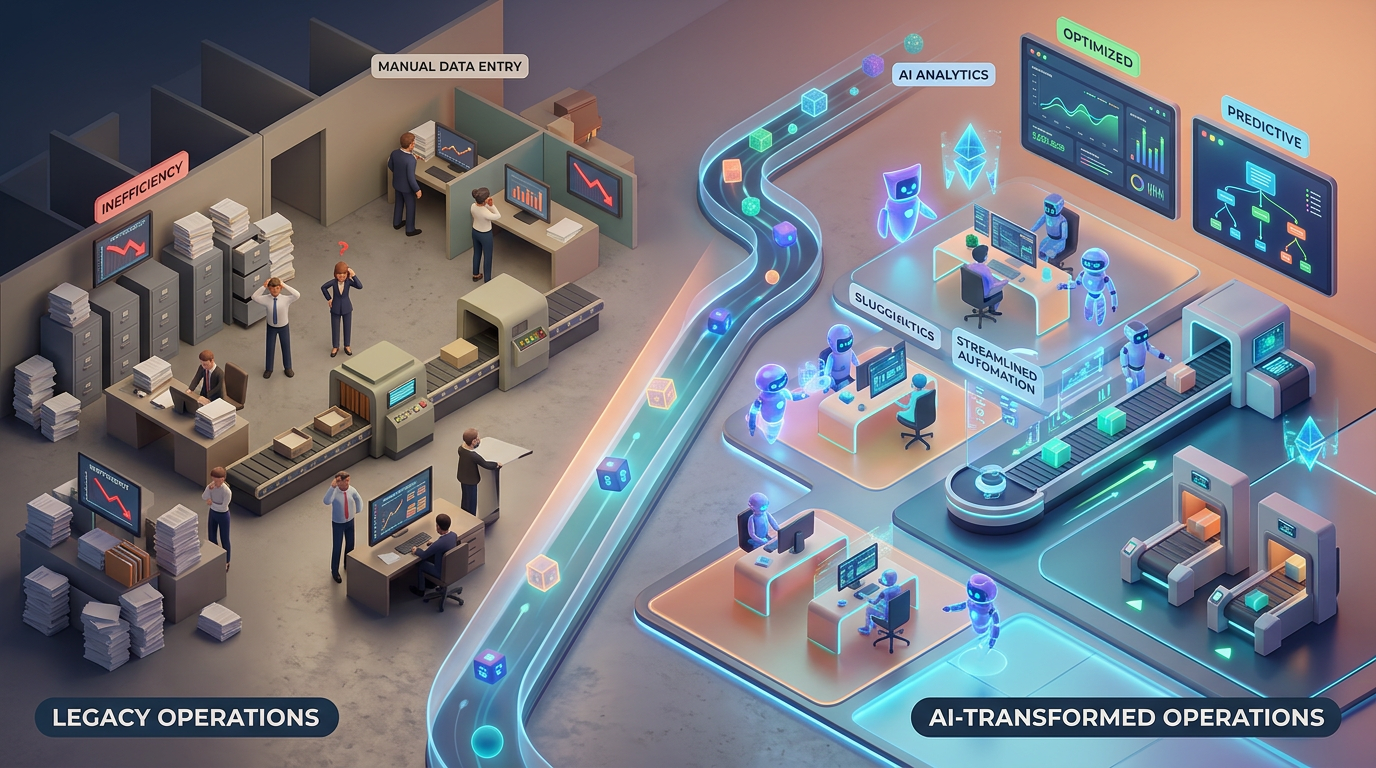
Instead of simply telling you what to do, AI can increasingly handle multi-step tasks, connect with business systems, make decisions based on predefined rules, and complete workflows with minimal human intervention.
For business owners, this could be one of the most important AI trends to understand.
What Are AI Agents?
An AI agent is a software system that can understand a goal, plan the steps required, use connected tools, and execute actions to achieve that goal.
A traditional AI tool might answer:
“Here are five ways to follow up with a potential customer.”
An AI agent could potentially:
- Identify new leads
- Research the prospect
- Update the CRM
- Draft a personalized message
- Schedule a follow-up
- Track the response
- Notify the sales team when human intervention is required
The difference is simple: AI moves from generating information to completing workflows.
Why This Matters for Business Owners
Most businesses don’t have a shortage of software.
They have a shortage of time and operational efficiency.
Employees often spend hours performing repetitive tasks such as:
- Entering customer information
- Sorting emails
- Creating reports
- Following up with leads
- Updating spreadsheets
- Scheduling meetings
- Monitoring business metrics
- Moving information between platforms
AI agents could connect these individual tasks into automated workflows.
That means businesses may be able to increase output without increasing their workforce at the same rate.
AI Agents vs Traditional Automation
Traditional automation generally follows fixed rules:
If X happens → do Y.
AI agents can work with more flexible instructions.
For example:
Traditional automation:
“If a customer fills out this form, send email template A.”
AI agent:
“Review the customer’s information, determine their likely needs, personalize the response, update the CRM, and alert the sales representative if the lead appears high-value.”
This flexibility is what makes agentic AI particularly interesting for businesses.
Where Businesses Can Use AI Agents
Sales
AI agents can help sales teams manage lead qualification, prospect research, follow-ups, CRM updates, and meeting preparation.
Instead of spending hours organizing sales information, teams can focus more on conversations and closing deals.
Customer Support
AI agents can potentially resolve common customer requests, search internal knowledge bases, retrieve account information, and escalate complicated issues to human representatives.
This can help businesses provide faster support while keeping humans involved when judgment is required.
Marketing
Marketing teams can use AI agents to assist with:
- Competitor research
- Content planning
- Campaign analysis
- Customer segmentation
- Performance reporting
- Lead nurturing
The goal isn’t necessarily to replace marketers. It’s to remove repetitive work so marketers can spend more time on strategy and creativity.
Finance and Operations
AI agents can also assist with operational workflows such as invoice processing, document classification, reporting, data reconciliation, and internal notifications.
For businesses dealing with large volumes of repetitive information, the productivity opportunity can be significant.
The Biggest Opportunity Isn’t Replacing Employees
This is where many discussions about AI go wrong.
The biggest opportunity may not be replacing an entire employee with AI.
It may be giving every employee an AI-powered operational assistant.
Imagine a sales manager who has an agent monitoring the CRM.
Imagine a finance team with an agent preparing daily reports.
Imagine a marketing manager with an agent analyzing campaign performance every morning.
AI becomes less like another software application and more like an additional layer of business infrastructure.
What Business Owners Should Do Now
You don’t need to automate your entire company overnight.
Start with one repetitive workflow.
Step 1: Find a Time-Consuming Process
Look for a task employees perform repeatedly every week.
Ask:
“What takes hours but doesn’t require much strategic thinking?”
That is often a strong candidate for AI automation.
Step 2: Map the Workflow
Write down every step involved.
For example:
Lead arrives → information is reviewed → lead is categorized → CRM is updated → email is sent → follow-up is scheduled.
Once the workflow is visible, you can identify where AI can add value.
Step 3: Keep Humans in the Loop
Not every decision should be automated.
Sensitive financial decisions, legal matters, hiring decisions, and important customer interactions may require human review.
A good AI workflow should define exactly when the system can act independently and when it must ask for approval.
Step 4: Measure the Results
Don’t adopt AI simply because it’s trending.
Track measurable outcomes such as:
- Hours saved
- Response time
- Cost per task
- Error rates
- Conversion rates
- Employee productivity
If the numbers improve, expand the workflow.
The AI Advantage Is Becoming Operational
The next competitive advantage may not come from simply having access to AI.
Almost every business can access AI tools now.
The advantage may come from how effectively a company integrates AI into its daily operations.
Businesses that successfully connect AI with their CRM, accounting software, customer support systems, internal databases, and communication tools could create much more efficient operating models.
The Bottom Line
The AI trend business owners shouldn’t ignore is the shift from AI that responds to AI that acts.
AI agents could transform repetitive business processes by planning tasks, using connected tools, and executing workflows with less manual intervention.
The businesses that benefit most won’t necessarily be the ones using the most AI tools.
They’ll be the ones that identify the right problems, build reliable workflows, maintain human oversight, and measure the results.
AI isn’t just becoming a better assistant. It’s becoming part of the way businesses operate.


Leave a Reply